Staatsoper Berlin 2025-26 Review: Samson et Dalila
Aigul Akhmetshina as Dalila Gives Compelling Performance
By Ossama el Naggar(Photo: Matthias Baus)
There are operas that survive on the strength of their plot, and then there are those that survive because the music transforms the improbable into the inevitable. “Samson et Dalila” belongs decidedly to the latter camp. Saint-Saëns fashioned a score of extraordinary sensuality around a drama whose biblical certainties had long ceased to compel.
Production Details
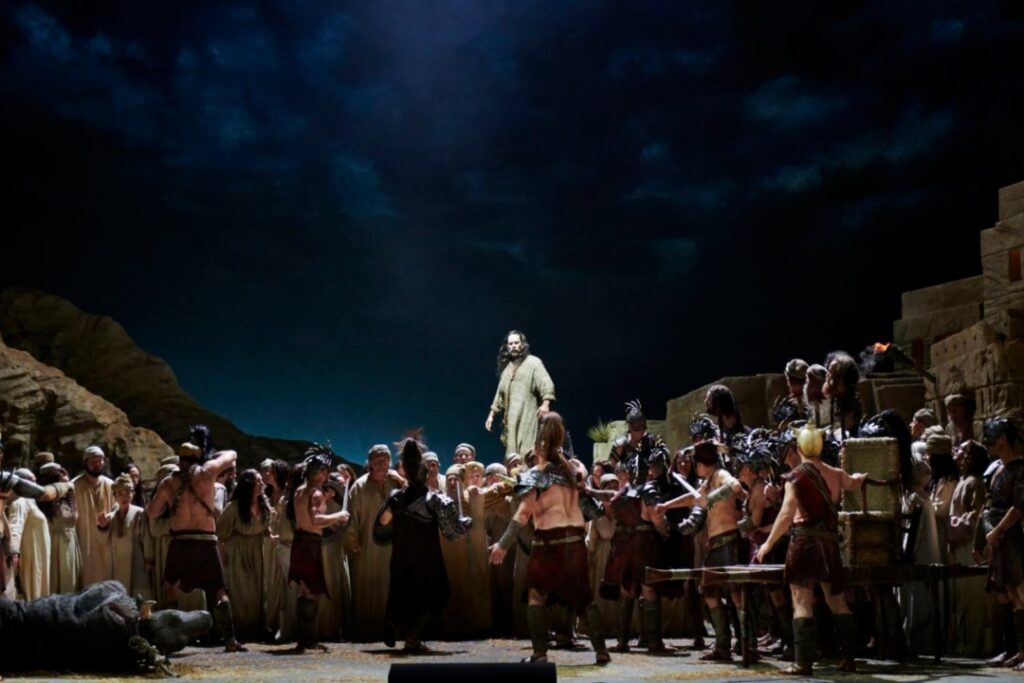
Argentine director Damián Szifron, whose 2014 film “Relatos salvajes” was nominated for the “Palme d’Or” at Cannes and an Oscar in the “Best Foreign Language” category, did not convince as an opera director. His staging of “Samson et Dalila” (seen July 7) was seriously lacking in profound study of the folklore, history and even geography of the region. The action takes place in the Southern coasted region of the Holy Land, namely present-day Gaza. Much of the sets insinuated a rocky region replete with caves. That could be in Petra, Jordan (450 kilometres away) or Cappadocia, Turkey (1,000 kilometres away) but definitely not the flat planes of Gaza.
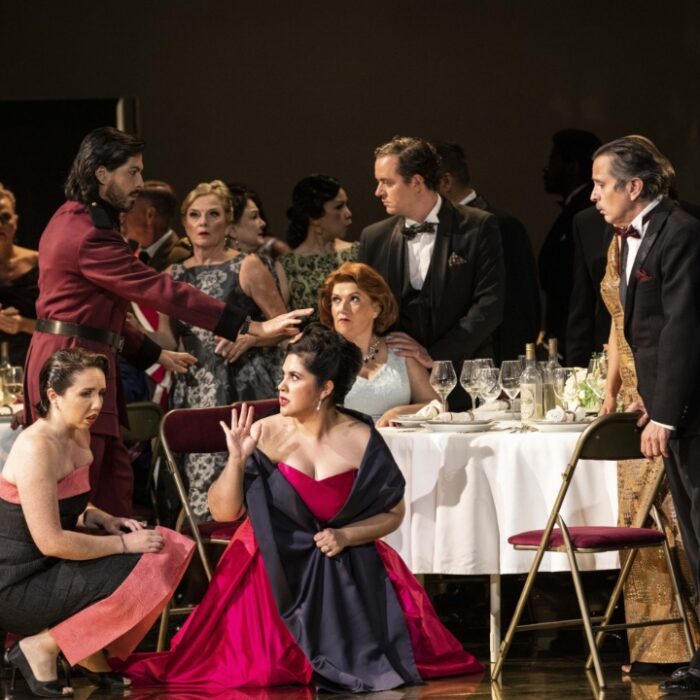
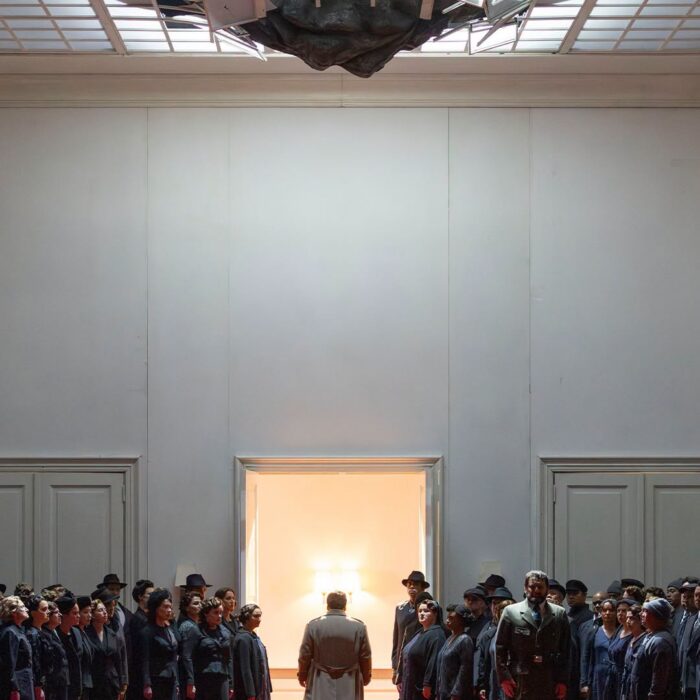
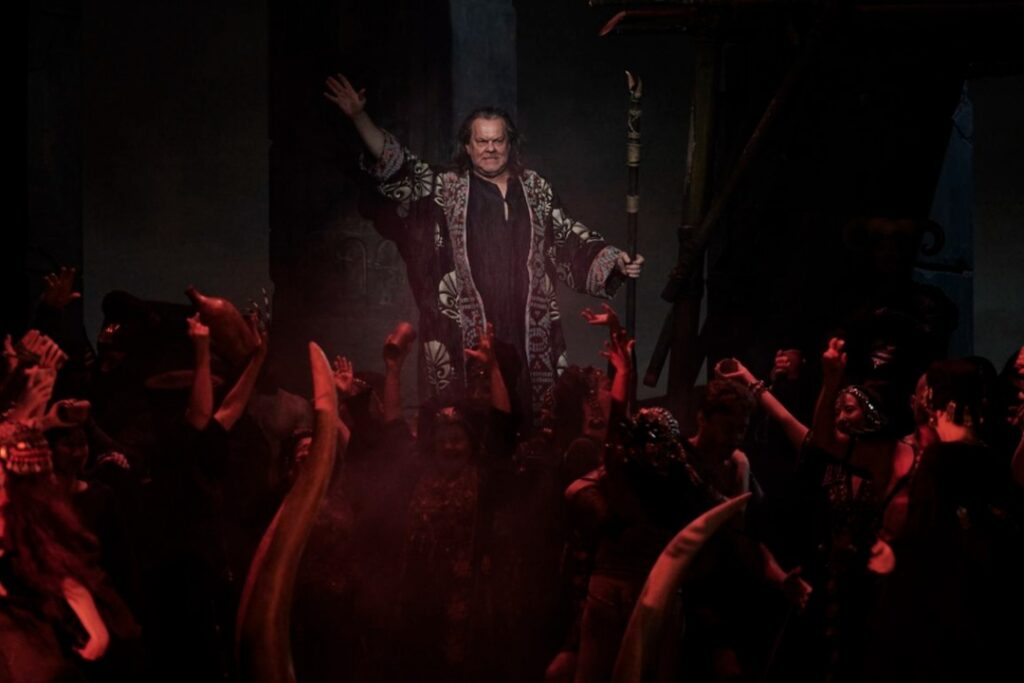
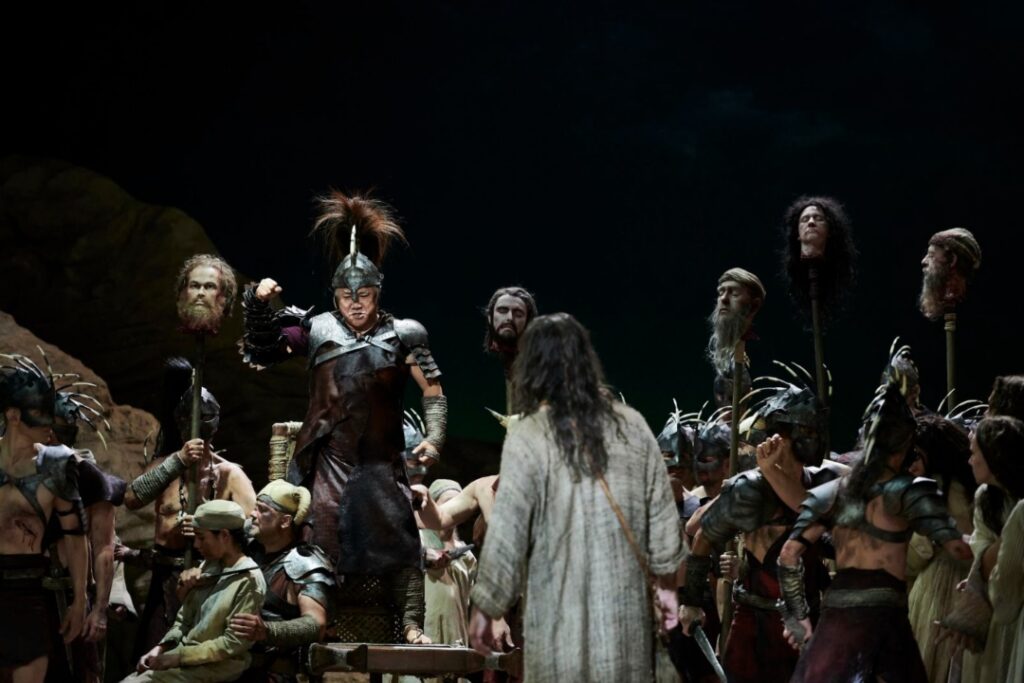
The costumes for the Philistine men were a mix of those of Vikings, Huns and sci-fi films in the style of “Conan the Barbarian” (1982). In contrast, the Philistine women in the final act were dressed in authentic traditional Palestinian black kaftans with coloured embroidered designs, a rather clumsy and tasteless idea, especially given today’s ongoing massacres in Gaza. It would have been prudent to stick uniformly with sci-fi costumes.
(Photo: Matthias Baus)
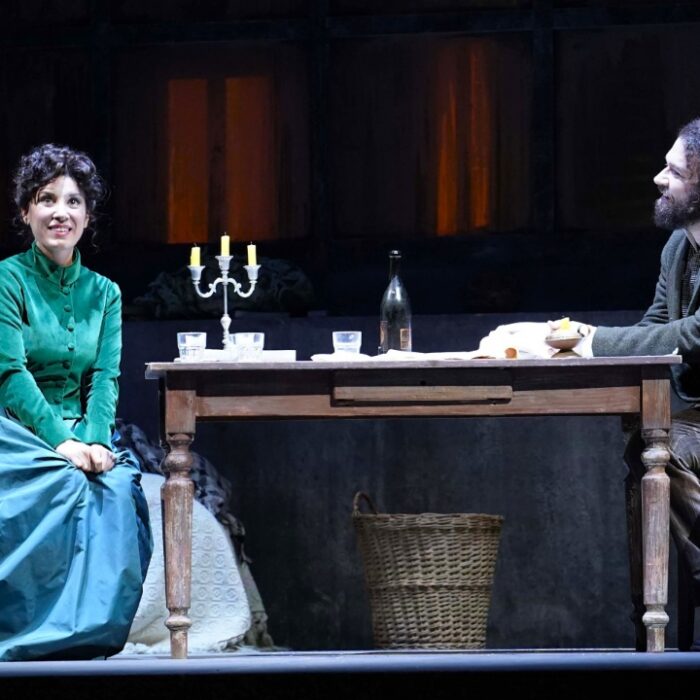
Interestingly, Szifron had Dalila act strangely and incoherently. There was no evidence she was coerced into seducing Samson, either in the libretto or in the staging. Yet, she changed sides in the final act, undoing Samson’s handcuffs and stabbing the High Priest of Dagon before fleeing the temple. For such a radical change, it would have helped to give a hint of her psychology and motivations in the preceding acts.
Most disappointing was the final act’s Bacchanale, usually the opera’s most entertaining segment. Tomasz Kajdański’s choreography was reminiscent of a Berlin rave, with rhythmically-challenged people jumping around aimlessly. The five female dancers who enacted a frenzied dance were good enough, but this could have been much more sensual.
Also disappointing was the gratuitous violence, from the guards beating up the helpless Samson in the final act to the ritualization of the Philistine’s unnecessary killing of elderly Jewish captives. Evidently, the director revels in graphic violence, perhaps resorting to a cinematic trait for his first opera staging.
Etienne Pluss’ severe and inauthentic architectural spaces, animated by Judith Selenko’s restrained projections, could be seen less as historical settings than states of mind, monuments to domination, isolation and impending collapse. The idea of cracks in the temple’s columns rather than actual collapse was both inspired and practical.
(Photo: Matthias Baus)
Cast & Musical Highlights
Alexander Soddy led the Staatskapelle Berlin with commitment and unfailing sensitivity, delivering a solid if occasionally uneven reading of “Samson et Dalila.” The orchestra revealed the remarkable sophistication of Saint-Saëns’ orchestration, its colors becoming a dramatic force in their own right. The clear musical (though not scenic) highlight was the Bacchanale, where Soddy fully embraced the score’s eroticism and exotic aspects without sacrificing refinement or descending into vulgarity. While the earlier acts lacked the same sonic opulence, the quieter passages unfolded elegantly, with each phrase blooming naturally. This was especially the case for Dalila’s passages.
Roberto Alagna’s Samson was conceived less as a biblical hero than as a man gradually undone by his own certainties. There were moments when his upper register betrayed signs of strain. Yet vocal perfection was never the measure of this performance. What lingered instead was its humanity: a leader burdened by responsibility, increasingly vulnerable to forces he scarcely understood, and finally resigned to a destiny that had become inescapable. Alagna was without a doubt affecting and convincing as Samson.
The evening, however, belonged unequivocally to Aigul Akhmetshina. I first heard this Russian mezzo a year ago as Charlotte in “Werther” (also in Berlin) and was utterly captivated. Her Dalila refused every familiar cliché of the seductive femme fatale. She possessed instead an unsettling emotional opacity that rendered her infinitely more compelling. Her voice combined sumptuous warmth and exceptional textual intelligence, but it was the psychological precision of the portrayal that distinguished her performance.
“Mon cœur s’ouvre à ta voix” emerged not as an uncomplicated declaration of sensuality, but rather an exquisitely calibrated act of persuasion, in which tenderness and calculation became impossible to disentangle. Every gesture appeared considered, every silence eloquent. She dominated the stage not through force, but through absolute command of attention. Her diction was second only to Alagna’s, excellent but not as marvelous as she was in “Werther” a year earlier.
(Photo: Matthias Baus)
Unfortunately, the supporting cast was not up to the standard of the two principals. Polish bass-baritone Łukasz Goliński’s style was as remote from French singing as one could imagine. This High Priest of Dagon mistook volume for expressivity, yet his loud shouting failed to convey authority. As for his diction, what he sang may have been some extinct Romance dialect, but it wasn’t French. The chorus, so often required merely to furnish spectacle, sang with uncommon discipline and dramatic purpose, becoming an active participant in the tensions that permeated the work. Their only fault was with their at times careless diction.
What ultimately distinguished this “Samson et Dalila” was its refusal to treat the opera as an exotic relic of French Grand opera. Despite the aforementioned weaknesses of his staging, Szifron recognised instead that Saint-Saëns had composed a drama in which desire itself became a political instrument and conviction the most fragile of human possessions. Thanks to Alagna, Akhmetshina and Soddy, this was a performance of intelligence and musical distinction, anchored by a Dalila of extraordinary complexity, whose triumph lay not in seduction, but in making the audience complicit in Samson’s surrender.