Opera Australia 2026 Review: Rigoletto
By Gordon Williams(Photo: Keith Saunders)
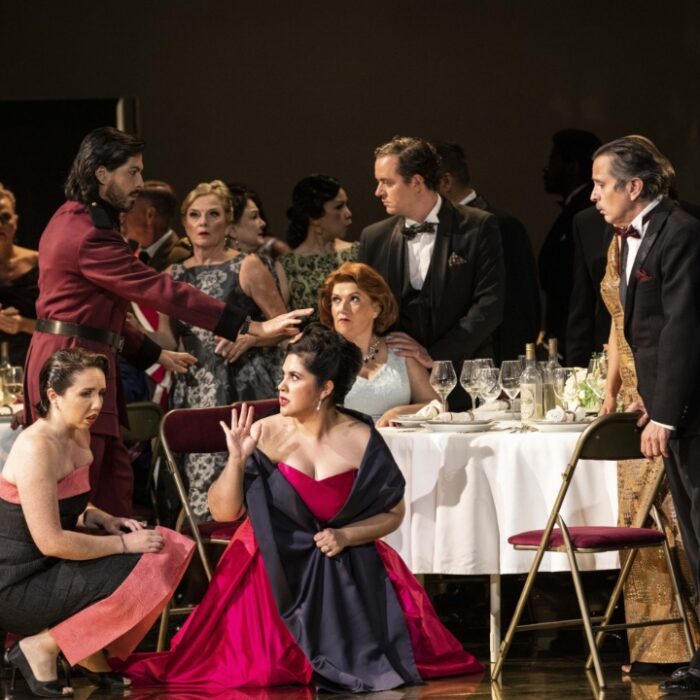
Opera Australia celebrated its 70th birthday with a revival of Elijah Moshinsky’s 1991 “Rigoletto,” a production that was inspired by Italy’s “La dolce vita” era. Opening night at the Sydney Opera House on July 21st was the company’s actual birthday and the audience was invited to sing “Happy Birthday” at the final curtain call. Such festivities may have sat at odds with the tragedy we had just witnessed, but were arguably in keeping with composer Verdi’s knack of making even the grimmest tale entertaining and something to come back for, as in the case of this production.
Production Details
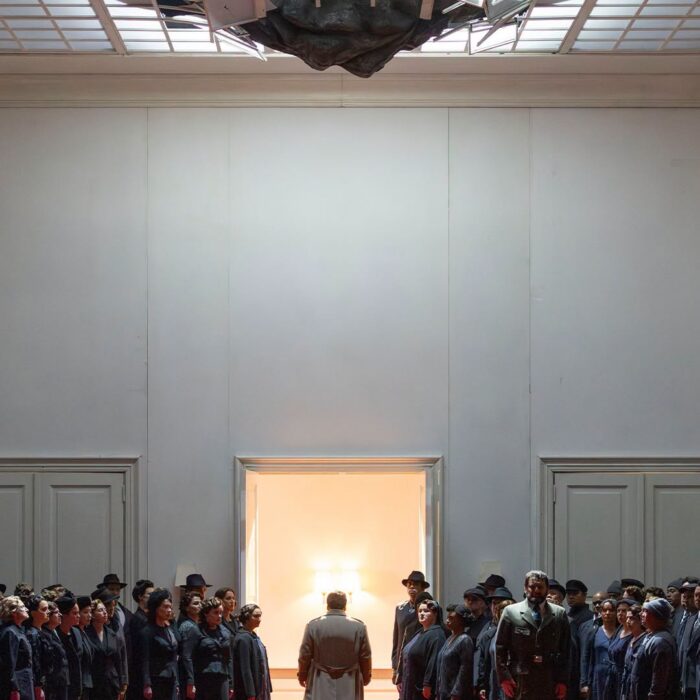
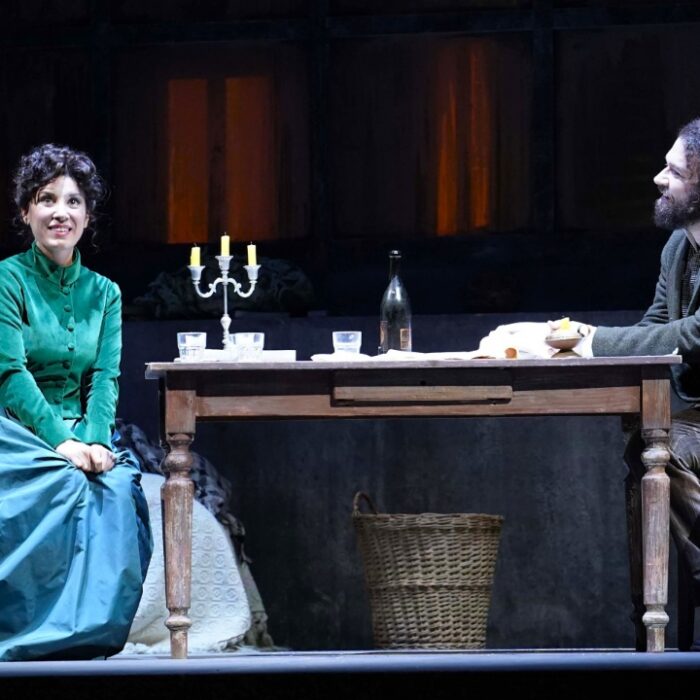
Yes, it was a “dolce vita” inspired interpretation. Sets and costumes were by Michael Yeargan. Baritone Dalibor Jenis as Rigoletto drove a Fiat 500 to the assassin Sparafucile’s tavern in Act three, but theatrical coups aside, this was a production that in the overall sense honored Verdi and Piave’s mastery of mise-en-scène. A revolving stage fluently changed our vantage points. Not only did the quartet in the third Act, “Bella figlia dell’ amore,” present the differing viewpoints of the four characters via Verdi’s score, these differences were visually apparent in our ability to see all the characters both inside and outside the tavern and upstairs. The revolving stage was a practical means of changing scene but, also, of providing punctuation and measuring emotional progress. Having revolved away from Rigoletto’s dressing room at the end of the prelude, wherein we watched the title character applying his clown make-up, and then coming back at the end of Scene one after Rigoletto had been cursed by the condemned and vengeful courtier Monterone at the Duke’s party, we could reflect on the extent and brevity of the change in Rigoletto’s fortunes which sets in train his downward path to tragedy. The revolving stage also provided the acting area with additional space in Act one Scene two when the inside of Rigoletto’s house was turned away to show us the street outside and reveal the chorus (the Duke’s courtiers up to no good) about to abduct Rigoletto’s treasured daughter Gilda (soprano Gemma Nha) to deliver her as yet another victim to their predatory boss, the Duke.
If there was any problem with this way of visualizing the first two scenes, it lay in Sparafucile’s appearance over Rigoletto’s costume rack inside his dressing room to offer his services as an assassin. Scene two usually takes place in the street. This strange appearance provided perhaps the only harder-to-believe moment of the evening, even if it was a graphic depiction of the extent to which Sparafucile might now invade Rigoletto’s consciousness. This was nevertheless an effective scene from the point of view of acting between the two characters. Rigoletto and the assassin offering his services, Sparafucile, played with effective gravitas by bass David Parkin. This was the first of a number of gripping ‘two-handers’ for which Rehearsal Director Kate Gaul deserves credit.
Illuminating Cast
Tenor Kang Wang nicely conveyed the Duke of Mantua’s cavalier disregard for the feelings of others, the women he stalks and the men he cuckolds, in the clipped phrases of his opening number “Questa o quella.” His Act three ‘hit,’ “La donna è mobile,” in which the Duke characterizes the fickleness of women (as one who should speak) was endearingly playful as much as we might not want it to be. Kang Wang’s visualization of women was clearly palpable. If anything, however, his loving caress of the Duke’s melodies at times throughout the evening rendered the character somewhat more appealing than usual. One could believe the Duke might genuinely be in love with Gilda, especially during the lightness of his reprise of “La donna.”
Did this undermine Rigoletto’s fear? Baritone Dalibor Jenis was very effective at conveying a bad temper, especially when Rigoletto decides, rather than questions, that Sparafucile is “un ladro” (a robber). His bitterness and self-mocking “buffone,” “Miei signori, perdono, pietate,” when finally exhausted, pleads with the “vile race of courtiers” to reveal where they’ve taken his daughter. Even his dementedness and gloating over the sack that he thinks contains the body of the Duke he wants dead – until he hears the Duke reprise his “La donna è mobile.” There was also an effective portrayal of self-realization, as when Rigoletto reflects that Sparafucile kills with a knife while he, the jester, kills with his tongue. And one could easily believe that Rigoletto was a jester by profession as when Jenis ad-libbed shock, clutching his heart when his cane fell clatteringly on the ground. But arguably not all of Jenis’s motivations hit the mark. His immediate registering that he has been cursed by Monterone felt more reflective than horrified, if more understandably reflective at the start of Scene two – “Quel vecchio maledivami!,” and perhaps his realization that it’s his (Rigoletto’s) house from which the courtiers have abducted a girl could have been clearer, as he seemed to look at the offending blindfold which had allowed him to take part before registering that it was his house.
In her bobby sox, Gemma Nha was a most convincing young, innocent, and gullible Gilda. Her “Caro nome” contained real variety and excited breathlessness. Her coloraturas meaningfully conveying blissfulness in contemplation of the name of the young student who has caught her eye, the Duke in disguise and under an assumed identity. Her notes were thrilling to listen to, but also carried meaning, especially at the end of the “Sì, vendetta” duet with her incensed father where they were tinged with desperation.
Bass David Parkin was a matter-of-fact Sparafucile, the more terrifying for being so. The physical disparity between him and Nha was terrifying at the end of that sequence in Sparafucile’s tavern when Sparafucile has decided to substitute another victim in place of the Duke and it’s Gilda who has walked in on his decision and whom he physically lifts up and packs off. At this moment, it was if “La dolce vita” had met Grand-Guignol.
More Cast Highlights
Among the smaller roles, Dominica Matthews was a believable housekeeper in Giovanna, and Jennifer Black’s depiction of the Countess Ceprano’s terror at the unwanted lasciviousness of the partying Duke could even be seen in her eyes.
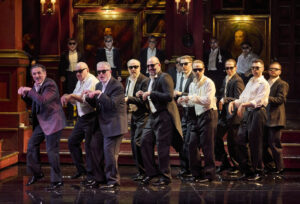
The evening wasn’t all doom and gloom, however. In Verdi’s score, the Men’s Chorus’s recounting of the abduction of Gilda sounds comic or at least jaunty, and here, turned into a dance number by a corps of men insolently donning sunglasses, garnered laughs. Quite literally and nastily, I suppose, the joke is on the jester!
Conductor Sesto Quatrini in his Opera Australia debut provided marvelous impulse behind the music, telling accents and other details that would so often enliven the score. His panorama of tempo was exciting, as for example, the panicked accelerando when the Duke accidentally makes a noise upstairs after sneaking into Rigoletto’s house to effect an assignation with Gilda, and the real vigor under Rigoletto’s bitter denunciation of the Duke’s insolent courtiers, “Cortigiani, vil razza dannata” before the turn to the plea “Miei signori, perdono, pietate…”
Opera Australia began its life performing Mozart’s “Marriage of Figaro” in Adelaide, South Australia. It celebrated its 70th birthday with another of the repertoire staples, “Rigoletto,” in the Sydney Opera House. What will the next 70 years bring? The next cab off the rank is a premiere, the Australian opera, “The Drover’s Wife.”