Macerata Opera Festival 2026 Review: Il Trovatore
By Jennifer E. Pyron(Photo: MOF)
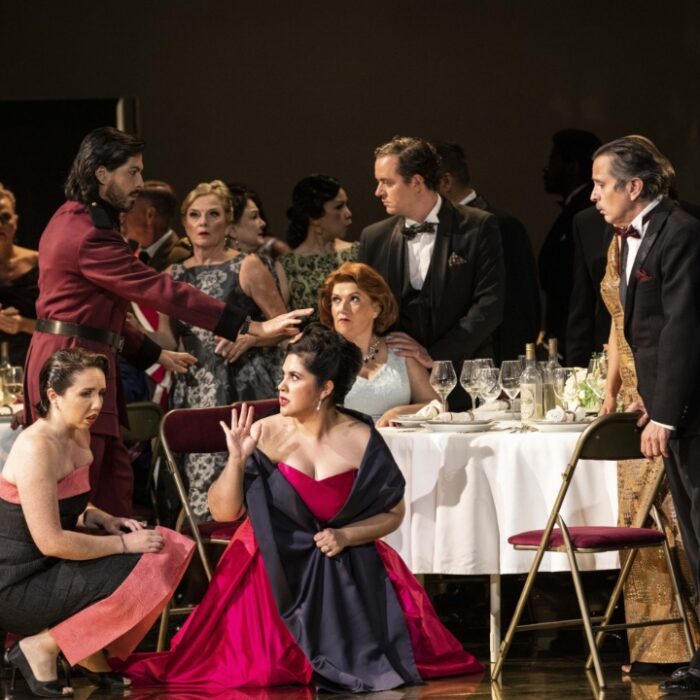
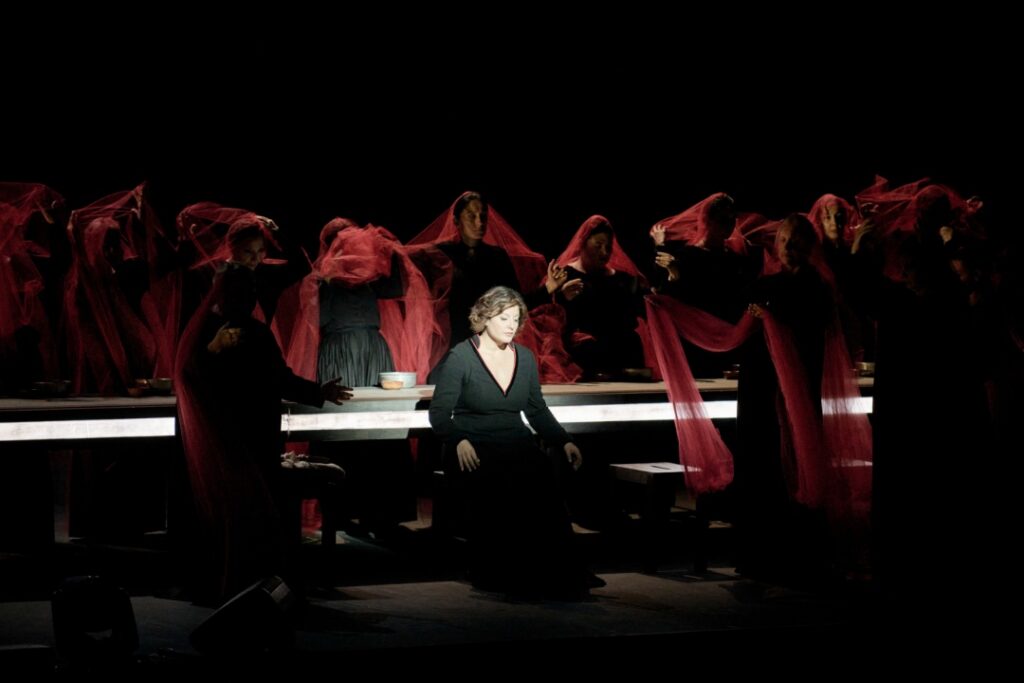
Macerata Opera Festival’s 62nd season opening weekend concluded with a legendary revival of Verdi’s “Il trovatore.” Director Francisco Negrin’s previously staged 2013 and 2016 production features a minimal stage design with dramatic red, black and LED lighting, pyrotechnics, and hidden trap stage doors where the cast appears and disappears in the blink of an eye.
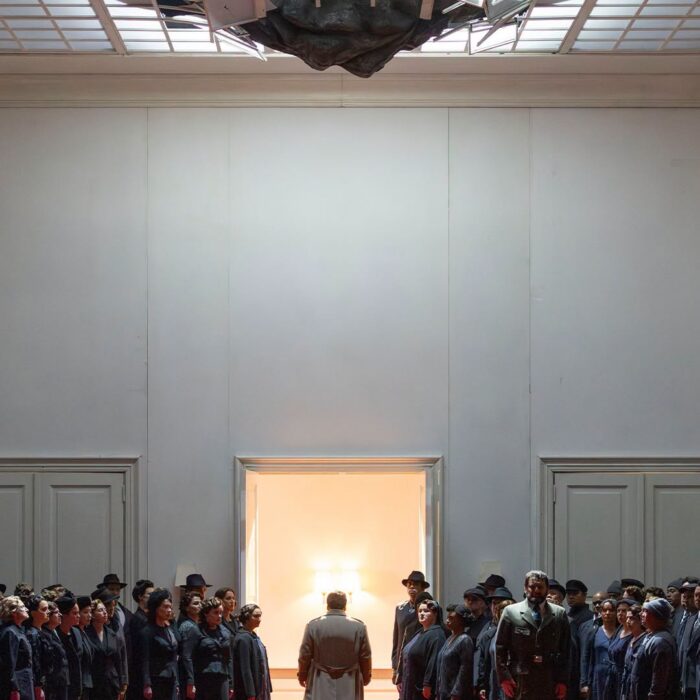
The chorus is also a major part of the stage design as they stand in strong, long lines of solidarity and conviction. Their silhouettes shone a crip black against the enigmatic red of the Sferisterio Arena’s stone wall. There were seven chandeliers that lined the same back wall with slim rectangular slits designed to emit LED lights strobe-like during heightened moments of chaos and psychological tumult.
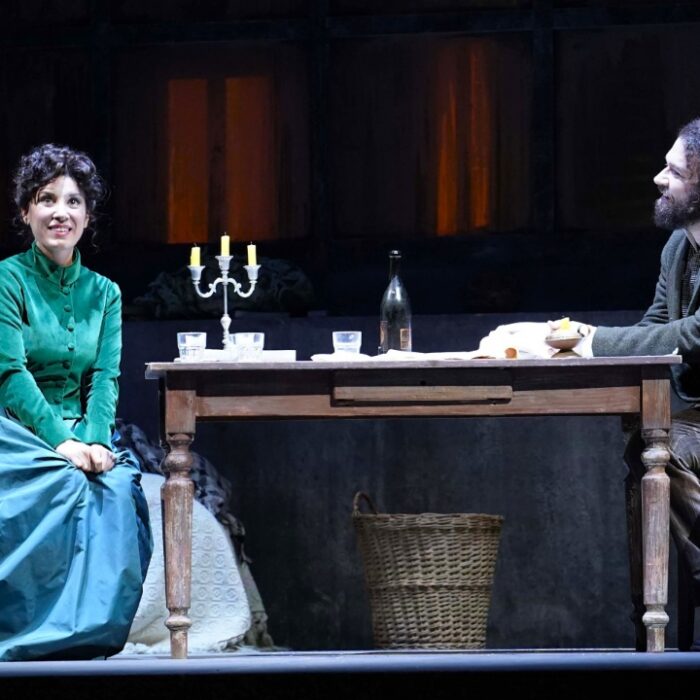
Overall this production included all of the elements of greatness with set and costumes by Louis Désiré, and the cast set a high bar standard, especially soprano Marta Torbidoni as Leonora and mezzo soprano Sofia Petrović as Azucena.
(Photo: MOF)
Musical & Cast Highlights
The prelude set the tone for the entire night as Conductor Dmitri Jurowski led FORM-Orchestra Filarmonica Marchigiana into the depths of Verdi’s genius. Dongho Kim as Ferrando, the captain of the guards, performed “All’erta, all’erta!,” “Di due figli vivea padre beato” and “Abbietta zingara, fosca vegliarda!” with urgency and exactness. His voice resonated from the stage as he told the story of the Count di Luna and how a haunted gypsy woman was accused of placing a curse of illness on the youngest of the di Luna children. The woman was condemned to the stake to be burned alive. Her daughter vowed to avenge her murder by taking the the di Luna child and as the gyspy’s ashes were still aflame there also lay the charred bones of a child, assuming the body of the abducted boy.
The guards (the chorus) listened in earnest to Ferrando. Their towering silhouettes resembled judgement day and the feasting frenzy of a witch hunt’s malicious raid. On stage right there appeared a re-enactment of this burning at the stake complete with a writhing woman consumed by a transfixed flame on the top of a stone tower. This powerful pyre made the strongest impression of the night and all flames that followed could not compare to the shocking effect of this first one’s imprint.
There was a smaller version of this eternal flame that lit intermittently throughout the production on far stage right, evoking the presence of the gypsy, along with impressive thin lines of live flames that raced across the two oblong tables on the stage that paralleled one another like two alternate sides of a story. The wild flames and the impossible physicality of the performers on stage in the midst of them were always somehow in the back of one’s mind. These elements made this production raw, visceral, and guttural, in ways that Verdi’s synopsis naturally derives. The mystery and danger of a live flame licking feverishly in the open air surrounded by Sferisterio Arena’s stunning stone walls was unforgettable.
Ferrando continues to enlighten the guards, vowing that he will search for the daughter of the murdered gypsy and bring justice to the young di Luna. The chorus turns mad in their response and claims that the gypsy takes the form of an owl and other spirits in her hunt. All in all they agree to find her daughter and murder her as well.
(Photo: MOF)
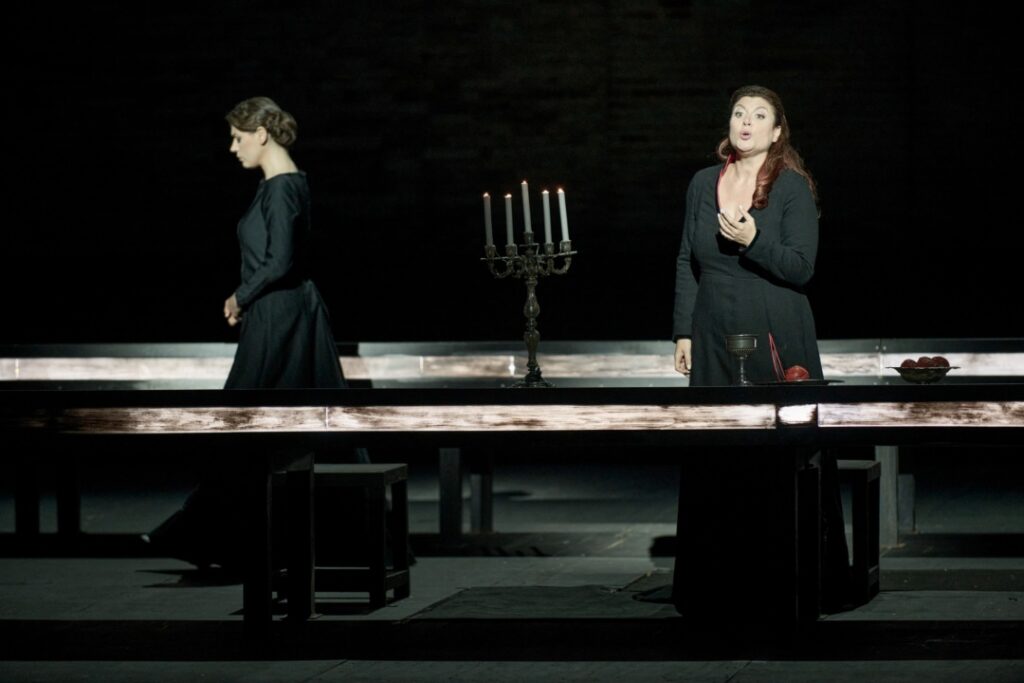
Meanwhile Leonora, lady-in-waiting to the princess, is seen waiting for her troubadour. The Count di Luna, in-love with Leonora, keeps watch over her from below, waiting to discover who she is waiting for so he can rival him in a duel.
Marta Torbidoni as Leonora was exquisite in this role. Her voice rendered the hearts of listeners with its pure emotions and honest interpretation. Every note Torbidoni elicited was full of life and reality. Her aria “Tacea la notte placida” was ethereal.
Soprano Alessia Camarin as Ines was the perfect companion for Torbidoni. Her voice during,”Che piu t’arresti?” and “Quanto narrasti di turbamento,” were rich in timbre and drama.
During the climax of the trio between Leonora, Count di Luna and Manrico, “Di geloso amor sprezzato,” Torbidoni’s voice took on a whole new palette of expressivity. This felt like a turning point in the opera’s musicality.
Unfortunately there was also an unraveling of the conductor’s precision and balance around this point as well. It felt like the singers were responsible for leading themselves as the orchestra played their part separately.
This put extra pressure on the singers to make their entrances and to make this production at a higher level musically. Fortunately, the singers were up to the challenge.
(Photo: MOF)
More Stellar Cast Details
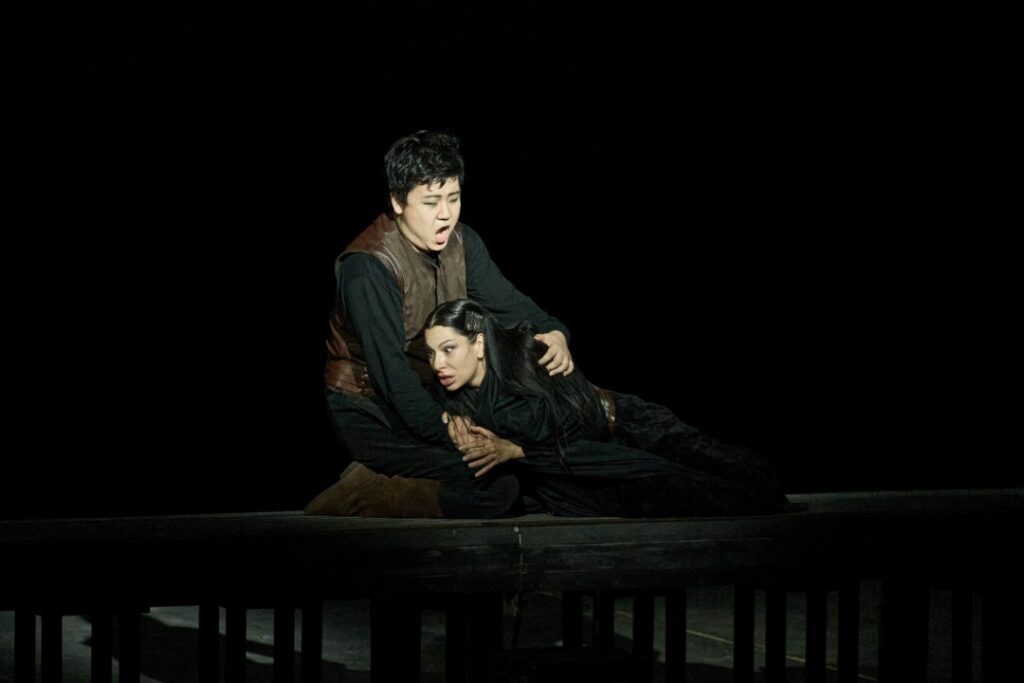
Tenor Piero Pretti was replaced with Haiyang Guo as Manrico for this opening performance. Guo’s voice sounded youthful in this role and at times it was a challenge to hear with the arena’s vastness as a contender. Over the course of the evening his acting and vocal stamina gained traction and his Manrico was in solid form. His voice transformed into something meaningful and true in Act two as he sang with Sofia Petrović as Azucena. From this point, he developed into a full bodied presence in this very intimidatingly powerful production. It was a sink or swim moment where his instincts kicked in just in time. His interpretation of “Di quella pira” was outstanding.
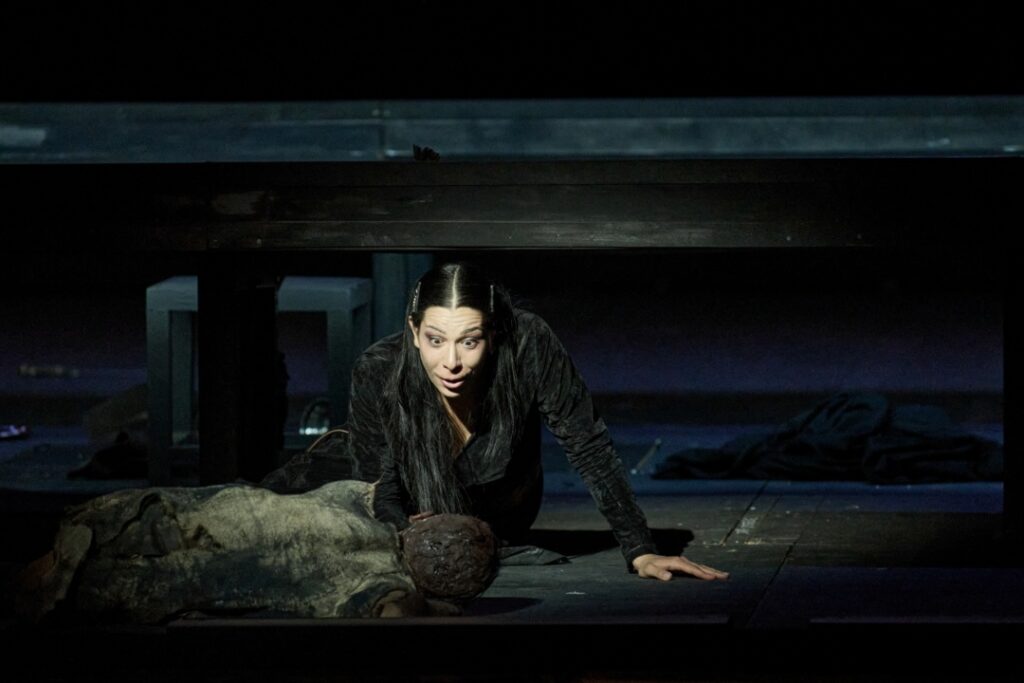
Sofia Petrović as Azucena was a knock out in this role. Her vocal depth and fortitude was like a masterclass in performance. Petrović’s dedication to portraying Azucena’s infinite complexities made her feel very real and even more tragic. Her “Condotta ell’era in ceppi” brought tears to one’s eyes in how utterly tragic her story unfolds. She sang of how she avenged her mother’s murder by throwing the child into the flames only to realize that instead of throwing the young di Luna, she mistakenly threw her own child instead. The desperation and depravity in her voice was bone-chilling.
(Photo: MOF)
“Il figlio mio, mio figlio avea bruciato! Sul capo mio le chiome sento rizzarsi ancor!” was a moment in time never to be forgotten.
In the final Scene of Act four when Azucena tells the Count that he killed his own brother instead of her son, “Prima che d’altri vivere,” Petrović’s voice elicited an eery awakening of newfound horror in this drama’s intensity. Both her and Marta Torbidoni as Leonora were ground-breaking in their performances. I am still in shock.
Vito Priante as Count di Luna gave a remarkable performance as well. His intensity and vocal stamina was the backbone in a lot of moments where the orchestra felt out of balance. He made a strong impression overall and his vocal highlights include “Tace la notte placida” and “Il balen del suo sorriso.”
The chorus during “Vedi le fosche notturne spoglie” was thrilling and haunting at the same time. This production embodied the spirit of Verdi and the multidimensionality of life’s choices and consequences when met with the exactness of one’s own demise.