Staatsoper Berlin 2025-26 Review: Pelléas et Mélisande
By Ossama el Naggar(Credit: Tatjana Daschel)
Ruth Berghaus’s legendary production of “Pelléas et Mélisande” (seen July 9), which has remained in the repertoire of the Staatsoper Unter den Linden since 1991, returned once again to Berlin, proving that genuinely great theatre neither ages nor relinquishes its power to surprise. The evening possessed the aura of an encounter with operatic history: not merely a revival of a celebrated staging, but a rediscovery of a particular theatrical language and aesthetic lineage.
Illuminating Production
One of the principal reasons for the enduring success of this “Pelléas et Mélisande” is the genius of its late director, Ruth Berghaus. The Dresden-born East German began her career within the Brechtian tradition before freeing herself from its dogmatism, which proved too restrictive for her singular imagination. This staging, together with her celebrated “Tristan und Isolde” for Hamburg and “Il barbiere di Siviglia” for Berlin, remained among her most important surviving achievements.
Hartmut Meyer’s costumes were no less evocative, combining the visual world of Antoine de Saint-Exupéry’s illustrations for “Le Petit Prince” with the stylised idiom of 1960s Czech animation, a reference more readily recognized in the former East Germany than in the West. The baggy garments and round hats broadened and shortened the figures, creating an effect reminiscent of Modigliani or Giacometti in reverse and transporting the audience into a fairytale universe. Equally suggestive was the spherical stage floor, an unmistakable allusion to “Le Petit Prince.” Its slippery surface denied every character secure footing; they slid and crawled, but seldom remained upright for long, a potent metaphor for the emotional and existential instability at the heart of Debussy’s drama.
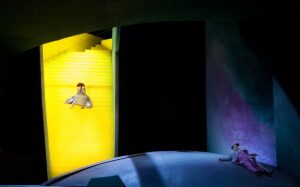
Berghaus’s production remained as striking as ever in its stark minimalism. Hartmut Meyer’s quasi-abstract sets, transformed by subtle shifts of light and color, continually generated new visual images despite the essential immutability of the stage picture. The famous yellow staircase, ascending almost vertiginously into the heights, provided both a visual and dramatic focal point. It served in turn as tower, castle and place of reckoning, its symbolic potency increasing with each ascent and descent. The lighting, no less important than the scenery itself, cast menacing shadows that seemed to embody the opera’s hidden worlds and unspoken fears. One constantly wanted to photograph the stage, so painterly and endlessly mutable were its tableaux. (The lady in front of me actually did).
Berghaus’s dramaturgy was equally compelling. The enlarged letters passed from character to character, pinned to the walls like accusatory documents, suggested a Brechtian inheritance transformed through symbolism and poetry. The production also revealed a pronounced feminist undercurrent. Golaud’s brutality towards Mélisande and the disturbing extension of Arkel’s desire for her brought into sharp relief the vulnerability of a woman trapped within a world of male possession and projection. Yet the staging never descended into crude realism. Instead, it retained the ambiguity and mystery that lie at the heart of Maeterlinck’s drama, preserving the sense that Mélisande remained a being from another realm, only accidentally wandering into the human world.
Not every directorial decision convinced entirely. The absence of Mélisande’s long hair inevitably weakened one of the opera’s most potent symbols. In the tower scene, where Pelléas speaks of her hair as if it were a living, enveloping force, its omission somewhat diminished the scene’s sensual and poetic impact. Yet this remained a minor reservation within an otherwise extraordinarily coherent theatrical vision.
Musical Details
Musically, the evening unfolded less consistently. François-Xavier Roth’s conducting displayed admirable structural understanding and an acute sensitivity to Debussy’s orchestral colors. The timbral refinements of the score emerged with remarkable clarity, and the Staatskapelle Berlin’s long familiarity with this repertoire was evident throughout. Nevertheless, the performance took time to ignite. For much of the first half, the orchestra sounded surprisingly restrained, even tentative, and the dramatic tension between scenes occasionally dissipated. Only with Golaud’s discovery of the missing ring did the temperature truly begin to rise.
By the third act, however, both conductor and orchestra had found their full measure. The scene of Pelléas and Mélisande with her flowing hair was rendered with unbridled intensity, and the Staatskapelle played with the coloristic richness and dramatic urgency one had hoped for from the outset. Debussy’s shifting harmonies and elusive sonorities finally acquired their full emotional and structural significance, creating a musical landscape of extraordinary beauty and menace.
Stellar Cast
The performance was, above all, distinguished by an exceptional ensemble cast. Magdalena Kožená’s Mélisande proved profoundly moving. Her interpretation combined fragility and independence, vulnerability and inscrutability. At times, her voice assumed an almost childlike inflection, suggesting not immaturity but rather the innocence of a creature who did not fully belong to this world. Her artistry, so intelligent and communicative, captured the character’s mystery and sadness with affecting subtlety.
Thomas Blondelle sang magnificently. His Pelléas possessed youthful freshness and lyrical beauty, his phrasing richly coloured and impeccably controlled. Initially reserved and emotionally elusive, he blossomed in the great love scene, where his long-suppressed emotions burst forth with tremendous expressive force. Moreover, Blondelle’s diction–essential in this opera–was impeccable. One could entirely understand Mélisande’s attraction to his dreamy, innocent nature.
Simon Keenlyside, who has long since made the transition from Pelléas to Golaud, offered a deeply human and multifaceted portrayal. If his performance initially lacked some of the character’s darker authority, he became increasingly compelling as jealousy consumed him. The scene with Yniold was especially powerful, exposing Golaud’s desperation, tenderness and cruelty with painful clarity. His helpless attempts to force the child into becoming an accomplice to his suspicions revealed not merely a jealous husband but a profoundly damaged man.
Anne Sofie von Otter brought her customary intelligence and stage presence to Geneviève, while Stephen Milling’s Arkel was sung with sonorous authority and subtle dramatic insight. Henrik Brandstetter, a member of the Tölzer Knabenchor, was nothing short of remarkable as Yniold, displaying extraordinary assurance and dramatic instinct. David Oštrek likewise made a memorable contribution in the small but significant roles of the Doctor and the Shepherd.
By the end of the evening, one was reminded once again why “Pelléas et Mélisande” remains such an inexhaustible masterpiece. Debussy’s only completed opera, often accused of monotony or dramatic inertia, emerged here as a work of profound emotional and psychological complexity. Above all, it was the singers and, eventually, the orchestra and conductor who made the drama feel deeply human and urgently alive.
More than three decades after its premiere, Berghaus’s production retains its power to provoke, disturb and enchant. Like Mélisande herself, it remains ultimately elusive, resisting definitive explanation and inviting us, once again, into its mysterious and shadowy world.