San Francisco Opera 2026-27 Review: Strauss in Concert
Soprano Kathleen O’Mara Sings Vier Letzte Lieder
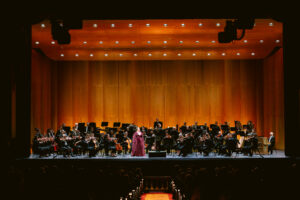
By Lois SilversteinPure Richard Strauss at San Francisco Opera. Not his well-trod operas, such as “Salome,” “Elektra,” “Arabella,” or “Die Schweigsame Frau.” Perhaps we heard touches of “Der Rosenkavalier,” but without singers. What we experienced was a suite played by the San Francisco Opera Orchestra under the baton of Eun Sun Kim, and a retrospective of sorts. This was a variation in the scheduling of the Fall Season comparable to 2025’s Beethoven’s “Symphony No. 9” (which was also without costumes or sets), and an addition to the repertoire both welcome and unusual.
Given that the opening night of “Simon Boccanegra” was cancelled due to the orchestra strike, we were glad that San Francisco Opera not only succeeded in continuing the season, but was bringing it to a successful conclusion. Some may have pondered what, exactly, could compel audience members to wait until halfway through 2027 for a return of the stars. The eagerly anticipated June opera series is over six months away. There are those who recall past seasons where San Francisco Opera ‘trod the boards’ from September until after Thanksgiving and delighted us with Spring opera at the Curran and June events. To those who wondered what would come next, this offering of Strauss was something of a panacea.
There is no doubt Strauss liked stories. Stories that he could set to music, that told of both gaiety and serious events, that tickled our imaginations and challenged our deepest-set values. Strauss gave us “Salome,” “Der Rosenkavalier,” and his elegiac “Vier Letzte Lieder” (“Four Last Songs”). Each work is a gem of introspection, personal exploration, and meditation on life’s ending. How Strauss created music for these tales is part of the mystery of these works and provokes in us the deepest fascination. Listening to the San Francisco Opera Orchestra under Music Director Eun Sun Kim in the final selection of the Fall Opera Season gave us a taste of Strauss’ range as both storyteller and musical magician.
“Till Eulenspiegel’s Merry Pranks,” the 1895 tone poem, opened the concert, while “Der Rosenkavalier Suite” closed it. Kim expertly led the orchestra throughout. Soloists included Kevin Rivard (horn), Joshua Choi (clarinet), and Maya Cohon (concertmaster). The music was animated and variegated, if not fully crisp and distinctive. “Till Eulenspiegel’s Merry Pranks” is the story of a legendary German peasant trickster and well-beloved folk hero. Stories of his adventures date back to the 16th century and are a lively part of German folk-history. Starting with this tone poem, Kim gave us a sense of Strauss’s varied Germanic interests. Anyone looking to explore German literature and fairy tales could simply listen to this and already get a taste of the rich oeuvre.
The lieder section of the program, between the two longer pieces, was sung by soprano Kathleen O’Mara, jumping in for soprano Adela Zaharia, who was unwell. O’Mara was recently awarded first prize at the 2025 Queen Sonja Singing Competition and won the Birgit Nilsson First Prize at the 2024 Operalia Competition. She brought her own specialties to the performance and gave us the “Vier Letzte Lieder,” instead of the originally planned six song Brentano cycle. The “Vier Letzte Lieder” were a fitting inclusion between “Till Eulenspiegel’s Merry Pranks” and “Der Rosenkavalier Suite.”
These four pieces were not composed by Strauss as a cycle, instead being grouped together after his death. Three of them can be sung or played in any order. Only “Im Abendrot” needs to be last as it is the finale – death itself – and the conclusion of Strauss’ subject. All are drawn from German poetry. The first three, in the order they are most often sung today, come from Hermann Hesse while the last comes from Joseph Freiherr von Eichendorff.
Nearing the end of his life, Strauss composed on the theme of finality. Even “Frühling” (“Spring”) – the first in the sequence sung by O’Mara – ignites the theme, with death embedded within the awakening of the new. The spread of notes, especially in their up and down movement and the feeling of spaciousness, evoked this idea. Here were things coming alive, a sense of splendor and blazing light, as everything filled with the essence of Spring. Renewal in the Springtime enables all of us to come alive again. Before it, we are simply sleepwalking, as if in dark grottos or a dream. O’Mara’s voice brought excitement in the rapid run of lines and the fluidity of her legato.
In “September” O’Mara captured the oncoming Fall, and nature’s ebb and flow. She evoked the expressiveness of life, even in the cessation of growth and bloom, the arrival of rain, and the cooling down of desire.
It was in “Bei Schlafengehen” that O’Mara showed her finest lyricism. The music was achingly beautiful. Again we heard falling, and ebbing and flowing. The violin solo intensified this feeling with its poignant, melodic line. We felt the decline of light and warmth, made bittersweet by the suggestion that we could be present to this too. The music, alternating between highs and lows, unequivocally suggested the coming and going of life and our implicit trust in it.
“Im Abendrot” stood as the climactic intensification of the four lieder. Here was the explicit acknowledgment of the passage of time and imminent separation. The long lines of “abschied”(“goodbye”) bid farewell to lovers, life, and the universe. The dissolution was at once chilling and gorgeous in its sensuosity and stillness. We all come to our ends with solemn acceptance of the arrival of Death. It was gorgeous.
It was remarkable to be confronted by this universal subject in intimate, individual song form, presented by the hands of a grand orchestra. Introspection and full sound was a striking combination. O’Mara made the quartet of songs glimmer with beauty, though the somewhat brisk tempo may have precluded full closure.
“Der Rosenkavalier Suite,” closing out the evening after the intermission, was a US premiere of the newly arranged piece by Philippe Jordan and Tomáš Ille. It gave a summary view of the musical treasures that make up the opera. It evoked longing for the complete work and nostalgia for the opera’s wit, languorous lines, imagery, buffoonery, introspection, ebullient human interaction, and themes: silver roses, cavalier culture, and love behind the curtains. Some of the original opera’s piquancy did pepper the aural landscape, and when it did we were drawn out of “nostalgia-land” and were a bit more forgiving with the suite before us. However, we still pined for the opera, especially in moments where the suite came too slowly and we were more acutely reminded of what we were missing.
Categories
Stage Reviews