Washington National Opera 2026-27 Review: Nixon in China
Thomas Hampson & Renée Fleming Bring Complex Portraits to John Adms’ Masterpiece
By Francisco Salazar(Credit: Cory Weaver)
On Nov. 19, the Washington National Opera presented the second of three performances of John Adams’ “Nixon in China,” a monumental 20th-century masterwork.
The company showcased the production at Constitution Hall in the same way that it did with “Madama Butterfly” with a “thrust stage” that was placed in the middle with audience members sitting on all three sides.
Like the first production, this improved upon the “Butterfly” and the results were immersive.
Absorbing
For the production, the company brought Elkhanah Pulitzer who had originally directed the work with the LA Philharmonic in 2017. For the staging, Pulitzer, in collaboration with film designer Bill Morrison and scenic / projection designer Alexander V. Nichols, found 22 transferred reels of Super 8mm home movies and used them as scenery for the production.
The footage was used as a backdrop to show the action of each scene. It was well-integrated into Adams’ music and showed everything from the arrival of the Nixons in China with footage inside their plane to Pat Nixon’s tour that saw a pig farm, an elephant and Chinese schoolchildren, things that are mentioned in her big Act two scene. It also shows the famed toast with Premier Chou En-Lai. The footage never distracts and instead enhances the experience.
The projections are also used minimally in more intimate moments like Act three when all six characters are reflecting on their past. They are also sparing employed during the impressive ballet in Act two, which takes centerstage.
Jessica Lang’s choreography for the political ballet, “The Red Detachment of Women,” was incredibly performed by the Washington National Opera Ballet using the minimal set and space to their best abilities and created a visually arresting moment. Acknowledgements must also be given to Kaya Mei-Wan Thomas and Jaryd Farcon who were spectacular in their expressive choreography.
Propelling Energy
In the pit, Robert Spano was astonishing, leading the orchestra with expert and meticulous precision. Adams’ score is minimalist while also mixing melody that echoes 19th-century composition as well as several different genres like jazz and big band references.
Spano’s attention to detail brought these details out, especially in the dance numbers in Act two and three and in the arias as he emphasized the minimalist rhythm, but also allowed the singers to bend the tempi for their legato lines. Then there were the slow building crescendoes that were spotlighted by the repetition in the music, leading to exciting climaxes at the opening chorus “The People are the Heroes Now” and the end of Act one “Cheers.” But just like Spano had control to these exciting moments, he also held back the orchestra in the intimate Act three music, giving space to his singers while moving the music along. The textures that he ultimately created were varied from the synth to the horns to the woodwinds and the rich violin solo in Act three. It was a triumphant feat of conducting.
The Nixons
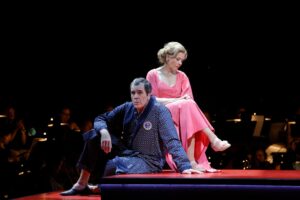
In the role of Richard Nixon, Thomas Hampson brought swagger and charisma to the public parts of the opera. Whether it was smiling, handshaking, or putting up a peace sign, this was a Nixon that was in control of each moment. But in Act three, Hampson revealed a vulnerable side to the character, turning in a multifaceted intrepretation.
Vocally, Hampson retains the flexible and lyric qualities of his middle voice and showcased some bravura runs in his aria “News has a kind of mystery.” When he repeated the words “News” and “listening,” the text got a more accented phrase. The one thing that was noticeable, however, was that at moments when he had to reach the higher parts of his baritone, his sound took on a hollow quality; this was most evident in the “Cheers” finale of Act one. Like his Scene one aria, Hampson’s vocal quality in the first two Acts had a brighter sound that portrayed the formality, pompousness, and swagger of his character.
It was in Act three, where Nixon reflects on his past and shares an intimate moment with his wife, Hampson elected for a darker timbre. His legato phrases were connected and less accentuated, all while keeping clear diction.
In the role of Pat Nixon, Renée Fleming brought her customary poise and elegance to the role, while also bringing some fragility, especially at the end of Act two and three. Her Act two extended scene “I Don’t daydream and don’t look back” was sung with her signature polish and command of the diction. The middle register was lush, while her high notes were bright and gleamed with no effort. Then in Act three, during her intimate exchanges with Hampson’s Nixon, there was a caressing nature to her vocal delivery coupled with a velvety rich tone.
Strong Support
In the role of Madame Mao Tse-Tung, Kathleen Kim made a huge impression as she began her “I Am the Wife of Mao Tse-Tung.” From the moment she stepped onto the scene, she displayed authority with her accented phrasing. Her high notes were sung with power especially as she repeated the lines “the book” and raised “The Little Red Book.” You could not look away as she delivered each line with force and grit. In Act three, her tone softened and you could sense the characters’ affection for Mao as Kim danced alongside John Matthew Myers’ Mao.
As Mao Tse-Tung, John Matthew Myers made his Washington national Opera debut and demonstrated an ardent tenor with potency in Act one, while also showcasing a weaker character physically. Then in Act three, he delivered a lighter sound. He was particularly compelling in his exchanges with Kim’s Madame Mao as the two danced and played well off each other both vocally and physically.
In the role of Premier Chou En-Lai, Joo Won Kang was, simply put, fantastic. At the opening of the opera he seemed to be in command, exuding vocal control. In Act three, his baritone brought vocal pathos as he questioned “Whether anything they did was good.” He brought out the heart of the story in his concluding lines, which slowly died down as the music did.
As the three secretaries Veronica Siebert, Anna Maria Vacca, and Cecelia McKinley melded their voices to perfection, while Robert Pomakov, as Henry Kissinger, was diabolical in the Act two dance number, and comedic in the opening Act scene. His bass boomed in the opening act and in his brief moments in Act three.
Props to the chorus, which was also compelling, especially in the opening “The People are the Heroes Now,” slowly building to a rousing fortissimo.
In all, this was a huge success for the Washington National Opera as the company continues to find its new path in these diverse venues.