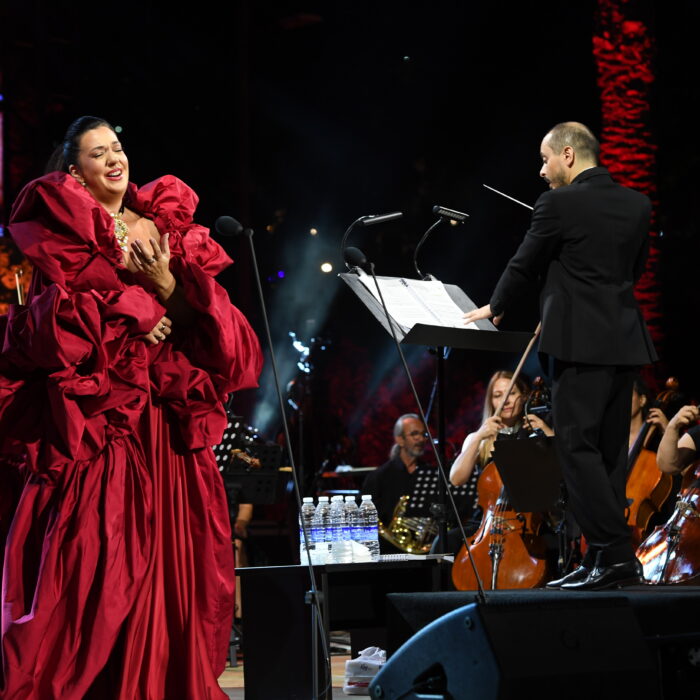
Royal Philharmonic Orchestra Publishes New Report on Public Interest in Orchestral Music & AI
By Afton Markay(Phot credit: Ben Wright)
The Royal Philharmonic Orchestra (RPO) has released its annual audience trends report, which this year features a new focus on Artificial Intelligence (AI) in Music from the audience perspective.
The research was conducted by UK Omnibus Group for the RPO among a nationally representative sample of 2,000 adults in 2025. Surveys conducted for previous years were undertaken among similar samples of 2,000 adults every spring and autumn.
Audiences, Concert Preferences, & Orchestral Music in Daily Life
RPO’s most recent findings document the public’s interest in, and terms of engagement with, orchestral music. Reaching its highest level in six years, it is reported that 35 percent of UK adults are wanting to learn more about orchestral music (up from 20 percent in 2024 and 11 percent in 2021). Among the under-25 age group, interest has risen sharply in a single year, from 11 percent to 30 percent At the same time, long-term engagement has also increased from 28 percent to 38 percent.
Whilst the popularity of core orchestral repertoire has remained at nearly 23 percent for the fourth consecutive year, there were big rises in demand for other forms of family-orientated orchestral concerts. Also, there is a call for diversifying orchestral concerts by including pop music, soundtracks, and hits from musicals (e.g., West End, Broadway etc.) on the program.
Moreover, the RPO’s tracking research shows that engagement with orchestral music outside the concert hall is driving the appetite to experience live performances. Over the past year, 80 percent of UK adults say they now encounter orchestral music as part of everyday life, with listening while commuting rising from 15 percent to 28 percent year-on-year, and 34 percent of participants reported that orchestral music now forms part of their holiday playlist.
AI in Music
The RPO asked participants to predict which areas of the arts will AI have replaced humans in by the year 2050 and in which areas AI simply will not touch the uniqueness of human creativity. Nationally, the results show there was not a dystopian threat to human creativity across the board, with live performance, whether music or theatre. In contrast, recorded music was seen to be at risk of AI taking over in the next few decades.
Overall, 56 percent of people think that AI would stifle creative innovation rather than enhance it. In relation to mixing and mastering, 30 percent of participants believe that this, along with restoration of archive catalogues (46 percent), and personalized playlist recommendations on streaming platforms (17 percent), is an acceptable use of AI in music. Results also show that people think AI positively works best for dance (49 percent), pop (46 percent) and rap (36 percent) music. The majority of people didn’t think AI works well for classical (45 percent), blues (75 percent), folk (77 percent) and soul (76 percent).
A significant number of participants expressed that aspects of a music concert cannot be replaced by AI. 41 percent report that AI cannot compare to the uniqueness and special ‘moment in time’ of a live performance, nor can it replace a memorable social event (36 percent). The collective atmosphere/shared experience with the audience (36 percent) and concerts as a visual spectacle (31 percent) are also not in danger of being lost to AI.
Concerns Over the Consequences of AI
More than 50 percent of participants expressed concerns regarding music being copied without royalties being paid and the implications for local music venues, if people stopped going to see live bands as a result of AI. In addition, 38 percent of people were concerned about the impact on career pathways in music – specifically, if people stopped studying music at school and college because they felt career opportunities were limited.
The vast majority of survey respondents (85 percent) say they would cut back on discretionary expenditure if they lost their job to AI. Whilst eating out and holidays would be the first to go, live music events (42 percent) would be next on the cutbacks list.
Read Related Stories