Musica Viva 2026-27 Review: Rising Stars
By Daniele SahrIn the beautifully preserved, neo-colonial revivalist architectural gem that is New York City’s All Soul’s church, early career opera singers from the United States and Spain shared the stage for a robust recital titled “Rising Stars.” It was brimming over with vocal talent as well as a roster of favorite works from across several centuries and continents.
The 10 emerging artists were brought together from The Metropolitan Opera’s Lindemann Young Artist Development Program and Madrid’s Teatro Real Crescendo under the nurturing wing of the Musica Viva organization and its artistic director, Alejandro Hernandez-Valdez. While the international partnership between the two programs was launched in 2024, this was the first time singers from both countries performed on the same stage. It established what proved to be a friendship without borders – one built in a foundation of musical excellency and genuine love for the operatic art form. A true nod towards global camaraderie.
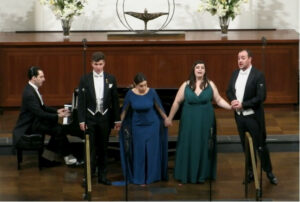
Soprano Lucía Iglesias, mezzo-soprano Yasmin Forastiero, tenor Pablo Puértolas, and baritone Enrique Torres Domínguez visited from the Crescendo program along with pianist Carlos Alfonso Ferri. They were joined in the crisp, white-washed tall sanctuary space by New York-based soprano Laura Santamaria, mezzo-soprano Sophia Baete, tenor Angel Raii Gomez, bass-baritone Lonwabo Mose and pianist John Morefield of the Lindemann Program. Some, like Iglesias and Forastiero, will go on to make their debuts this season at Madrid’s Teatro Real. All of the New York-based singers have roles at the Metropolitan Opera this season.
The close-knit sanctuary-space offered the audience a rare opportunity: a program tailored to introduce us to each singer’s individual style outside of large-scale productions. I could quickly tell that these emerging artists are well on their way to developing their own bold, signature approaches. Each had a defining artistic flair that reached beyond the superb technical training driving at the core of their vocal careers.
Bass-baritone Mose harnessed a polished, powerhouse low-range that he embellished with textures of storied authenticity and spot-on characterization that was stunning and equally jocular in his aria solo as Figaro singing “Non piu adrai.” As Juliette from Gounod’s “Roméo et Juliette,” soprano Iglesias was tantalizing in her use of vibrato that held each note to such command that she manipulated their every place pointedly to great and charming effect – in this case building a combination of youthful joy and hints of foreshadowed doom in her performance of “Ah! Je veux vivre.”
The evening’s mezzo-sopranos, Baete and Forastiero, chose enticing works that offered technical and musical range. Baete sang the aria “Must the Winter Come so Soon” from Barber’s “Vanessa” with a perceptively understated warmth tinged with melancholy that was not only deeply convincing but drew from the complex messages offered in Barber’s work; her technical prowess was radiant. Forastiero performed Saint-Saëns’ “Mon cœur s’ouvre à ta voix” from “Samson and Delilah” with a vocal maturity and evenness of phrasing that added visceral gravitas to the aria. She spun her legato passages like silken thread.
Puértolas brought to the stage his soaring lyric tenor range in “È la solita storia del pastore” from Cilea’s “L’Arlesiana.” With piercing drama and a ringing swoon to his approach, he unfolded the melodic line methodically and with a control that left us breathless. Also visiting was baritone Domínguez whose performance of a Spanish work, “Luche la fe por el Triunfo” from Torroba’s “Luisa Fernanda” felt like a fitting gift to his New York hosts. He led with character by painting each phrase from the heart while mining gorgeous tone from seemingly cavernous sources of rounded sound that he rightly showcased to the pleasure of our listening. Puértolas and Dominguez also performed the Bizet duet “Au fond du temple saint” that blended blissfully as they balanced their range and harmonies together with textured distinction. They ended with arms around each other’s shoulders.
Also, from the Lindemann program were tenor Gomez and soprano Santamaria. As Tonio in “La Fille du Régiment,” Gomez held court with magnificent presence mixed with charismatic pomp while his cannonball-like vocal power grabbed us at first note but held us with supple sweetness. He hit the famously high C pitches in Donizetti’s “Ah, mes amis” like fireworks – no easy feat – while holding long notes with stellar agility. To her credit, Santamaria chose to perform Puccini’s “O mio babbino caro” and avoided the pitfalls of an overly saccharine interpretation opting for a surprisingly innocent version that focused more on the lyrical beauty of this work. A sensitive musician, Santamaria gave her lush voice a finessing touch that was markedly memorable. As a duo, Gomez and Santamaria brought tears to eyes in their performance of Bernstein’s “Tonight” from West Side Story that felt particularly poignant in the meeting of these two operatic organizations in New York City.
Ensemble pieces showcased the acting skills and stage work also in these artists’ toolkits. Duets by Massenet showed strong pairing of tones and dramatic engagement with Baete and Mose singing “Oui, je souffre votre Vitesse” and Iglesias and Forasterio in “Bonjour, grande soeur.” And the SATB quartet “Bella figlia dell’amore” from “Rigoletto” was punchy and electrifying in their rendition that ended with a juxtaposed sultry legato line.
To close the evening, the final works brought all the singers to stage at once. The potency of their combined operatic voices pushed the acoustics of the church to its limits but also pointed to the experience they will continue to develop when it comes to adjusting vocal timbre without sacrificing musical integrity – as was demonstrated by guest singer, bass Paul Whelan. In the sextet from “Le nozze de Figaro,” “Riconosci in questo amplesso,” Whelan modeled an ease with subtle pausing and pull back in dynamics that gave more space for character and plot development.
The penultimate work on the program was Donizetti’s “Chi me frena in tal momento” which showcased the singers’ ability to match talents organically along with an enticing group momentum that grew to soaring heights.
No celebratory evening would feel right without closing with Verdi’s “Libiamo, ne’ lieti calici” from “La Traviata.” Musica Viva made it a grand splash with their director and conductor Alejandro Hernandez-Valdez joining at the piano while other members of the Musica Viva NY chorus came up on stage to join in. It almost felt like an old-fashioned sing-in, especially given the welcoming atmosphere the whole program created. Nevertheless, we wisely left the performance spotlight to those truly talented on stage, instead showing appreciation with rigorous applause.