Royal Ballet & Opera 2025-26 Review: Turandot
Anna Netrebko & Masabane Cecilia Rangwanasha Shine in Puccini’s Final Opera
By Mike Hardy(Photo: Camilla Greenwell)
The Puccini opera where he gets the girl. But is she worth having? Is HE?
The more I see Puccini’s final opera, “Turandot,” the more I’m left wondering if, had he not expired before its completion, he might have taken a long hard look at it and elected to make some seriously drastic, if not complete, changes.
Of course, it has been rewritten and restructured after his passing, right up until as recently as 18 years ago, with discussions and performances of alternative endings having been ongoing since its premiere in 1926, after the initial Franco Alfano and Arturo Toscanini completions.
But no amount of rewriting and transforming can detract from the appalling and totally unpalatable characters of the opera’s two main protagonists. In one corner, Princess Turandot, the girl who plays IMPOSSIBLE to get, whom I have described previously as some horror movie version of Elsa from Disney’s “Frozen,” more frigid than the arctic tundra, glibly ordering the decapitation of all and sundry who should vie for her affections once they fail to correctly answer a series of her riddles, designed to trip them up anyway. She is the ‘black widow’ who devours her would-be suitors INSTEAD of the mating act, as opposed to after it.
In the other corner, a posturing, egotistical, self-centred Prince Calaf, who is ignorant of, and seemingly blind to, the desperate pleas of his secret admirer, former slave-girl Liù, and his father, the exiled King Timur, and more entranced by the execution by beheading of the previous chancer for Turandot’s amour.
He elects to take up Turandot’s challenge himself, which he conquers with ease. She in turn fails to keep her end of the deal, rejecting his win and pleading to be freed from the contract. He gives her the opportunity to escape should the Princess discover his name, (which she fails to do), yet still persists in worshiping her even after the bullying and threatened torturing of Timur, his father, and even after the enforced death of the one who DOES truly love him, Liù, who kills herself in order to not speak his name and to thus facilitate the ghastly, proposed coupling.
Turandot finally acquiesces to his ardent wooing and concedes that his name is love.
Quite.
They deserve each other.
I have never and could never view this work as a “love triumphing over evil” fable because this ice Princess is clearly way too evil, way too devoid of both heart and soul, to ever be genuinely touched by something so intrinsically human as love.
Fortunately, in my humble opinion, this outing is saved by some pretty spectacular visuals, solid singing and Puccini’s undoubtedly exquisite music. Not to mention, on this occasion at least, by one of the very last of opera’s great, current divas in the title role.
Production Details
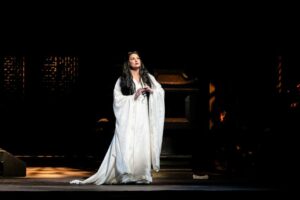
Andrei Serban’s production is over forty years old, and it is perhaps because I have seen it several times now that its magical properties are beginning to wear thin. Jack Furness’s revival is still visually stunning for sure, however, a cornucopia of vivid color; deep red, cascading silk streamers with giant masks suspended from the ceiling against a backdrop of chorus populated, pagoda-styled tiered balconies, courtesy of the wonderful designs of the great, late Sally Jacobs.
Asian dancers move and prance with precision and unity reproducing authentic Chinese inspired martial arts movements, the performers showing tremendous athleticism and discipline, painting some quite wonderful lines, forms and poses, courtesy of Kate Flatt’s and Choreologist Tatiana Novaes Coelho’s direction and guidance.
Lighting director F. Mitchell Dana has an easy gig here, requiring only to provide subtle backlights and focusing spots that enhance silhouettes.
A Superb Cast
I have long opined that in any audience at a “Turandot” performance, a significant proportion are there, predominantly, for opera’s most famous and most revered aria of all time, “Nessun Dorma.” I would suggest, on this occasion however, that a huge section of the audience were there purely because of Russian superstar soprano, Anna Netrebko. Of course, albeit it for different reasons, a handful of the public gathered at the theatre entrances were there for her also, in their insistence that she somehow bears some culpability for the Russian-Ukrainian conflict, but the less credibility afforded to them, the better.
Those inside, however, showed only interest in her artistic prowess. And they weren’t to be disappointed. Current reviews of her performances over recent years point to some minor degradation of the voice, insecure upper register or noticeable vibrato. I detected none of these flaws. Her incisive and voluminous instrument easily cut through Puccini’s often enthusiastic score with its assertive orchestration, something some of the other singers laboured to accomplish. Moreover, she has an undeniable, almost palpable presence which exudes charisma and status. On her first entry, long before singing a single note, carried atop the ostentatious, regal chair, there was a distinct gasp of awe from the audience.
The role isn’t noted for its harmonious beauty or melodious qualities, but Netrebko managed to infuse her passages with subtle warmth and pleasing colour, adopting gentle, extended lines. Her “In questa Reggia” was sung with convincing expressiveness given the otherwise ridiculous story. She changed through the gears to produce a superb “Gli enigmi sono tre, la morte è una!” escalating though the vocal crescendos with Calaf majestically and her “Figlio del cielo!,” in her pleas to her father hinted at an almost vulnerability.
However, I have to say that I detected a distinct lack of conviction and, indeed, a coolness in her romance with Calaf, played here by her former husband Yusif Eyvazov. Having separated in 2024, their joint statement insisted on their continued close friendship and professional commitment to future roles together, but this love story failed to display any signs of credibility. I have never seen a “Turandot” where the prince failed to kiss the icy princess in their alliance. Alas, that was the case here where any purported meeting of lips was veiled, and any tangible intimacy was restricted to gazing into each other’s eyes. Whether this was a decision taken by mutual consent, by one or the other or as a directorial decision is not known.
Certainly, there was no lack of ardency in Eyvazov’s acting. He strutted and postured around the stage with great animation, playing the obsessed prince to perfection. There had, hitherto, been some rather unkind critics opining that perhaps his presence on the world’s stages was partly because as a consequence of his relationship with Netrebko; that much of his success was as a result of her influence. On this performance, I would wholeheartedly refute such aspersions. He sings with a strong, undeniably solid technique and has a bright, mostly clean tenor instrument. His “Non piangere, Liù!” was well phrased and nuanced, and those audience members who DID just come for the “Nessun Dorma” shouldn’t have been disappointed with his sterling efforts. He does appear, particularly when rising past the passagio and into the upper register, to employ some form of constrictive “covering” which produces a timbre which I feel detracts from the overall quality of his voice, tempering its beauty. That said, he is clearly a world class tenor of merit.
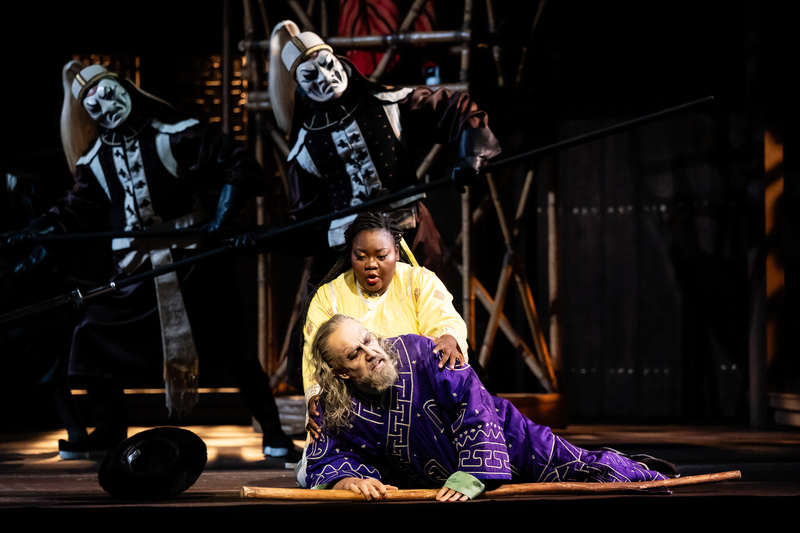
©2025 Camilla Greenwell
The last time I saw Masabane Cecilia Rangwanasha I described her as an absolute tour de force who stole the show and received the most applause at the curtain. I have to say that, despite a deserved standing ovation for Netrebko, that was pretty much the case here. The audience cheered loudly and applauded frenetically as she took her bow. It helps that her Liù is the only decent, respectable and endearing character in the opera, but the lady unquestionably possesses huge vocal talent. Her keynote aria, “Signore, ascolta!,” was sublime and beautifully measured with just the right amount of gentle phrasing and soft tones. It was greeted with deserved applause. It was topped, for me, by her “Tu che di gel sei cinta” which was heartbreakingly emotive, no mean feat considering the ridiculousness of the unfolding tale. She is surely destined for greatness.
The comedic interludes and story narration are provided by three courtiers, Ping, Pang and Pong, reminiscent of the traditional clowns of Italian theatre, commedia dell’arte.
Pick of the three was Simone Del Savio in the role of Ping. He possesses a wonderul voice of truly rich, clarion qualities. Warm and vibrant, he sung a fine rendition of “Ho una casa nell’Honan” at the beginning of Act two, where he recounts the story of his home and life from another time. He is supported here by Emmanuel Fonoti-Fuimaono and James Kryshak as Pang and Pong respectively, vocally adept and suitably jocular, although they were not the most physical of trios that I have seen in this role, displaying little in the way of the athleticism or acrobatics frequently associated with these roles.
Special mention must be afforded to bass, Rafał Siwek in the role of Timur, the deposed king. He sings with a beautifully sonorous timbre and rich, velvet color. His “Liù! Liù! sorgi! sorgi! È l’ora chiara d’ogni risveglio!” at the passing of Liù was most poignant and he presents a very credible, dignified character.
Veteran tenor Raúl Giménez sits, (literally), in the role of “Son of Heaven” and Princess Turandot’s father, Emperor Altoum. Descending as from heaven in his most elaborate, extravagant golden throne, he gives a stellar performance as the wise, stoic ruler.
Jette Parker artist Ossian Huskinson was a great Mandarin in this role the last time I reviewed him, and here he was no exception. Confident with a stage presence and maturity beyond his young years, he is also blessed with a rich, fine bass-baritone instrument which he uses here to authoritative effect.
The Orchestra of the Royal Opera House and the Royal Opera Chorus were exemplary, as usual, vocally resplendent and visually entertaining. Special mention is to be afforded to Maestro Daniel Oren whom I believe to be a remarkable conductor. Totally in command of his orchestra and totally devoted to producing the best from his onstage performers. At curtain call, he took time to generously single out key orchestral performers before turning to ensure that the chorus members were applauded and fully appreciated.
I’m sure this staging will run for many years to come yet, but it needs to pay attention to what I consider to be a couple of glaring directorial weaknesses. In Act two, Ping sings of his homeland across a backdrop of a simply painted silkscreen-type banner, which emanates from the side of the stage, obviously carried and supported by unseen chorus members acting as stagehands. Later in the act, the members return to the same side of the stage, carrying the prop, only this time on full display to the audience, as if changing the set during an interval. I am at a complete loss to understand the reason or purpose of this.
More saliently, and for me, perturbingly, at the cessation of the opera where Turandot has finally relented and elected to couple with Calaf, with the crowds cheering and celebrating, the “corpse” of Liù is slowly and ceremoniously wheeled back on, directly at front of stage, reclining on the carriage from which she was initially removed in, after her death. Presumably this is meant to further symbolize and accentuate the sacrifice that she made in order to enable the courtship being rejoiced on stage…..but it just doesn’t work.
For me, it is redolent of a naff TV contestant show where the rejected “Star prize” is wheeled out and displayed, showing the hapless competitors what they could have won.
Puccini is said to have “poured his soul” into “Turandot” his final opera, and as I suggested at the start, I can’t help thinking he would have been disappointed with the final results. He was all too aware of its brutal subject matter, and I am left wondering if the maestro simply couldn’t see a way of humanizing Turandot at all.
But at the end of the day, this was all about TWO queens of the night. One, Masabana, still at the start of a blossoming, fruitful career; the other, genuine opera Royalty in Netrebko.
As she sings in the final act: “Che nessun mi veda… La mia gloria è finita!”
“Let no-one see me, my glory is over!”
On this performance, the glory is very much prolific.