Royal Ballet & Opera 2025-26 Review: La Bohème
By Mike Hardy(Photo: Ian Hippolyte)
Richard Jones’ production of “La Bohème,” currently at Covent Garden for its eighth run, is a magnificent piece of art. It is still, however, tempered with a few anomalies including nonsensical stage changes in full view of the audience.
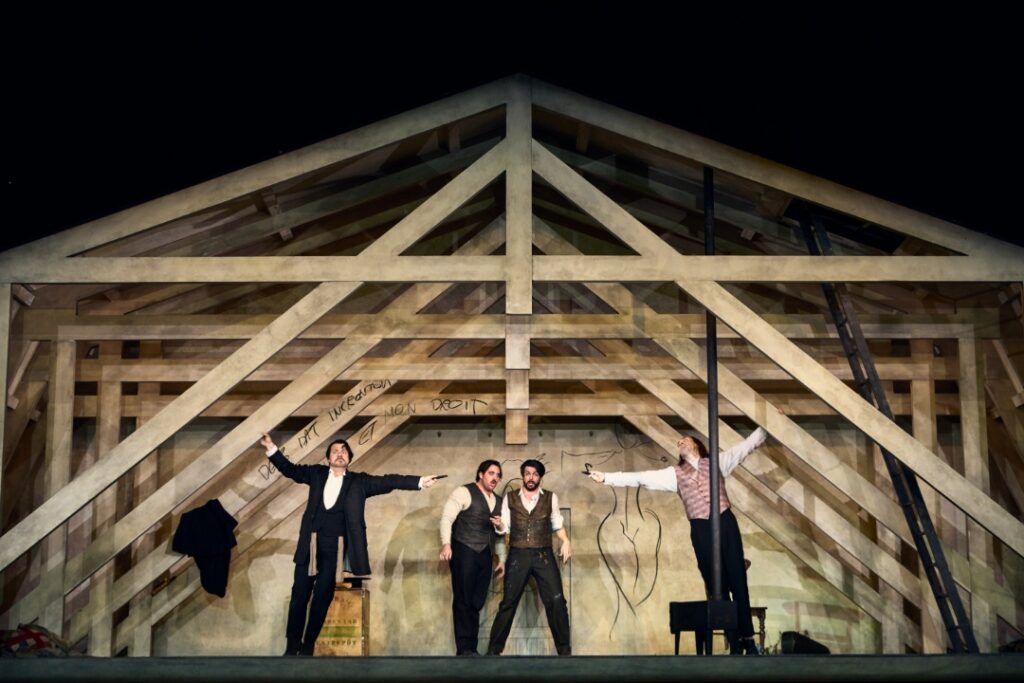
I’ve grown to accept set designer Stewart Laing’s bohemian residence, portrayed here as a clinically spruce garret; albeit an ultra-modern loft conversion with awkward crossbeams, that is ridiculously overlit with bright lighting, (especially given the residents are portrayed as barely able to afford a candle). Which, speaking of candles, makes it look all the more absurd when the key protagonists, Rodolfo and Mimì are supposed to be searching for a dropped key in mere moonlight, their candles having been extinguished. It’s difficult not to smile inwardly when Rodolfo sings “O soave fanciulla, o dolce viso di mite circonfuso alba lunar,” (O loveliest of maidens, O sweetest vision, bathed in the soft glow of a moonbeam!), while being veritably blinded by the harsh stage lighting.
But that oversight pales in significance where, at the end of the first Act, the two lovers exit the stage to head for the Latin quarters, and the garret is slowly wheeled away by stagehands before transporting the set for the second Act. This was replicated again at the cessation of Act three, where that set was removed and the wooden garret is brought back for the final Act, all in full view of the audience.
I have to take real issue with this and assert that I believe the curtain should fall here in order to make the changeover. I get that the ‘artistic parlance’ is that it remains up to somehow remind the audience that what they are watching isn’t real life and that exposing the cogs of the stagecraft, demystifies the whole theatrical process. I, however, genuinely believe that this lengthy series of mechanized publicly displayed processes detracts from both the magic of the occasion and the emotional layers of the performance.
(Photo: Ian Hippolyte)
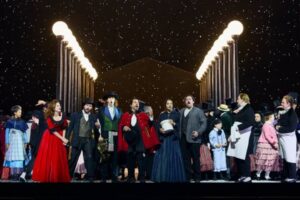
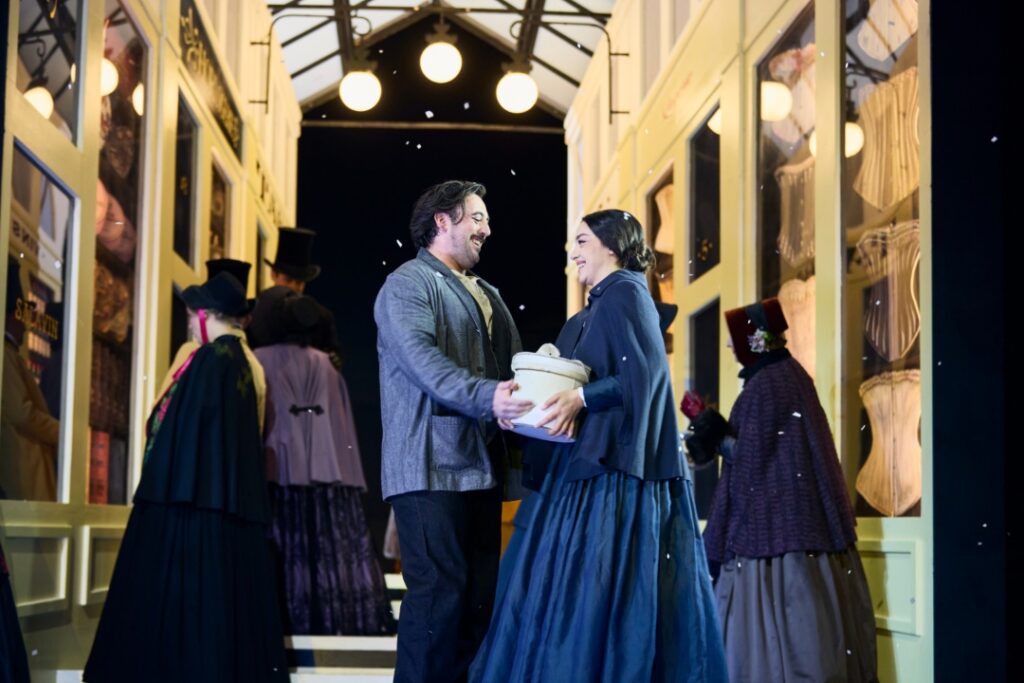
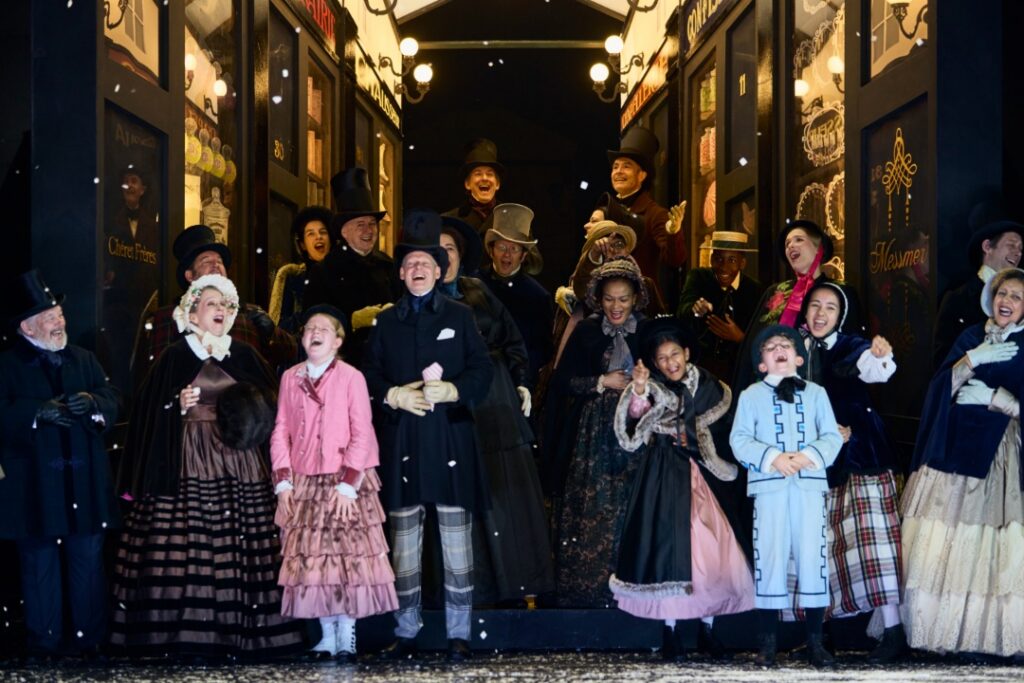
That said, in the second Act at least, one has to applaud designer Laing for a brilliant and ingenious stage set; a series of mobile three-dimensional constructions depicting Parisian shopping arcades. They are most effective and these later almost surreptitiously transition away, seamlessly, to reveal the Café Momus scene. Visually, the whole Act is a stunning smorgasbord of color and vibrancy. Presumably, revival movement director Danielle Urbas has a major hand here and I especially loved the way the children took front of stage for a more prominent role, rather than just the perfunctory skip through when toy seller Parpignol puts in an appearance. Likewise, the military marching band, something else I’d long considered a tedious addition, actually serves to enhance the whole performance.
In previous reviews of this production, I have lamented the shortcomings of either the director or the artists themselves, but on this occasion, I have to say that both proved to be absolutely adept.
(Photo: Ian Hippolyte)
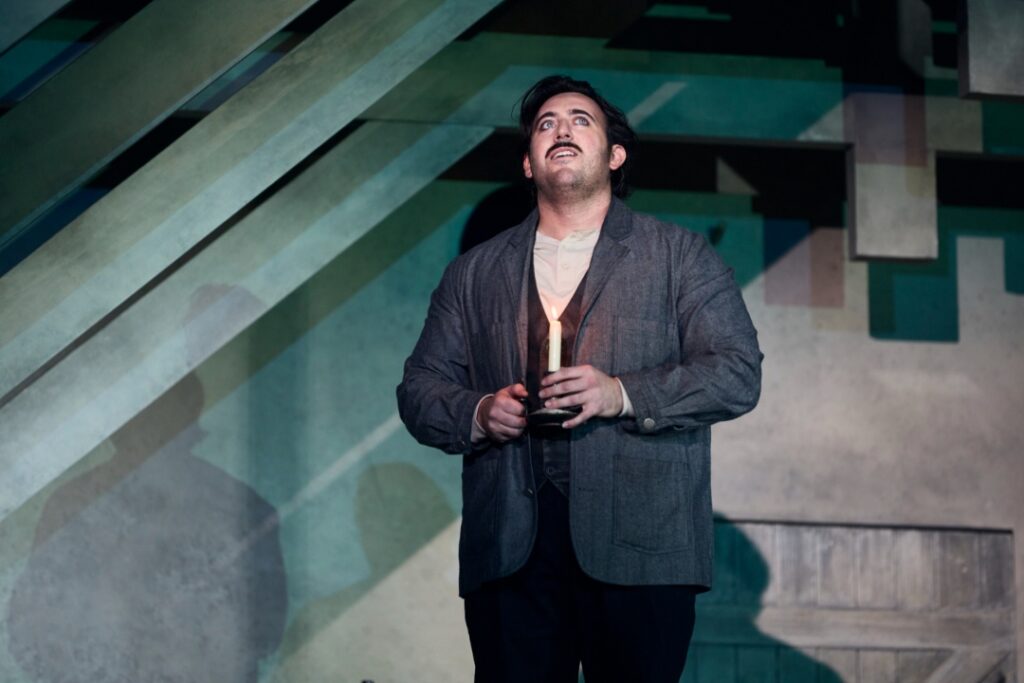
Freddie De Tommaso as Rodolfo
I had some reservations about British-Italian tenor Freddie De Tommaso in the role of Rodolfo. Not so much regarding his vocal abilities, which are consummate, but in his abilities to portray the romantic dreamer poet. I have seen his other Puccino heroes, Cavaradossi and Pinkerton, both of which were suitably bold and confident. But I have to report that a finer Rodolfo would be hard, if not impossible to find. Delightfully comical and occasionally zany in his interactions with his fellow bohemians, he firmly established his laddish qualifications, but his portrayal here was steeped in sensitivity.
His initial meeting with Mimì, where she collapsed and was lying on the floor, was both enchanting and endearing. He stood over her recumbent form and stared at her with comical uncertainty, uttering: “Ed ora come faccio?” which translates to “Now what?,” creating much mirth in the audience.
His third Act exchange with Mimì, after she bid him farewell, was particularly notable in the way he conveyed genuine hurt in his response: “Dunque è proprio finita?,” where many tenors inflect this part with an almost mocking or teasing manner. De Tommaso sang with almost palpable anguish.
His “Che Gelida Manina” was accomplished, the soaring “La Speranza” ringing and beautifully clarion. His love duet was delightful, but I especially loved his last Act duet with Marcello, “O Mimì, tu più non torni,” where he injected such a beautiful, genuinely wistful timbre. He frequently infused his lines with a glottal sob that gave his passages conviction, sentiment and passion.
It’s difficult not to employ melodrama in the final Act, given the tragic circumstances unfolding, and it’s easy for the tenor to emotionally over-exaggerate, but De Tommaso was a superlative actor in his final scenes. Firstly, as Mimì sang her final lines, he was visibly sobbing. Afterwards, when he discovered that she had died, he violently pushed away his fellow bohemian attempting to comfort and restrain him, tearing away the sheet that had been placed to respectfully cover her. He cradled her limp form in a heart-wrenching, truly pitiful manner. I have never seen such a convincing final Act, and I desperately hope there wasn’t a dry eye in the house because I am not ashamed to say that, despite having seen “Bohème” countless times, I shed tears at this point.
I take a little solace in the fact that after the performance, De Tommaso confessed that he had also been genuinely crying, such was the emotive power of Puccini’s music and the persuasive acting of his Mimì, performed here by Armenian soprano Juliana Grigoryan.
(Photo: Ian Hippolyte)
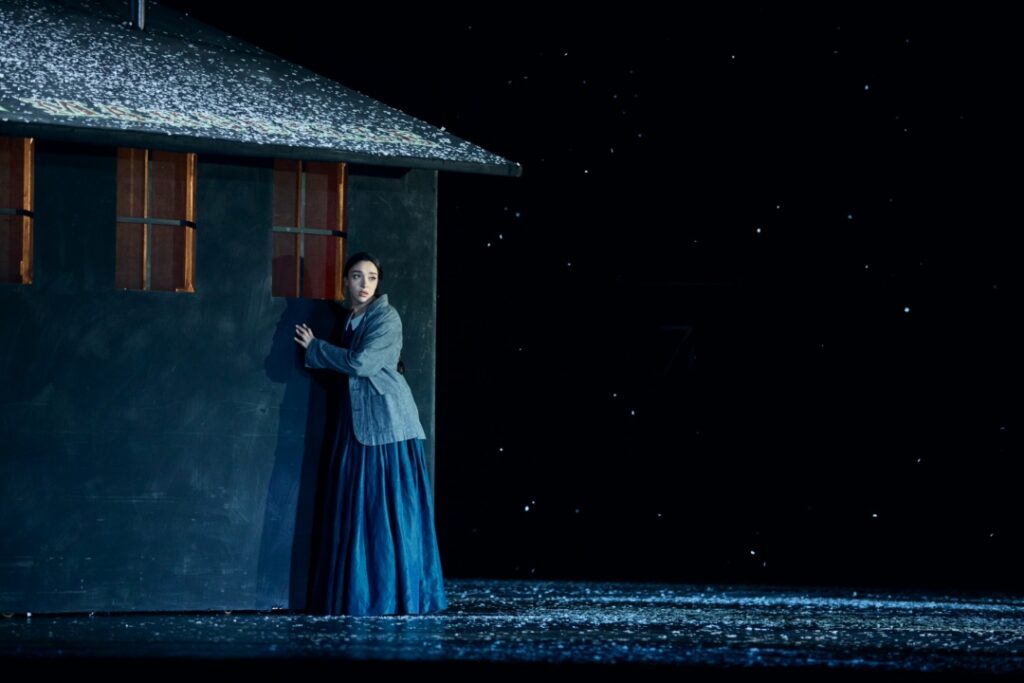
Juliana Grigoryan as Mimì
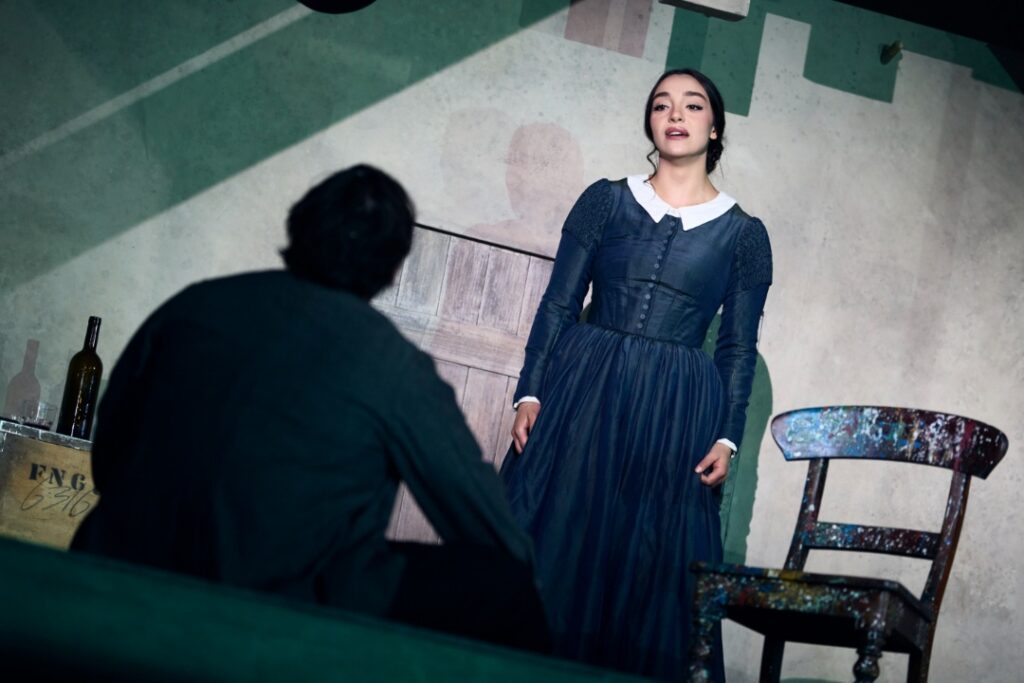
Grigoryan, who has enjoyed something of a stellar rise since winning Operalia, sang with an exquisitely rich register throughout. Her warm and caressing tones in the middle were capable of soaring to high notes with precision, often producing divine sotto voci and diminuendos of an ethereal quality. Her vocal presence was illuminated by her beautiful, intense and emotive eyes. In this role she carried herself with convincing fragility and vulnerability. More importantly, there was an almost tangible connection between her and De Tommaso that made for an entirely credible romance. Her keynote aria, “Sì. Mi chiamano Mimì,” was exemplary. On the line, “che parlano d’amor, di primavere,” she soared beautifully on the “primavere,” floating an exquisite celestial note. Likewise, when she during the line “ma quando vien lo sgelo,” she was supernal.
(Photo: Ian Hippolyte)
Her third Act “Addio…Donde lieta uscì” was particularly evocative. Her forlorn appearance commanded empathy. Her final line from that aria, “Addio, senza rancor,” highlighted her spinning more of that sublime, soft timbre and held the last “rancor” transcendentally. Suffice to say, the heart-rending beauty and sentiment in her final Act, “Sono andati?,” made a significant contribution to my weeping.
I don’t know precisely what type of Mimì Puccini envisioned when he wrote the score, but I would confidently suggest that Grigoryan is it, and more.
(Photo: Ian Hippolyte)
More Stellar Cast Highlights
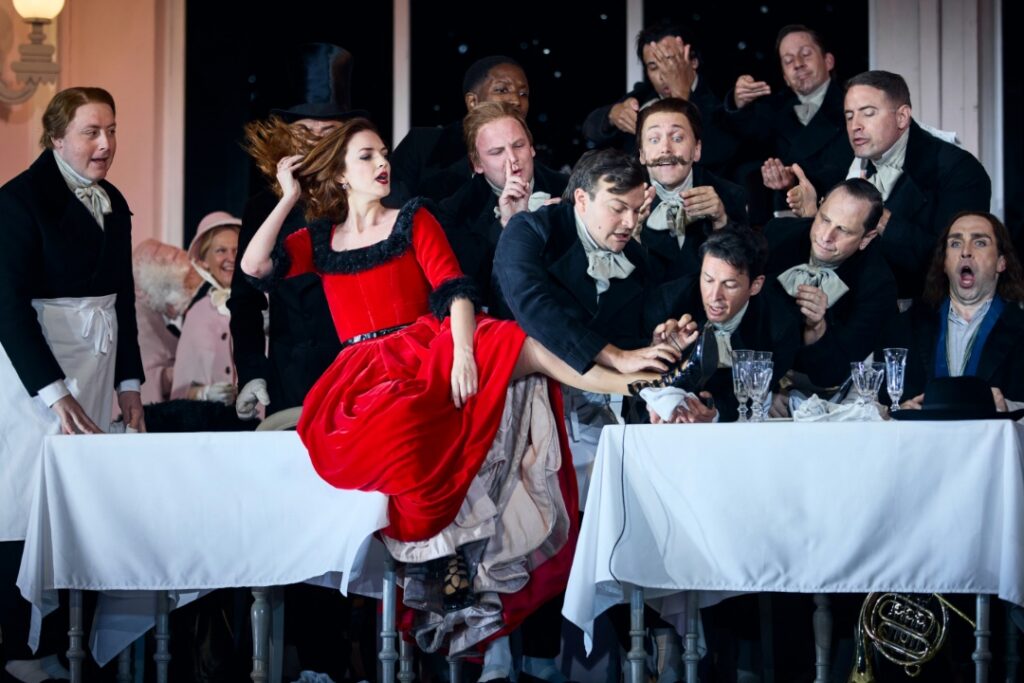
At the risk of sounding monotonous, I would also have to say that one would do well to find a better Musetta than Spanish soprano Marina Monzó. Hilarious and ebullient in equal measure, she positively radiated audaciousness before even singing a line. The absolute life and soul of Act two, she exuded charisma, even when portraying inebriation, precariously stepping from table to table, before removing her silk undergarments and dropping them onto Marcello’s head. Her “Quando m’en vo” was supremely well sung, her line “Ma ti senti morir!” floated deliciously, elongated with a splendid messa di voce. Suitably antagonistic in her Act three ruckus with Marcello and sublimely angelic in the final act where she led the prayers for Mimì with “Madonna benedetta, fate la grazia a questa poveretta che non debba morire,” in stark contrast to her Act two showgirl. This performance was her debut at Royal Opera, and it has surely cemented her guarantee for future engagements.
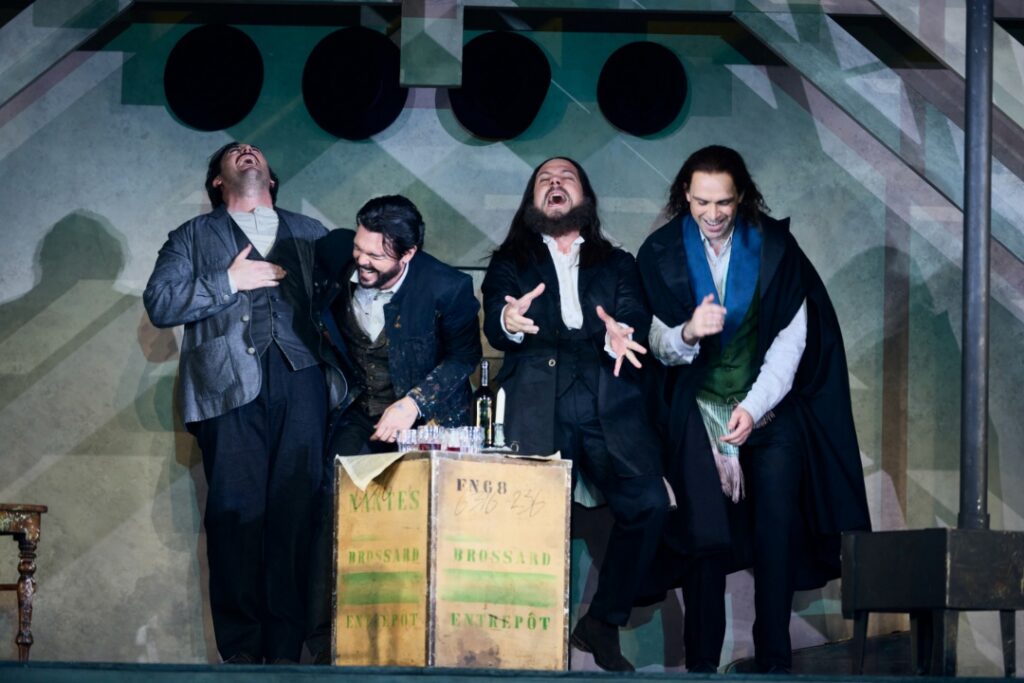
I saw Luca Micheletti in the role of Marcello at the Met in 2025 and was suitably impressed. I would have to say that he was even better here, singing with a wonderful, opulent limpidity and incisive, dark tone. Majestic in the second Act where he resisted the advances of Musetta, authoritative in the third Act with Mimì, where he waxed lyrical on love and relationships, (before engaging in a puerile squabble with Musetta), and meltingly resplendent in his duet with Rodolfo in the final Act. He displayed impressive breath control and had a dynamic stage presence.
(Photo: Ian Hippolyte)
Latvian baritone Modestas Sedlevičius bounded on stage, looking like Tiny Tim and proceeded to display flamboyancy at every turn, hamming it up, in the role of Schaunard, with his tale of how he acquired the food and drink he shared with his fellow bohemians, before parading and dancing among the marching band with leaps and heel clicks galore at the end of the second Act. He sang with a polished, powerful instrument, oozing finesse that belied his clumsy, haphazard character.
To complete the quartet I’m going to, again, have to single out the finest Colline I’ve ever heard live. Gianluca Buratto sang with astonishing reverberation for a bass. The Italian singer had a remarkable, oaken and sonorous tone, quite unlike anything I’ve heard before. I’ve never been a huge fan of the famous overcoat song, “Vecchia zimarra,” predominantly because the bass voice in this aria struggles to reach the right resonant frequency to permeate sufficiently throughout the auditorium. Buratto did so with ease and unquestionable beauty. It was a testament to his gifts. His aria received a hearty applause at its cessation.
Eddie Wade played the licentious landlord, Benoît, looking every bit the Victorian gentleman, singing with crystal clear diction and authority. British bass-baritone Freddie Tong was a suitably embarrassed Lulu as the chaperone to Musetta, in his role as Alcindoro.
(Photo: Ian Hippolyte)
Illuminating Musical Details
It goes without saying that the Royal Opera Chorus was magnificent, not just in their singing, but in their wholehearted acting. As previously alluded to, the children of the Youth Opera Company were a delight, being guided to greater involvement than seen in previous stagings of this performance.
Italian conductor Lorenzo Passerini expertly coaxed the orchestra to produce their magic. He seemed to call for elongated pauses at certain key points and arias in the performance, as if to give greater impact and emphasis to the artists singing. Ironically enough, one of my personal favorite moments in this opera isn’t sung at all. It is in the final Act when Colline and Schaunard leave the two lovers alone and the orchestra plays a short sequence of three of the leitmotifs from the opera, as Rodolfo turns and realizes that Mimì is awake. Here, under Passerini’s guidance, the orchestra produced a heavenly rendition of what I consider to be the finest passages ever composed by Puccini.
And my final lesson learned here is that one can take a production, give it a different revival director, and produce something far superior to the original. The revival director is listed as Simon Iorio with assistants Talia Stern and Ashley Pearson. Of course, it isn’t possible to precisely detail what contributions each made to the production, or who specifically made them; but it has to be said that THIS particular staging of this production is a triumph.
(Photo: Ian Hippolyte)
The characters of the principles had a natural, authentic chemistry, so much so, that even the salacious and puerile obscene scribblings the quartet made on the walls of the garret seem almost excusable as “boys will be boys” horseplay. Musetta and Marcello’s lewdness during Act two seemed almost acceptable and the ancillary characters in the third Act, the random inebriates, the gathering workers, all seemed to make the Barrière d’Enfer that much more plausible.
A triumph indeed, and huge congratulations to all involved.