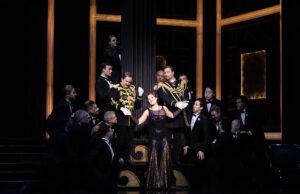
Opera Australia 2026 Review: The Merry Widow
By Gordon Williams(Photo: Carlita Sari)
Apparently in the early years of the 20th century, Gustav and Alma Mahler, the master symphonist and his composer-wife, unable to remember exactly one of the numbers from “The Merry Widow” which they had just seen, went to the trouble of visiting Doblinger’s music store in Vienna to refresh their memories. Gustav distracted the staff while Alma checked the relevant passage in the score.
I was reminded of this story, perhaps apocryphal, during the intervals of Opera Australia’s “Merry Widow” on Wednesday night, July 8, as the disarming infectiousness of Franz Lehár’s score could be measured in the numbers of people in the foyers humming or whistling melodies they’d heard in the previous Acts.
Why would Gustav and Alma have avoided being seen as enjoying “The Merry Widow?” Quite possibly they were somewhat embarrassed to be identified as loving such lowbrow entertainment.
Production Details
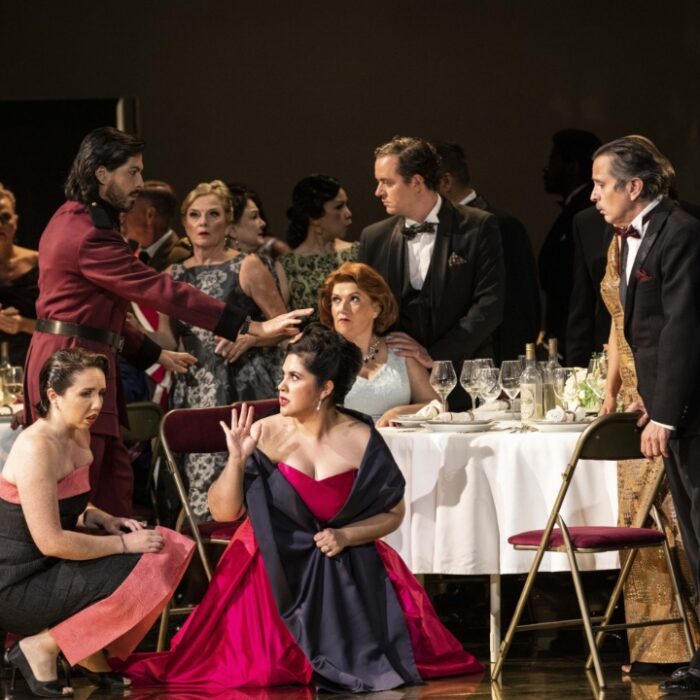
Graeme Murphy’s new production, commissioned by Opera Conference, Australia’s national partnership of professional opera companies, makes an unapologetic virtue of “The Merry Widow’s” lightness. The Sydney Opera House’s audience on opening night enjoyed this tale of the comical attempts by Baron Zeta, the Pontevedran ambassador to France, to induce his (fictional) country’s wealthiest widow, Hanna Glavari, to marry a fellow-Pontevedran, thereby keeping her fortune in the financially-shaky country. Murphy updated the story to the Art Deco period, 1920, a couple of decades on from Lehár’s original setting. Was he subtly evoking for us thoughts of the financial crash that would eventually shake the whole world by the end of the 1920s?
But any wider significance was worn lightly, and maybe it wasn’t even meant to be there.
Stellar Cast Highlights
Opera Australia’s principals were uniformly engaging and delightful. Soprano Julie Lea Goodwin literally shone in the role of the widow, dazzling on her entrance through a sea of white-gloved hands – a lovely choreographic touch from director Murphy. Of course, one might expect choreographic excellence from Murphy and his creative associate, Janet Vernon, longtime past leaders of Sydney Dance Company.
Tenor Alexander Lewis was able to span both operatic and musical theater roles. He was convincing as former lover Danilo Danilovich who doesn’t want to come across as coveting the widow-Glavari’s money but, with a final touch of poignancy, confessing his feelings for Hanna at the end. Actor-singer David Whitney, as Baron Zeta, who wants to effect the marriage of Hanna to Danilo really was the lynchpin of the show in his quasi-ringmaster role, ably assisted by Benjamin Rasheed, as the Pontevedran embassy clerk Njegus, who had one of the evening’s steals in his Act three number, “I am quite Parisian,” not the only contradiction on the surface as the number showed.
Tenor John Longmuir sang so effortlessly and charmingly as Camille de Rosillon, one half of the B-plot of Rosillon and Valencienne (soprano Alexandra Flood), that it felt a shame Camille ended up with nobody after Valencienne went back to her husband, Baron Zeta, and he had to slink off, Beckmesser-like, at the end. Valencienne’s divided loyalties between the lure of Camille and her wifely ‘obligations’ were palpable in Longmuir and Flood’s performances.
More Illuminating Details
It is a mark of the excellence of Murphy’s direction that all the character-shifts in this intrigue made sense. The glamorous look of the production was a great credit to the design team Murphy inspired. The sets by Michael Scott-Mitchell even received a round of applause as the curtain rose on Act two and Scott-Mitchell had reproduced something like Monet’s depictions of lilies for Hanna’s Parisian garden.
The cast was lightly amplified but so subtly that the singing quality of voices was still appreciable and the miking was really only noticeable once the dialogue had begun and it was clear that the cast was not projecting into the auditorium as forcibly as they might. As a result, one could enjoy without strain Justin Fleming’s lucid and witty translations of the original Léon and Stein lyrics. These lyrics, mostly full rhyming couplets, were a model of clarity and ‘forward projection.’ And the clarity and clear intent of the singers’ diction meant no problem that English surtitles were only provided for the songs. There were Chinese surtitles by Samantha Xu for both songs and dialogue.
The only drawback to the projection of the amplification, arguably, was an initial difficulty in sourcing the origin of vocal sound, but this might also have provided a benefit in that it made it difficult to distinguish between singing and dancing cast. Indeed, I had over-estimated the extent to which this was a cast of singer-dancers. But there was a lot of physical energy per se from the stage.
Musically, conductor Vanessa Scammell swept the Opera Australia Orchestra along in this waltz-dominated, effervescent score. There were fine solos from orchestral principals, particularly the woodwind. And the Act two male septet, known in German as “Wie die Weiber man behandelt” was a musical and comedic highlight–all the more impressive coming from both acting and singing men of the cast. All in all, a delightful time before we hit the seriousness of “Rigoletto,” the second opera in Opera Australia’s winter season.