Q & A: TikTok Sensation Jamie Hannah on His Classical Approach to Pop Music & the Impact of Authenticity
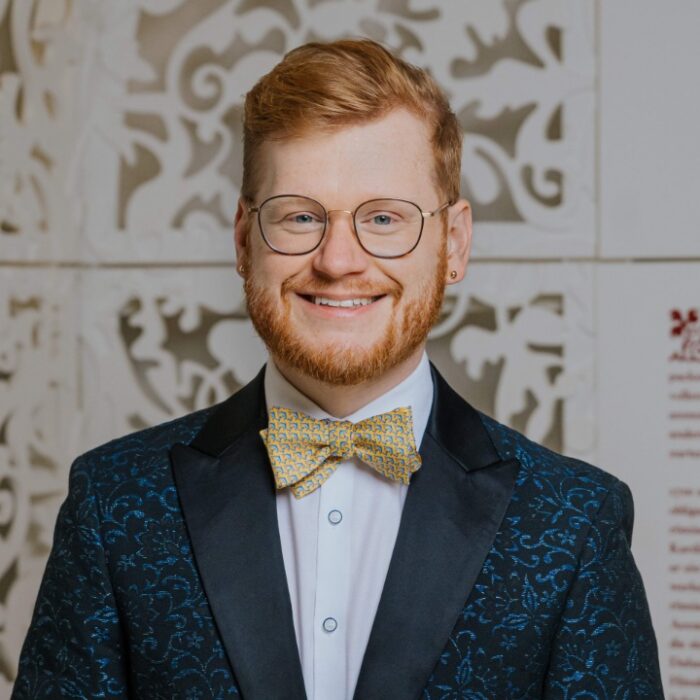
By Afton Markay(Photo credit: Mark Short)
Singer-songwriter and countertenor Jamie Hannah has captivated the internet with his “Italian Aria series.” In only eight months, the series has earned over 10M views and brought Hannah more than 200K new followers. Hannah’s Italian aria-style renditions of pop songs such as, “Can’t Help Falling in Love” (2.7M views on Instagram, 1.6M on TikTok), “Like a Prayer” (2M IG, 800K TikTok), and “Hallelujah” (1.8M IG, 1.2M TikTok), have not only introduced opera to millions, but have also brought solace to many listeners.
In this interview, Hannah shares his creative process, thoughts on genuine audience connection, and a bit about upcoming projects.
OperaWire: When did you begin singing?
Jamie Hannah: My parents always remind me of how, when we played hide and seek growing up, they could always find me because I’d be singing behind a couch or something. Singing has always been a huge part of who I am. I don’t come from a particularly musical family, but we love going to musical theatre and the opera. Growing up I listened to an eclectic array from Ariana Grande to soul singers, and I found myself singing all the time around the house.
I started taking proper classical vocal coaching sessions when I was about six or seven years old. Then, at the age of 13, I joined the National Youth Choir of Great Britain. That opened my mind up to so much new music from around the world, and to female composers, queer composers, and it was more than music then, it was the message and a connection to the audience. Performing in concert halls in places like China and South Africa made me realize there’s a real industry here, and that I wanted to be part of it.
I also loved hanging out with musicians. I never really fit in at school as a queer kid, but I found my crew among musicians. Music became that space, even before coming out. And then at 18, I decided to pursue a full-time career and went to opera school and I’m here now.
OW: Did you seek out classical lessons, or was it just what was available?
JH: I always wanted to be a singer-songwriter and writing my own music, but I was also reminded of the importance of establishing that foundation in my voice. I’d be singing a show tune or something, and my mum would say, “Well, you know, Cheryl Cole was classically trained.” So, I was guided into classical, and I fell in love with it.
OW: When did you decide to switch to pop?
JH: When I was 21, I stepped away from classical for a bit and got into the pop world. But I didn’t really resonate with audiences, it didn’t feel authentic. But when I started doing these classical arias online and they went viral, it was like a reminder to myself that classical music was always what I wanted and it’s a part of my being.
When I was at the Royal College of Music, my peers would practice art songs and Monteverdi all day, and I’d be off doing Ariana Grande covers. I thought, there must be something to this. And now, building an audience and community online is so crucial. I started thinking about how I can integrate my studies in Italian, French, German, and Russian into a pop sensibility, and I’m so happy I did.
OW: Can you tell me more about turning pop song songs into the style of Italian arias?
JH: A friend asked me to sing as she walked down the aisle at her wedding in Mexico. We bounced song ideas back and forth and I suggested “I Will Always Love You.” She said “yes,” but to “give it a je ne sais quoi to make it extra special.” So, I offered to sing it in Italian. She loved it! After the wedding, I posted the video and it went viral, which really made me think there could be something to this. Then I tried other timeless pop songs like “Can’t Help Falling in Love,” “Like a Prayer,” and “Easy on Me.” Some do better than others, but I love the process.
It’s a way of honoring my younger self, the kid who never felt cool but found safety in choir. And now, I bring that into my music as a unique voice. It’s not about which style is better. Pop leans into emotional truth, like if your voice breaks, or if you’re a little flat, that’s all part of the charm. Opera is about precision. But they don’t have to compete. It’s all music. It’s all art.
OW: Do you do your own translations and arranging?
JH: I do the translations myself, but I check with an Italian friend to make sure they make sense. I also work with a pianist friend to arrange the instrumentals in the style of Italian opera. We start in this sort of etherial space and add all the colors, and swells, and such. We build them in Logic, so we can work on it together, but I usually start at the piano. What I love doing is the vocal arranging, I’ll start stacking 20 to 30 harmonies and see my inner choirboy coming through. It’s really great fun to do.
OW: What kind of feedback have you gotten on your videos?
JH: Doing these Italian arias has really brought me home to what’s resonating with people. Some of the comments are really heartbreakingly beautiful, and I really feel called to continue.
I’ll read you some of my top comments, “I’m very ill and don’t have long left, but I’m so glad I found your wonderful music that calms me so much as I near the end of my earthly life,” “I have major depressive disorder and your voice shuts off the demons and lets the light in. Your voice takes me to that special place that transcends life struggles and into that heavenly space so rarely touched,” “I suffer with both Autism and suspected ADHD, so its rare when I find a song that can both grab my attention and help me relax, but this version does,” “I’m incredibly emotionally numb for depression and increasing parade of meds over the last 10 years. I’ve seen my ability to fill get less and less and very little stimulates emotion in me but your voice does something that evokes feeling in me,” those are just some of them.
Helping people has always been my intention. Even when I was doing more pop stuff, I wasn’t doing it to be famous, or to try and gain attention. The thing that brings me the most joy has always been connecting with members of the audience. I make a conscious effort with every message that I received to respond to them because someone’s taking the time to share a piece of their soul with me. It’s an honor that people feel that they can confide in me just through hearing an Italian aria.
OW: Do you think TikTok is a beneficial platform for emerging musicians?
JH: I think TikTok is a good app to generate an audience. It’s free and each video gets sent out to 200 new accounts each time, so if the content is of good quality you do have a chance of building your audience over time. One has to be consistent, and the videos are time consuming to make, but it’s an incredible platform to build a community on and open doors.
OW: What advice do you have for Classical musicians trying to start a TikTok?
JH: It’s really hard to find a niche which differentiates you on social media. It took me nearly five years to come up with the Italian aria idea, and there are so many incredible singers in the world, so if a classical musician is going to try and market themselves online they have to find a way that hasn’t really been done before.
Opera has this elite reputation, so that’s why I started off very DIY, like, I was in a hoodie. I just wanted to keep it accessible. Opera is beautiful, but it does need to innovate sometimes to appeal to younger audiences. That was really what my vision was when I started, I wanted to merge the two and bring a younger demographic into this genre.
OW: Do you see yourself ever performing on the opera stage?
JH: I’m in the process of developing a body of work which strikes that balance between the two – think Josh Groban, Katherine Jenkins, but also a little bit of a Sam Smith twist. I would love, in time, to be able to be on the opera stages, but I don’t want to fully commit to doing solely classical.
OW: What would be on the set list for your dream concert?
JH: I’d love to headline my own show one day at the Royal Albert Hall, Sydney Opera House, or maybe even Versailles. I’d open with something like “Ombra mai fu.” I’d include original music too , but also honor my roots, my journey, with operatic and choral influences. I want to pay homage to Monteverdi, but also make something fresh.
OW: Do you have any new projects on the horizon?
JH: Yes! I am releasing a body of work at the start of next year. It won’t be covers, but it will be very much in the same world as the covers on TikTok. I really hope to be able to step into my own original music world with this community.
Categories
Interviews