Q & A: Shepherd School of Music on Staging Verdi’s ‘Falstaff’ and Supporting the Future of Opera
By Logan MartellOn April 17, 2026, the Shepherd School of Music at Rice University raised the curtain on their mainstage production of Verdi’s comedic opus, “Falstaff.” Celebrating its 50th anniversary, the school has grown from its inception as Rice’s music department through the support of community partnerships and donors, and has developed into a vibrant and effective center of musical education and collaboration.
I had the opportunity to travel to Shepherd on invitation of the school, and over the course of the two days I spent exploring the campus, speaking with the faculty and students, and attending the performance, it became clear that there was truly something special to be found there.
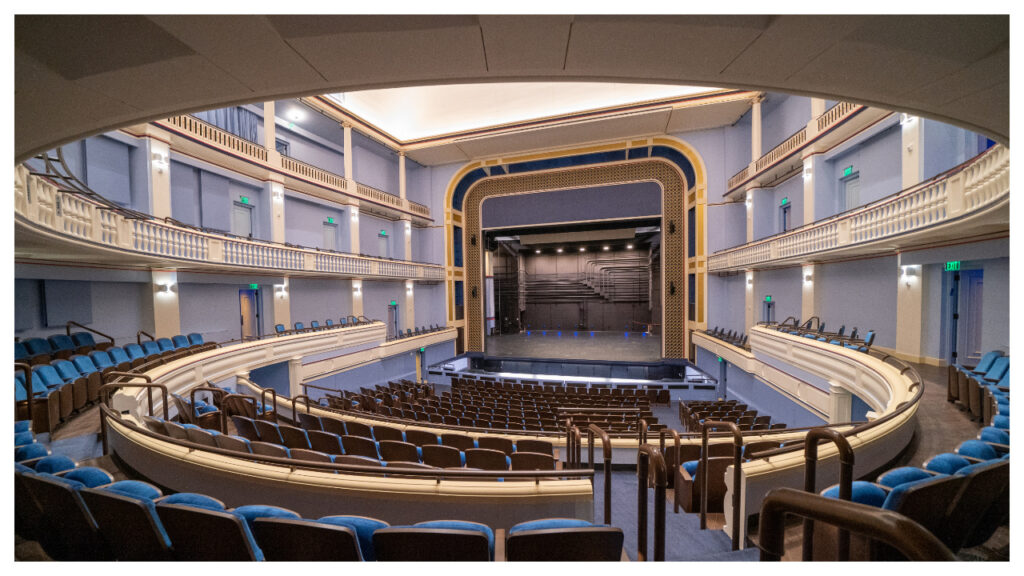
Much of the momentum over the last two decades is thanks to the efforts of former dean Robert Yekovich, who spearheaded numerous fundraising campaigns as well as the construction of the Brockman Hall for Opera. Opening in 2021, this new addition to Rice’s campus is a beautiful testament to their investment in the future of the performing arts. The auditorium itself blends a Romanesque style with subdued blues and yellows for a subtle yet charming impression. Acoustically, it is designed for supporting young singers as they develop their instrument, and allows enough space within the orchestra pit for full rehearsals. Beyond the auditorium, I was shown through spacious dressing rooms and impressive workshop spaces for sets, costumes, and props.
Credit: Brandon Martin
During my time on campus, it was not uncommon to glimpse classes or various practice, with students learning from truly renowned artists. Without naming names, some of these I recognized from shows I have seen at places including the Metropolitan Opera. Leading the school since 2021, Dean Matthew Loden provided much insight on Shepherd’s recipe for success as we spoke and walked the building.
“I’m a native Houstonian,” said Loden, “and my very first day job apart from playing the violin was as the Director of Admissions at the Shepherd School. So I was coming back into a world that felt very familiar, but in the 20 years I’d been away something extraordinary had happened. The faculty that had always been world-class became even more so, and just the trajectory of the school and what it had been accomplishing, how many students had been placing in competitions and orchestras, winning commissions — it all added up to a really critical mass of success that was really very exciting to come into and be part of, especially at the tail end of the pandemic.
Knowing there was this beautiful Brockman Hall for Opera that had been completed and paid for, and was ready to be beautifully turned on at the end of the Covid-19 issues, presented a once-in-a-generation opportunity to figure out how to make this space work for opera, for the entire school, and for the entire city of Houston. So it was a beautiful arrival, and it’s been an amazing, very short period of time — five years now. I think over the 50 years of our history, the secret of our success is that we’ve maintained a very narrow focus. We’ve decided that there’s only a handful of things we want to do, but we want to do them better than anybody else, and we want to, wherever possible, avoid any kind of institutional drift — where the mission gets complicated or messy. What are the points of light that we need to pay attention to? [What do we need to do] in a different fashion to help amplify what we’re already doing for the benefit of the students and faculty that are here?”
This sense of artistic refinement and specificity is also reflected in its admissions policy, which allows in less than 40 vocalists per year in order to provide each student with the most support. Leading the opera department is Joshua Winograde, Director of Opera Studies and bass-baritone. Among many duties, Winograde is responsible for programming the repertoire, a process that begins only after he has heard from each student and gained a sense of their abilities.
“First and foremost, I think we need as many performance opportunities for the students as possible,” began Winograde. “I really feel like we need big casts, I think that there are some lessons to be learned about ensemble performance, and I think that those lessons are good for students to learn at this stage. So that’s another reason that we limit what we do to fairly large casts. I think double bills can allow us to get around that in some way, but for the most part, that’s a primary consideration. Secondarily, the example that I always like to use is that when you only have 35 singers in a department, and when you know 24 of them are at the graduate school level, although we do give a lot of performance opportunities to undergrads that are ready for them, the master’s students are who we’re programming the titles for. I feel like it’s really important we set everybody up for a slam dunk success, and they may be concerned about what it’s going to take to get from where they are today to the slam dunk success.”
With these thoughts in mind, Winograde’s decision towards Verdi’s “Falstaff” made great sense. A comedic and yet subtly-rueful celebration of life, Verdi’s final work is packed with rich and entertaining moments for the artists and audience alike. Leading the cast and orchestra was conductor Miguel Harth-Bedoya. Having joined the faculty in 2025, Harth-Bedoya serves as Distinguished Resident Director of Orchestra, overseeing the conducting for nearly all orchestral performances. Through the course of our conversation on the opera and his own current and upcoming engagements, his passion and dedication to his craft was as apparent as it was engaging.
“I think I am the most benefited student of all,” said Harth-Bedoya when asked on his experience as director. “I’ve learned so much from my colleagues, staff members, and my students themselves. I have two big group of students: the music major students, and about 75 non-music major students that play in the Campanile orchestra. The number of things I learned about what they do, how they see things differently than when I was their age — it teaches me to stay up-to-date with everything, whatever technology or social media platform, because you have to be able to not only teach them what we do, but how to apply it.”
On the opera itself, Harth-Bedoya described it as “a rollercoaster of what I call ‘you open the faucet and music comes out…’ Until you close it at the end of a scene, it just goes on and on, which is really the exciting part about this, which I hope translates to the audience. Moments where one person is speaking, then two people, then three, then seven people speaking different things at the same time, and they all make sense only because of the music — that to me is genius.”
The enthusiasm for being able to cultivate and connect with the next generation of musicians is one that is shared among the faculty. Speaking on her experience since joining as Professor of Voice, renowned soprano Ana Maria Martinez had great insight on the growth and impact of the school.
“The Shepherd School is, I think, paramount in the formation of young musicians both in the instrumental world and the vocal world… Having Joshua Winograde at the helm of Opera Studies has truly changed much of the trajectory. He was able to touch base with his contacts in the opera world and get top-level artists, directors, conductors, to give masterclasses and guidance to young singers. He’s running it much like a young artist program. [This approach better prepares] our singers for a more competitive, and hopefully fulfilling, life. This is a vocation…
Each teacher devotes much of their lesson time with those students that are in the opera working on their roles; but they’re also working on other repertoire with the students. The students have to constantly work on their audition package of arias for competitions and young artist programs — there’s so much going on in their lives, so you’re working on all the immediate requirements, but you’re also working on everything else that has to do with their preparation…
You must support them emotionally as well, make sure they’re doing okay, so they feel that their community here cares about them, the whole human. You want to lead by example in setting your values, so that they prioritize [what they need in order to] graduate as a great member of society. I think we take that very seriously here.”
From what I saw of the campus, and what the faculty shared with me, their passion was certainly infectious, but just as important was what I glimpsed in the moments between these meetings and tours. The campus was often abuzz with students on their way to classes or enjoying their time between; the fragments of humorous conversation and muffled excerpts of various musical passages rehearsed through the halls left me with an impression of a vibrant community of emerging musicians.
Ahead of the performance, I was able to speak with three of the students taking part in the opera: Tzvi Bat Asherah as Ford; Sophia Grace Donelan as Alice Ford; and Matan Gendelman in the titular role.
Regarding the parts that they enjoyed the most in this production, Donelan stated “For me, it’s been the comedic acting. Because opera has so many tragedies and I really love comedic acting, so challenging that part of my skillset has been really wonderful — and I love Shakespeare.”
“In a similar vein,” continued Asherah, “I think figuring out Ford’s character, and how jealous he can be while also trying to figure out this alter-ego of Fontana, has helped me explore more of my acting capabilities alongside pushing the boundaries of what I can do vocally, since this is a bit of a higher role than what I’ve sung in the past.”
“’Falstaff’ is such an amazing ensemble opera,” said Gendelman. “It depends on all of the cast to be at the highest level, and we here at Shepherd School have these amazing colleagues, [these] amazing singers that I get to have the chance to perform with and do a dream role of mine. It’s truly been a pleasure to work with all the colleagues, all the stuff behind it — the coaches, the stage workers — it was really fun.”
Bringing my time at the school to a close was, of course, the performance. Without delving into a full review, the production tastefully balanced a modern, country club setting with faithfulness to Verdi’s score and Boito’s libretto. The cast of students truly seized their moments, with much energy to flesh out the comedic and more nuanced moments. The musically supportive hall itself was almost always filled with aural beauty, making the performance feel all the more immersive.
Emerging from one of America’s most prominent business and research schools, the Shepherd School of Music at Rice University has built something truly special. Through support and collaboration with their community in Houston and beyond, they have built an institution that is well-equipped for the demands of musical education. Through the expertise and artistry of the faculty they have nurtured a student body where each can bring the best out of the other. With such a conducive environment, the years will no doubt continue to prove the Shepherd School of Music’s position as one of the nation’s leading arts schools, as they guide young artists into their careers and beyond.
Stories you may also like…
Q & A: Composer Hana Ajiashvili on Her Azrieli Award-Winning ‘Riddle,’ Finding Inspiration in Color & Music’s Omnipresence in Her Life
In Less Than Five Minutes, Get To Know Stage Director MariaLuisa Bafunno