Q & A: Barbara Hannigan on Performing with the New York Philharmonic & ‘La Voix Humaine’
By Francisco SalazarBarbara Hannigan is one of the most unique artists in the opera world. Not only is she a leading soprano, but she also one of the leading conductors in the industry.
Her versatile artistry has allowed her to develop, over the past three decades, major artistic partnerships with the world’s foremost musicians, composers, directors, choreographers, and ensembles. Among those collaborators is the New York Philharmonic, which whom the soprano has performed on two occasions.
In 2010, she appeared with the famed orchestra in “Le Grand Macabre” under Alan Gilbert and then later on combined with the ensemble for “Quatre Chants pour Franchir le Seuil.”
This weekend, Hannigan will bring her artistry back to the New York Philharmonic, this time as both singer and conductor as she takes on Poulenc’s “La Voix Humaine.” OperaWire had a chance to speak with Hannigan about her process and her artistry.
OperaWire: What are the challenges of singing and conducting simultaneously?
Barbara Hannigan: Well, to do this, it needs to look and feel natural, which it does, to me. One needs to, in a way, be able to split the brain into seeing/hearing and anticipating what the orchestra needs, as well as maintaining the complete vocal and theatrical delivery of the role. I think in one way, it can actually makes everything easier, to eliminate “the middle man” (no offense to conductors, because I love singing with other conductors!), in this particular production.
OW: Tell me about this production of “La Voix Humaine.”
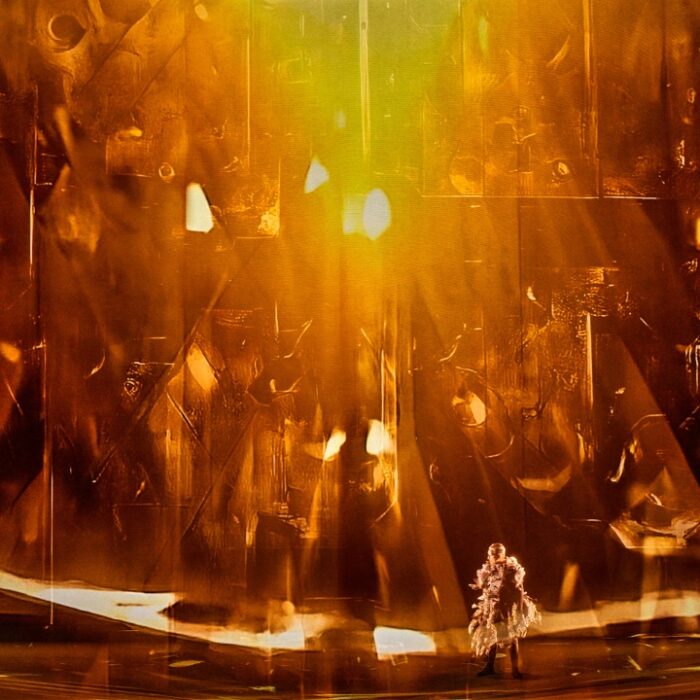
BH: This is a fully staged version, except that I stay in one place. On the podium. It is a kind of psychological thriller, a vortex that this character goes through as she is dealing with the deep emotions that come with the end of an affair. Because I have the 3 video cameras placed within the orchestra, and am interacting with them (which is seen on the large screen behind the orchestra), as well as interacting with the orchestra…this is, in a very unique way, a full production. What they call in Europe, “Gesamtkunstwerk” – total art.
OW: Tell me about this score and the challenges orchestrally and vocally?
BH: Poulenc’s opera is written for full orchestra – very romantic and lush orchestration. It is a one-sided telephone conversation between the woman “Elle” and her lover. We only hear what she has to say. And from the text (by the incredible French writer Jean Cocteau), we understand that it may very well be possible that “Elle” is addicged to fantasy. She may be living out this relationship exclusively in her imagination. She speaks about the importance of lies, of fantasy, of living in an imaginary world. She may even imagine she is playing this role while conducting New York Philharmonic!
OW: What is your history with the New York Philharmonic and what you have learned from them over the years?
BH: I worked with New York Philharmonic on two occasions: one was in the iconic production of Ligeti’s “Le Grand Macabre” conducted by Alan Gilbert and directed by Doug Fitch. The other was a special event with members of the orchestra with a haunting piece by French composer Gerard Grisey called “Quatre Chants pour Franchir le Seuil,” which Alan also conducted. Both times, working with them was a joy. As far as learning from them, this has been life-long, as I have been listening to their recordings since I was a kid.
OW: You’re well-known for contemporary music. How does Poulenc’s music fit into your repertoire and what do you love most about this score?
BH: Indeed I have given a lot of attention to contemporary music, and have a special love for early 20th century works: two of my favorite roles to sing are Berg’s “Lulu” and Debussy’s “Melisande.” And of course, I sang Poulenc’s “La Voix Humaine” at Paris Opera, several years before I created this special production. As a conductor, it is very rare that my programs are exclusively contemporary: Haydn, Strauss, Beethoven, and Mozart are featured alongside Stravinsky, Messiaen and Ligeti. In the case of a score like “La Voix Humaine,” I think Poulenc and Cocteau together were a dream team: the role truly has a very deep dramaturgical insight in the human experience.
OW: How did you decide to program Strauss’ “Metamorphosen” with Poulenc’s “La Voix Humaine?” Why do you think these two pieces work together?
BH: Both pieces are extremely emotional, and deal with loss and isolation. The Strauss on a collective level. It asks: how did we get here? How did this happen? It looks to the past, and the present (I would not say, to the future). The Poulenc is much more individual. The character of “Elle” experiences runs the gamut of raw emotional experience: anger, loss, frustration, madness, and also humour…just as humans sometimes laugh hysterically or make jokes at the most inappropriate times, Elle finds herself being coy or silly in one second, sarcastic or cynical in another, and absolutely heartbroken in the next.
OW: When you started your career, did you ever think you would have this dual path as a soprano and conductor?
BH: When I started, no, I didn’t imagine this. I was concentrating on singing. It was not until I was in my 30s, once my vocal career was well and truly established and I had developed trust and relationship on an international scale, that other conductors, musicians and orchestral managers were suggesting that I “try my hand” literally. These are people I trust and respect, and so I agreed to make my debut at the Chatelet in Paris in 2011. After that, it was clear that it was something to be explored further, so I began to make time for it, in tandem with an already-full calendar as a soprano soloist. Now I divide my time as I wish. Sometimes I only conduct. Sometimes I only sing. Sometimes…I do both. And only with pieces where I feel it makes absolute sense, from both a musical and dramatic perspective.
OW: What are the advantages of conducting yourself on stage?
BH: It is always an adventure, it is an enormous challenge not just for me but for my colleagues in the orchestra, it is fun, it makes us listen and collaborate in a different way than we are used to. Everything I do is a challenge, in my perspective. From the very first note of my warmup, every day.