Q & A: Lisette Oropesa on ‘I Puritani’s’ Elvira & Her Vast Repertoire
By Mike Hardy(Photo: Steven Harris)
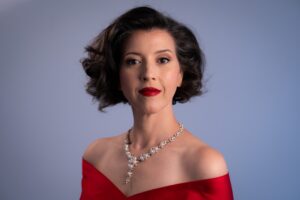
Lisette Oropesa is a widely acclaimed lyric coloratura soprano who is one of the most in-demand artists on the world’s stages. Her expansive repertoire includes Gluck, Händel, Mozart, Rossini, Donizetti, Wagner, Verdi, Bizet, Massenet, Bellini and Puccini, among others. She has recorded a continuously expanding discography of studio albums, live recitals, and opera films.
Operawire caught up with Lisette at the Royal Ballet and Opera where she is rehearsing the role of Elvira in Bellini’s “I Puritani.”
OperaWire: You made your debut here at Royal Opera in 2018. What do you recall about that time?
Lisette Oropesa: I remember being very nervous and very much feeling a lot of pressure because I debuted as Lucia, which, of course, is a big deal, and it was a wonderful production. I had a meeting with director Katie Mitchell in advance to just talk about her ideas of the production. She warned me about all the corners, right? I’d be on stage the whole time. There was a love scene, which she later eliminated. There was a murder scene, where I would be visibly seen murdering the bridegroom. So, there were some things that made me feel immense pressure.
And then every interview that I did, they mainly talked about (Joan) Sutherland. So, no pressure! Of course, I felt that I just wanted very much to do a good job. And I feel the same way now, I mean, that hasn’t changed. It’s the same. I feel an amount of pressure very much, a certain amount of responsibility,
OW: So, how are things this time round? How is this production of “I Puritani?”
LO: I’ve sung “Puritani” twice before, but this is my first time singing this production. It has different demands. The pacing is a little different. Elvira is on stage more, which is already a challenge because she does sing quite a lot. So, she’s on stage even more, and there’s a lot of detail. There’s more detail in this production.
I feel like most of the time when you see Bel Canto, except in London, most of the time elsewhere when you see Bel Canto, it’s very much about broad strokes and kind of getting the production out of the way so that the singers can come through. Whereas in London, I think the appreciation for theatre in this country is different. It’s on par with the appreciation for singing. So you need to be acting, you need to be emoting, you need to have intentions, you need to have motivations.
OW: I believe a quote attributed to you is: “Elvira is the absolute peak of a career.” Can you elaborate on that a little?
LO: Yes. It’s very demanding and very hard to cast. I was speaking with a stagehand the other day during rehearsal, and he was saying how much he liked the opera and that he hadn’t seen it before in his 20 years working there and asking why it wasn’t performed more. So, yeah, it’s hard to cast.
Elvira is a tough role. It’s tough because it’s not really clear what type of soprano you need.
Because there are moments that are florid and fast and high, and then there are moments that are quite low and lyric, and then there are moments that are long and almost Wagnerian, and they require a big sound or at least the impression of a big sound or a continuity.
So, it’s a kind of obstacle course, if you will. The tessitura is not the same. I’m studying Norma at the moment as well. Norma’s tessitura is pretty much in the same region for most of the role. There are a few low notes…. there are a few high notes. But the stretch of what is required throughout the evening is not as great as “Puritani.” For me, “Puritani” is much more “mozzarella-like,” you’ve got everything from here to there and everything in between.
And Elvira sings a lot. It’s a long sing. It’s a long night. Just when you think it’s over after the mad scene, she’s got another huge duet with a tenor that just goes on.
But you’re right about that quote, that is something that I said. You really can’t sing it when you’re too young, and you can’t sing it when you’re too old. You have to be in the right vocal, physical shape, in my opinion, for me. I think if I had done this 10 years ago, I wouldn’t have made it. And if I had waited 10 more years, I don’t think I’ll have it anymore. If a company were to say to me: “We’ll write a ‘Puritani’ for you eight years from now”…. I’d probably say no. I think in eight years I won’t have another “Puritani” left.
So, you have to be blessed. I’m blessed that I can even do it.
OW: Looking through your career, you have what I consider to be a pretty astounding, far-ranging repertoire. Did that happen by accident or design?
LO: It’s a little bit of both, to be honest. Because, I mean, for example, I really love Mozart. So, I sang a lot of that, and then Mozart kind of leads to Händel, and then Händel leads to Bel Canto. And I really love singing in French. I always love singing in French, so I have a lot of French roles that I like. And then there’s a few earlier pieces and lighter (French) roles that I can do.
Because I also think my voice type is like a universal blood donor. There’s a lot of repertoire written for this voice type, or lyric coloratura. I wouldn’t do verismo, just like I wouldn’t do Wagner. But French stuff is perfect for me. There’s a ton of Bel Canto I can do within reason. You know, of course, I’ve had requests to do things that are absurd, but I have to say no. Things that are too high, that I would love to do but I can’t. So, I know that I have limits, but I really just enjoy everything I’m doing.
I’m grateful that I don’t have, like, maybe these three roles, and those are the only roles I’m interested in doing. I get offered much; I just love it all. So, it’s kind of my own fault.
OW: Would I be right in thinking that you’re a driven person, that you’re always pushing yourself, not necessarily to the limit, but seeing what you can achieve and how much you can challenge yourself?
LO: Yeah, you are right. I think an easy career is harder and harder to have these days. I don’t think you can have an easy career until you can rest on your laurels. And by then, even still, the career is difficult. The career is challenging. And as you get older, you’re not as resilient as when you’re young. When you’re young, you’re fresh, you bounce back, you know, you can push through fatigue, you can push through illness. As you get older, you become more finicky. Everything starts to be a problem: The heat affects me, sleep affects me, my mood, my time of the month, or this and that. And it starts to become harder to sing anything.
So, I will at some point have to slow the hell down and respect that, because I can’t last that long. At the same time, we lost a bunch of years during the pandemic that we’re not going to get back.
And there are things that, if I feel healthy and well, I’m here 100 per cent. If I’m not, I pull back, and that’s kind of where I’m at.
OW: Talking about your health, I know you have been plagued with some reoccurring issues over the years which have impacted your career. Are you willing to talk about this?
LO: Sure, It’s reflux. (laughs) It’s like forever. I mean when I was much younger, I had reflux. Like when I was in my 20’s. And I started my career and it never bothered me. I went vegan. I’ve been vegan for 15 years. And I hit 40. I was singing in Naples in “La Traviata” and I just had this pain in my throat. It wouldn’t go away. I thought I was getting sick. I went to the doctor because I lost my voice.
I went to the doctor and he said: “No, you don’t have a virus. You have reflux, acid reflux.”
And I said: “I can’t have acid reflux. I’m vegan. Vegans don’t have acid.”
But he assured me that I did. I had to start taking medicine every day, trying to eat earlier in the day and not at night, sleeping at an incline, it’s a major thing and it turns out most singers have it.
It’s a disaster because what happens is that singing causes the abdominal sphincter to loosen because of how you support the voice. And so, you’ll eat or you’ll drink coffee and then you’ll sing, and it’ll just like the acid will come up, and all of your oesophagus and everything, all of the musculature gets red.
It may not touch your vocal cords, but it’ll touch everything else around it to the point that it gets inflamed, and then your voice can’t function because it doesn’t have the strength. It’s like fatigue, it’s like it can burn your muscles.
I know singers that take massive amounts of reflux meds. I know singers that don’t eat certain foods. I know singers that don’t drink. I’m one of them; I can’t drink anymore. All these things that we used to enjoy that now negatively affect your voice. And you feel it in the morning, you sound hoarse. Because you’ve slept, because you ate too late, and it’s all come up.
And the traveling, the stress, the amount of talking that we have to do, I mean, all of this stuff compounds, and as you get older, your reflux gets worse for sure. But I’ve learned to manage it.
OW: Of course, you also have a reputation as a serious runner, indeed a marathon runner. Is this a health-oriented thing or part of that driving nature of yours to push yourself?
LO: I do run to stay fit and get myself outside enjoying nature. I find it inspiring, relaxing, and infinitely enjoyable. It’s a time to disconnect from my screen or whatever’s preoccupying me and focus on my body and breath. I don’t listen to music or anything, just get going and it’s almost meditative. My husband always runs with me too, and it’s a great bonding time for us.
OW: I have read that two of your greatest influences were Maria Callas and Montserrat Caballé, two widely contrasting artists. What was it about them that entranced you, and who else do you consider having influenced you?
LO: I adore both artists for their sheer capacity to emote with the voice. Callas, as we know, had so many qualities that just swept you away when listening to or watching her perform. Even in recordings, you can hear the electricity behind every phrase, and it’s so exciting. And Caballe was the Queen of control and line. I listen to her just to admire the incredible breath control and colors that she was able to sing with. Truly extraordinary sopranos!
OW: So, taking into consideration your expansive repertoire, is there anything left that you’d love to sing that you yet haven’t?
LO: Not yet. Everything I want to sing, I’ve got coming for me. I’m looking forward to Thaïs. That’s a new one that I’ve got coming up in France and in Germany. And Norma, which I’m doing this summer, God willing. And Liu in “Turandot,” which I’m also doing this summer.
OW: I also know you’ve been busy doing master classes. Do you think you’ll teach more in the future?
LO: I’m doing a lot more master classes and I’ve got a few more coming up. I don’t know that I’ll end up going into academia. But who knows? If it’s the right thing for me, then that’s where I’ll go. I really love young singers, and I feel like it’s important that I pass on what I’ve learned because otherwise, who are they going to get it from, if not people that have gone through the industry? And teaching is something I do enjoy and get pleasure from.