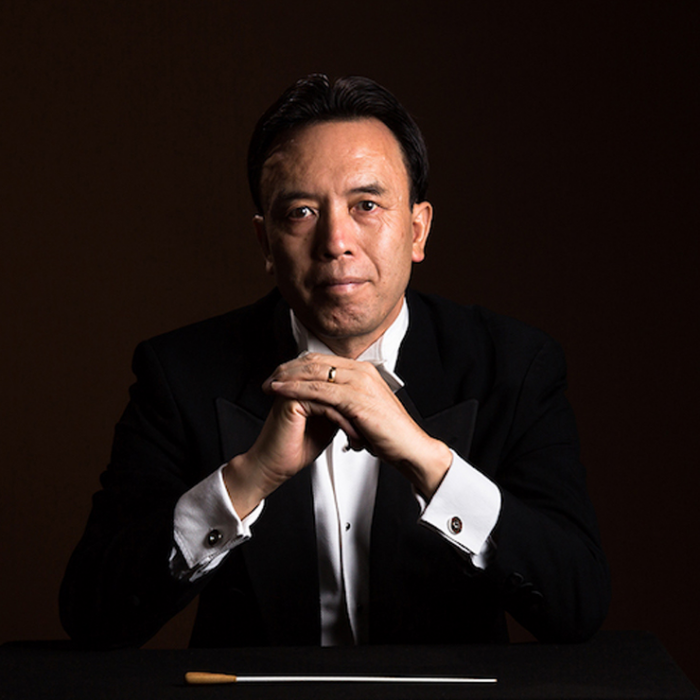
Q & A: Composer Carlos Simon on the Creation of the ‘Good News Mass’ Ahead of its Ravinia Premiere
By David SalazarComposer Carlos Simon has built a career at the intersection of the Black church and the concert hall, channeling a Pentecostal upbringing into music written for orchestras, opera companies and choruses.
That path has taken the Atlanta native from Composer in Residence at the John F. Kennedy Center for the Performing Arts to the inaugural Composer Chair of the Boston Symphony Orchestra and, beginning in the 2026-27 season, Composer in Residence at Amsterdam’s Concertgebouw. His 2022 album “Requiem for the Enslaved” earned a GRAMMY nomination and reflected a recurring interest in his work: sacred forms reworked through African American musical traditions to speak to the present moment.
His newest large scale work, “Good News Mass,” continues that exploration, bringing together orchestra, choir and collaborators from beyond the concert world in a piece Simon describes as both deeply personal and universally resonant. Ahead of performances at Ravinia with the Chicago Symphony Orchestra under Marin Alsop, the composer spoke to OperaWire about the origins of the work, the challenges of writing on this scale, and how his relationship to the piece has evolved since its premiere.
OperaWire: Tell me about the Good News Mass and what inspired its creation?
Carlos Simon: My Pentecostal upbringing and Western style conservatory training creates a dialogue between my gospel music heritage and the traditions of the Black Catholic community. Drawing from my gospel roots, I feel I join a lineage of African American composers who have reimagined the mass form, from Mary Lou Williams and Florence B. Price to contemporary artists like Kim Harris, M. Roger Holland, Robert Ray and Damien Sneed. In Good News Mass, I not only honor this legacy but push it further, blending sacred traditions with multi-genre ingenuity to craft a Mass of and for our time.
Good News Mass “explores the ups and downs of being human and finding God in the midst of it all. What does it mean to question the existence of God? Where is God during our seasons of loss? How is God experienced in times of joy and hope?” The composition is both deeply personal and universally resonant, offering listeners a liturgical journey of introspection and celebration.
OW: What is your usual creative process when approaching a new composition? Did you have to alter your approach for a work of this size?
CS: My compositional process is always the same no matter the piece or the size. I always start with improvisation at the piano after doing much research in order to fully understand the concepts I want to talk about in my work.
It then transfers to a more complicated and analytical side where I am crafting the work from technique and process.
OW: What were the challenges of creating this work?
CS: The hardest challenge for this piece was to imagine the scale of the work, and how to gauge the art as well as utilizing all the forces at play, whilst making sure that each individual voice had the appropriate and equal amount of time.
OW: How would you describe the musical language of the piece? How did you approach the vocal parts of the work?
CS: Unfolding in 16 movements across three acts, Good News Mass begins with the “Introit” and culminating in “God’s Love.” It includes reimagined liturgical staples—”The Lord’s Prayer,” “Prayer of Confession,” “Lord Have Mercy”—as well as vibrant gospel declarations like “Oh, Give Thanks unto Our Lord” and “The Greatest of These.”
The weaving together of diverse musical idioms shines through, combining gospel harmonic syntax, choral grandeur, spoken wordsmithing, and orchestral brilliance.
Moreover, a unique feature of Good News Mass is its emphasis on orature, that is, the oral literatures central to Black religiosity. Marc Bamuthi Joseph’s poetry recalls the West African griot tradition, enriching the performance’s narrative depth. This storytelling is amplified by visual art from filmmaker Melina Matsoukas,
creating a multi-sensory experience that bridges the sacred and the contemporary.
The multi-genre soloists, spoken word artist, and choir infuse the performance with the textures of traditionally versatile “Black church” worship: Hammond B3 organ, congregational singing, gospel choir antiphony, and altar call zeal.
OW: How has your relationship to the work changed since its world premiere?
CS: It has become one of the most spiritual experiences for me listening, and performing the work. I have found myself at performances, thanking God that He would trust me with this music to share with the world. It really is a blessing to have the gift of music.
OW: What excites you most about presenting this work in Ravinia and what do you hope that audiences in Ravinia will discover upon witnessing your work?
CS: Firstly, I get to perform the work on Hammond Organ with the Chicago Symphony. Secondly, I get to work with the Chicago Symphony and Marin Alsop! I’m excited to see what they bring to this work at Ravinia and for the audiences to experience it too.

Stories you may also like…
Q & A: Baritone César San Martín on the Emotional Power of Zarzuela, Returning to “La Verbena de la Paloma” & the Global Nostalgia for Our Roots
Q & A: Mezzo-Soprano Anita Rachvelishvili on Returning to Her Path, NYC, Teaching & The Importance of the Greek National Opera