Q & A: Countertenor Rafał Tomkiewicz on Playing Oreste at This Summer’s Early Music Festival in Innsbruck
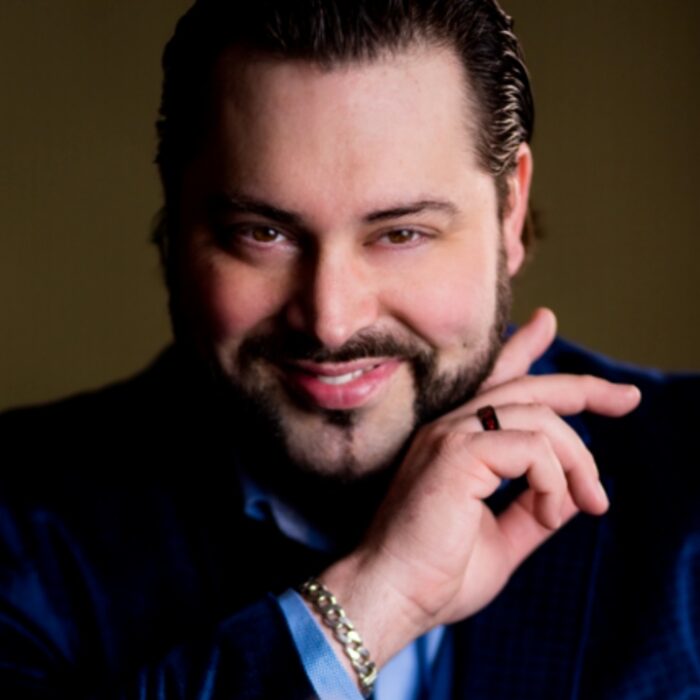
By Alan Neilson(Photo: Iga Beata Mackiewicz)
Countertenor Rafal Tomkiewicz first came to the attention of OperaWire in 2018 at the Innsbruck Early Music Festival, where he was competing in the final of the Cesti Competition. It was an event that proved to be a springboard that launched his international career.
Since that time, Tomkiewicz has seen his profile rise and now performs at venues across Europe in roles created by many of the baroque’s greatest composers, including Händel, Vivaldi and Monteverdi, among others. He also finds time to fit in some works from outside the baroque, such as Mozart, Gluck, Orff and Britten.
This month, he returns to Innsbruck, but this time onto the festival’s main stage, where he will be playing the role of Oreste in the festival’s production of Tommaso Traetta’s 1763 opera “Ifigenia in Tauride.”
Fortunately, OperaWire had the opportunity to meet up with the Polish countertenor during rehearsals for what proved to be an interesting interview.
OperaWire: What was your pathway to a career as an opera singer?
Rafał Tomkiewicz: Actually, this is a very interesting story. I attended the oldest private music school in Poland, where I played violin and piano, sang in the chorus and also attended dance lessons. This was my first contact with music, and I really enjoyed it. I had my own funk reggae band and also performed at weddings. When I finished music school, I had to think of a career, and I enrolled in an engineering course at a college in Krakow. However, while I was there, I realized that I missed music a lot; I knew that I had a good tenor voice, although I sang only pop music not opera. So, I took a few private lessons with the aim of getting into music academy and becoming an opera singer. My tutor was not so optimistic and told me that although I had a good voice, I wouldn’t make it as an opera singer and even doubted that I would get into the music academy. Fortunately, I ignored his advice and worked hard on improving my voice. After two or three years, I managed to get on a course and train as a tenor.
Throughout the program, I struggled with the very high notes. I was really fighting with my voice, and my final exams were arriving fast. Even my professor advised me to take a year off! Then, three months before the exam, he asked me to sing the high notes with a falsetto voice. It was the moment that I, and also my professor, realized that I had a very good head voice. We checked the scale up and down, and we realized that I had a wide range and also discovered that I possessed a good, strong coloratura. He told me that my voice was ready for the stage. I immediately started practicing at home. It was not difficult; it cost me nothing, and for my bachelor exam, I sang as a countertenor.
Then I decided to do a masters with Artur Stefanowicz, who had a very successful career as a countertenor.
Then in 2018, I came to Innsbruck for the Cesti competition!
OW: What role did the Cesti competition play in establishing your career?
RT: Before Cesti, I had never sung on stage in a professional capacity; I had sung a couple of concerts as a countertenor but nothing else. I had never sung in an opera, and this was my first competition, and I got to the finals, which I was very pleased with. It was beyond what I had expected.
For a young singer that wants to make a career in the baroque repertoire, Cesti is the ideal platform for making yourself known. Even though I didn’t win a prize, Jochen Breiholz from the Theater an der Wien Opera Studio invited me to sing title roles at the Wiener Kammeroper with the opportunity to sing in some of the major productions, such as Vivaldi’s “Bajazet.”
When I entered Cesti, I never imagined my career would take such a major turn!
OW: What was your first professional performance on stage?
JT: It was as Tolomeo in “Giulio Cesare” in the Grand Theater Poznan in Poland. It was a concert version.
OW: How would you describe your voice?
RT: I would describe it as a falsetto voice presented with a classical technique.
However, I would say that whether I sing tenor or countertenor, I treat the voice the same; my body works the same. The only difference is that for the countertenor I use the head voice, while for the tenor I use the chest voice. But my technique does not alter.
It is also a very versatile voice, and I believe a very natural voice, which I actually only discovered when I started singing as a countertenor. I didn’t have the same flexibility when singing opera as a tenor. I would describe myself as an alto countertenor, but if the piece requires a high G or A, then it is possible. As I said, I am very flexible.
For Oreste, the role I am preparing for at the moment, I have some very low notes to sing, which I have to sing with a mix of the head and the chest voice. I don’t find this difficult, but often I follow the low notes with leaps of up to almost two octaves, which is difficult. This is something I am working on, as I want it to be precise.
The decision of whether to use the head or chest voice also depends on a number of factors, such as the size of the orchestra; if it is small and mostly in the middle register, I would never use the chest voice. It would not be necessary. However, if it is a big orchestra with horns and the like, then when I make a downward jump, I would mix the voices. It depends on the repertoire, orchestra size and on how I feel that day, so there are always decisions to be made on how I would use the mix of voices. I have to be flexible.
OW: At the moment, you are in rehearsal for Traetta’s opera, “Ifigenia in Tauride,” at the Innsbruck Early Music Festival. Few people will have any knowledge of this work. Could you give us a quick outline of your role?
RT: Ifigenia has been taken to the island of Tauride. She executes people who become shipwrecked on the island. I play her brother, Oreste, and I have just killed my mother and am struggling with the furies, who torment me with visions of my mother. The goddess Athene offers me a solution, which requires me to steal a Palladium from Tauride and bring it to Athens. If I do this, the furies will disappear. Orestes and Ifigenia meet in Tauride, a pivotal moment that significantly influences the plot. However, the opera finishes before I return to Athens, so we do not know what happens to Oreste in this particular production.
It is a very good opera, and I really like it.
Nicola Raab, the director, has been very helpful. She is very precise and has a good insight into the psychological aspects of the characters, and works with you to uncover the deeper psychology that drives the character, which really helps you to understand their motivations.
Musically, Traetta is a little later than Händel and has more in common, for example, with Gluck. Almost all the arias are bravura in nature with big jumps and plenty of coloratura. The orchestra has a big sound.
It is dramatically and musically a very strong opera!
It also contains plenty of choruses, but as far as I know, Nicola does not want to present them on stage too often. In the main, you will only be able to hear them. It makes sense, as many of the choruses are the voices of the furies, which are supposed to be happening inside my head, so there is no need to see them.
It will be set in the modern era, so I am dressed in a modern-day outfit. It is as relevant to today as it was in classical times. Looking at my character, for example, I am suffering from a form of schizophrenia and guilt. This can be true of any age.
OW: What are the biggest challenges you face in preparing for this role?
RT: Definitely the tessitura.
The whole part has been written for the higher part of my voice. It means that I don’t have to drop down and find the right balance in my voice, apart from the few low notes I mentioned before, which I have to mix with my chest voice, but the high tessitura is a real challenge, which is made more difficult by the big orchestra. I have just finished singing Oberon in Britten’s “A Midsummer Night’s Dream,” which has a much lower tessitura, which was very comfortable for my voice.
Also, my character has many long, complex arias to sing as well as a duet with Ifigenia. It is a role that requires plenty of stamina. The opera also has lots of recitatives, and there have been no cuts.
Then there is the extra pressure of having the performances recorded for a CD. We are only doing two performances, so we have to get it right! There is a single session to make corrections, but it will be a challenge.
OW: Do you like playing Oreste?
RT: He is crazy, and I like playing these sorts of roles. I think playing psychopaths feels quite natural. I don’t know why.
OW: What performances do you have scheduled for the next few months and over the longer term?
RT: I will be singing Nireno in a revival production of “Giulio Cesare” in Frankfurt. Then, I will be singing the title role at the Landestheater in Salzburg, which is a role I have been waiting for! I am also scheduled to record a CD of my favorite arias.
In the future, I just want to sing and enjoy my career, whether that is singing minor roles or the primo uomo. I just love to sing!