Q & A: Carla Lucero on How Opera & Storytelling Meet Social Justice
By Xochitl HernándezIn a modern world burgeoning with new operas each year, some artists are ensuring their cultures be spotlighted in an industry constantly being innovated. Quinteto Latino and Opera Cultura, are two artistic pioneers with similar missions: spotlighting Latino artists while uplifting communities through diverse storytelling.
Quinteto Latino, a wind quintet engaging audiences through education and performing commissioned pieces by Latino composers approached composer Carla Lucero to write a chamber opera. Lucero’s mission to create art that makes music meet social justice is evident in her compositions and operas like Las Tres Mujeres de Jerusalén, and Juana, just to name a few.
OperaWire sat down with the composer to discuss her sixth opera, one gaining traction internationally after its Mexican tour and nationally with it’s most recent performance at Movimiento de Arte y Cultura Latino Americana (MACLA) produced by Opera Cultura in conjunction with Quinteto Latino.
OperaWire: How did you become a composer?
Carla Lucero: I actually started as a classical pianist. I knew at a pretty young age that I really wanted to be a composer but at that time, I didn’t even know there were living composers, let alone women composers. When I got to Cal Arts as a piano major, I audited the composition courses, theory classes, all sorts of things in that first year, put together a portfolio and got into the second year program for composition. I was really excited, but I was the only woman in my graduating class.
OW: How did you navigate being an up-and-coming female composer?
CL: It definitely took a lot of self encouragement, and then also encouragement from colleagues like Hector Armienta. I met him in college and he is the founder, and artistic director of Opera Cultura. So this is kind of like a full circle thing because Opera Cultura is presenting this production.
OW: What was your path like for getting your foot in the door?
CL: After graduating, I went right into Hollywood working in the film industry mainly. I had an internship while I was at Cal Arts at a studio called Hal Roach Studios and they owned like different television programs and all these old film archives. They also had a karaoke division called the singing machine where I started to arrange all of their karaoke tapes. That was a real lesson for me in how quickly things have to be orchestrated and arranged. But it wasn’t really satisfying my love of composition and I found it impossible to get into the film industry as a composer in the 80s. All the doors were locked. I’d get jobs in film production companies and my job was like basically to be like a little servant to the men in charge, and I thought, ‘No way. I can’t do this.’ So, I actually started an all woman rock band while I was in Hollywood. That still didn’t satisfy me so I started composing for dance companies — I worked extensively with Heidi Duckler Dance. But opera was always my first love.
OW: Why Opera?
CL: I grew up listening to it basically out of the womb. I was listening with those double albums where they were in a box with the libretto and pictures of the characters in a booklet. My mom and dad both love opera and what’s cool is my mom is from India and my dad is a Latino from New Mexico and then the two of them met in Africa. So you can imagine the music I listened to as a child was very global and we had this deep connection to opera. Even if, for example, I didn’t speak Italian, I knew by seeing Italian opera that they were portraying a story and I loved it.
OW: Did listening to opera so much during your formative years influence you to write an opera?
CL: I knew at some point I wanted to write an opera. After I got really sick of the whole Hollywood thing I decided it’s time to try. I was in my 30s, a feminist, and queer. I thought, ‘How am I going to do this in Hollywood? They won’t even let me in the door.’
OW: Where did you find that door you were looking for?
CL: In the Bay Area/San Francisco. Specifically the Bay Area Chicanx community. They were the first people I felt ever accepted all that I am. And when I moved here, I thought ‘I need community.’ And upon joining I got to meet all these incredible women who are now icons in the Chicana movement. Artists like Esther Hernandez and Viviana Paredes. People that are now really well known. I kind of feel like I grew up with them. Many of them were very maternal.
So the Bay Area is where I wrote a couple pieces for my first opera, which is WUORNOS. I got a production company interested within 3 months of moving to San Francisco which made me realize ‘okay I’m in the right place.’ But once you write your first opera it’s like running a marathon. I didn’t know how I was going to write my next one. WUORNOS already took me five years. But the good thing is the process teaches you things. You start to realize what you could do better or where you could grow. Now, I’m in the midst of writing my ninth opera that is commissioned and I still have a lot more operas in me. I didn’t even think I’d ever get to nine.
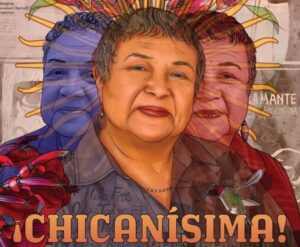
OW: So what is Chicanísima about?
CL: Chicanísima is my sixth opera. It premiered in 2024 in San Francisco at the Bravo Theater. And then it went to Mexico for about a year. I was approached by Quinteto Latino, an ensemble based here in the Bay Area. They’re amazing. They’re activists who work in promoting Chicana and Chicano
musical works. Armando Castellano, the founder, said I can choose the subject. I have a long friendship with Olga Talamante,—and speaking of finding belonging in the Chicana community —she really helped me develop a strong community base in the Bay Area. She’s so humble and I’ve learned so much about her activism. She was imprisoned and tortured during her time in Argentina. I was just horrified when she told me about what happened to her, I mean she’s remarkable. Even after all that, Olga is so active in the Chicano movement, LGBTQ movement and human rights movements in general. Even though she was tortured and imprisoned, it truly didn’t sway her to want to continue to make this world a better place. So Armando and I agreed the opera had to be about her.
OW: Is there a common thread in all your operas?
CL: All of my operas always have strong women who defy stereotypes, and often they are women of color or queer.
OW: Do you create that common thread based upon your own experiences while breaking in to this industry?
CL: 100 percent. I feel like I’ve had to prove myself 100 times over. If you think about the representation of women in opera, we’ve come a long way, but we are nowhere near where men have been historically. We as women are still very underrepresented, and then you think of women of color, it gets even smaller. And when it comes to queer women I’ve experienced companies that have a level of fear when premiering a work by a woman who is out.
OW: With everything that’s happened recently in the Chicano and Latino community: immigration/ICE, the Cesar Chavez scandal, and other latest news, how do you feel this opera can be impactful for the community?
CL: I really think it’s important to be reminded that we stand on the shoulders of giants—so many Chicanas really took the brunt of abuse while speaking up whether it was physical, or in the press, or in working conditions. We’re kind of going full circle now. It’s important that our community sees people who are courageous, who withstood very similar circumstances. I fear if people don’t know history, they think that they’re having to do everything again from scratch. But there’s so much courage we can garner from Olga. And with what happened with Cesar Chavez, so much happened in secret shadows which often occurs with perpetrators of abuse.
Dolores Huerta was not an abuser but suffered at the hands of Cesar like Olga suffered at the hands of others. But why are we lumping together the all the good these women and the movement did with the terrible things a man did? Those in United Farm Workers did so much labor and work and we shouldn’t allow conflating the bad and the good together, it erases all the hard work of those who were courageous. Because our communities are already under attack and I feel like that’s kind of the name of the game in this current political climate: to divide and conquer while already down. Instead, we need to focus on coming together and unite against a negative force and I feel like this opera shows that. We have to strengthen our communities through storytelling.
OW: How does storytelling make an impact?
CL: Storytellers like artists and journalists—God bless them. Because they bring real life issues to light. I love how you can see a production and people process information differently, it can either spark conversation, slightly change my mind, or solidify something I’m already thinking. Other people process information by reading, like reading an article, some by watching a movie, others by live theater and opera which is my favorite.
OW: Why Opera?
CL: It reaches people on a level that is completely different than reading something on the internet. The information is telegraphed through music which has such an emotional connection that is difficult to achieve any other way. It is storytelling that reaches audience on a visceral level since it is both informative but also emotional. For example, when we had the premiere at the Brava Theater in 2024, a good half of the sold out audience had never been to an opera before. They came because of the subject matter: Olga and the Chicano movement.
OW: What is one thing you hope audiences take away after seeing this opera?
CL: I hope they see Olga as an example. She was just one person who had a huge impact. Don’t ever think ‘Oh, I’m just one person, just a Joe Schmo so how can I do anything?’ You can create a ripple effect. Motivate others, attend rallies, donate to causes, donate to the arts, because even as just one single person, you are very powerful.

Stories you may also like…
Q & A: Baritone César San Martín on the Emotional Power of Zarzuela, Returning to “La Verbena de la Paloma” & the Global Nostalgia for Our Roots
Q & A: Mezzo-Soprano Anita Rachvelishvili on Returning to Her Path, NYC, Teaching & The Importance of the Greek National Opera