Princeton Festival 2026 Review: Madama Butterfly
Illness Divides the Title Role in a Production That Points at America
By Chris RuelAt the Princeton Festival’s June 12 “Madama Butterfly” staged at Morven—the former governor’s mansion in Princeton, New Jersey—the Cio-Cio-San the audience watched was not the Cio-Cio-San it heard. The headliner, Toni Marie Palmertree, sidelined by a vocal infection, acted the role onstage while Brenna Markey sang it amplified from behind the set through speakers. Ironically, the staging presented two stories at once: the one written by Puccini and an allegory of today’s America.
Presence & Absence
Markey deserves real credit for stepping into one of the most punishing roles in the soprano repertoire and on terms few singers ever face: a full role, sung blind, from behind the curtain. Her voice is a full lyric instrument rather than a lyric-spinto, and the weight told. There was a heaviness to the sound that muted the playfulness that Act one asks for; her fifteen-year-old sounded like a fully fledged Puccini heroine, transforming into the harder, broken woman of Act two less than a change than as more of the same color. She was strongest at the bottom of her register, where the tone was secure and impressive, and most exposed at the top, where the support thinned out under pressure or was pushed. All of this aside, Markey performed more than admirably in a tough, jump-in situation and deserves recognition and strong applause for her unexpected outing.
“Un bel dì vedremo” came across as a midpoint rather than a peak. The line wanted a dramatic lift, and the phrase-endings closed, notes simply stopped where they might have tapered through color and dynamics. Whether Markey could ride over the orchestra at full climax is genuinely impossible to judge with her voice routed through the sound system; the levels, not the singer, may have been the culprit when her voice disappeared, overpowered by the onstage singers and the orchestra. By the close of Act two, Markey sounded fine, a little tired but far from spent. Her timing—teaming with a lip-syncing performer onstage—was impressive.
Palmertree, for her part, gave the production a Butterfly with real presence. But the lip-sync produced an inescapably disembodied heroine, and that was impossible to ignore or forget. There is a world of difference between two singers interacting onstage—feeding off one another—and one of those singers pantomiming. The letter scene is the clearest casualty: Joel Balzun’s Sharpless carried unmistakable dread as Butterfly derailed the reading, yet the exchange did not play as a negotiation between two people in the same room. Balzun otherwise brought the full moral weight the role demands; he was, in the truest sense, the conscience of the evening.
Victor Starsky’s Pinkerton was among the best singing of the production. His voice was powerful and frankly heroic, perhaps a size too large for Puccini. The pure, brassy color demanded attention, with ringing top notes. “Addio, fiorito asil” was delivered with genuine lyric softness and unfeigned shame. His Act one charm read clearly enough that one understood, without strain, why Butterfly believes him; without projecting dastardliness in color or movement. The portrait sat between caricature and human, which is more or less where opera asks characters to inhabit.
The five-star performance of the night belonged to Kayla Nanto’s Suzuki. Her voice blended beautifully with Markey’s, but it was her work in the silences that stabbed at you. Her reactions to Butterfly in Act three ranked among the production’s most devastating wordless moments. Nanto stole the show, doing so with her stellar acting and not with vocal fireworks.
Milanov & the Princeton Symphony Orchestra
Hidden behind the set, Rossen Milanov managed the pacing well: tempos settled where they needed to, and the orchestra held the entire evening without sagging, making it one of the production’s highlights. I cannot speak to Milanov’s style, as he, along with 98 percent of the band, was not visible.
The pentatonic textures no longer read as especially “other,” they have become too familiar to do so, and were not strongly differentiated from the surrounding writing.
What did surface under Milanov’s baton were the score’s thematic ironies, with the United States national anthem threaded through Butterfly’s music, which carried a contemporary charge against America’s present conduct and standing.
The Orientalism Problem & Armbands
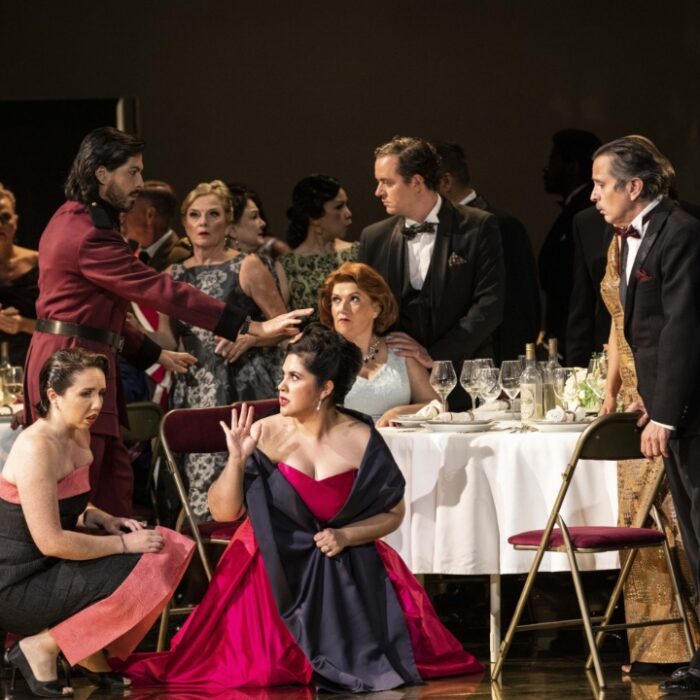
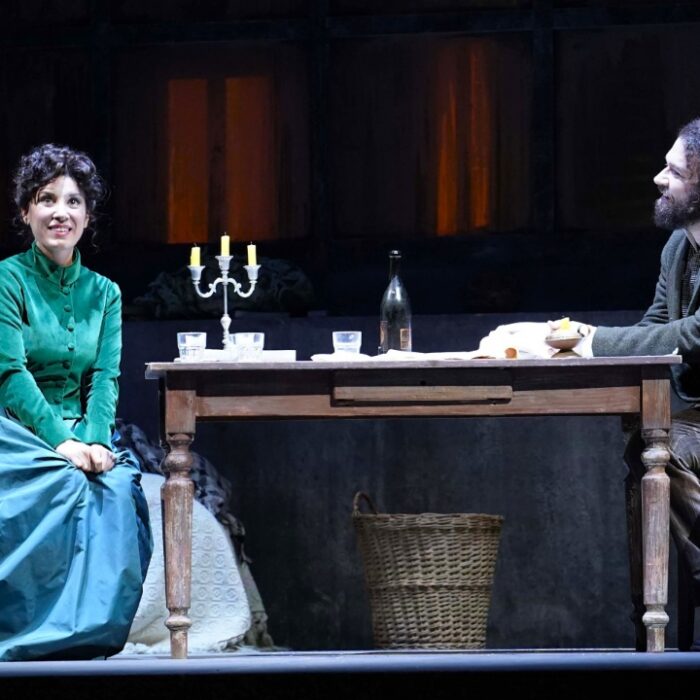
This was a “Butterfly” alert to the problem of orientalism, and it largely solved or sidestepped it: costume designer Neil Fortin lifted the opera out of easy exoticism fused with an imaginative design of traditional Japanese dress. Red, white, and blue were recurring colors, appearing on lamps and costumes. The show screamed America, rather than fetishized exoticism.
Military authority, which can dominate a stage, was also subverted. Pinkerton’s uniform, buffoonish with medals and trimmed in piping, read more like a bellhop than a naval officer (not a bad thing), and Sharpless’s uniform, while less cartoonish, didn’t project a consul but a military governor. The American-flag armbands on both men left little doubt about where the production stood in the current political climate.
What gives the armband its heft is the recognition that “Butterfly” was a parable of power (gunboat diplomacy) that hits differently today, perhaps with more force. Pinkerton, a representative of military might, arrives and takes what the power structure allows. He then wrecks it and sails away, leaving Sharpless and Suzuki in the rubble. The contemporary, global state of affairs is easy to read in director Eve Summer’s interpretation.
The Big Stick in the Room
When Theodore Roosevelt sent the Great White Fleet around the world in 1907–08, sixteen battleships in peacetime white, calling at Yokohama (1908) among its ports, the gesture was at once a display of overwhelming force and an act of diplomacy: speak softly and carry a big stick, letting the visit do both kinds of work at once.
The current United States has kept the big stick, speaks far too loudly and obnoxiously, and has abandoned any form of diplomacy. What is left is a rogue nation entitled to destroy what it likes and to leave the wreckage to create more elsewhere.
The American flag on Sharpless’s and Pinkerton’s arms is not a decoration. Armbands are rarely a democratic fashion statement and are most often the mark of raw power, whether it has rightful authority, such as identifying military police with MP in white on a black field, or a nationalist or political party symbol emblazoned upon it.
The handling of the child, played by seven-year-old Troy C. Jones, was the production’s final twist of the knife. Far from a prop, he portrayed a real, frightened boy, screaming and crying for his mother as Pinkerton’s wife carried him away—an innocent destroyed by adult frailty and a sad echo of how immigrant children are treated in today’s America.
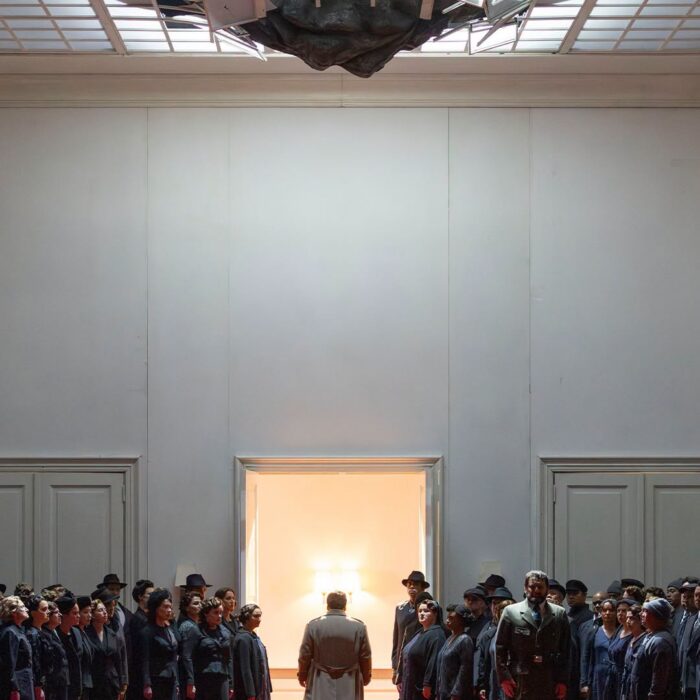
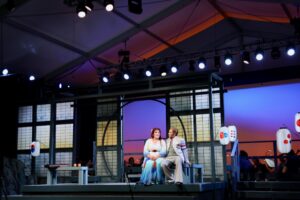
Blair Mielnik’s set comprised a plain Japanese house with sliding doors, with the wings and aisles pressed into service as entrances and for key interior moments, serving the drama without competing for attention, even though movement through the aisles broke the fourth wall.
Final Thoughts
What this production got right is precisely what most stagings get wrong: it sidestepped the opera’s built-in orientalism and, where it could not maneuver around it, neutralized it through design.
Its central flaw was structural. With no onstage cover, the audience never stopped knowing that someone stood behind the curtain singing while Palmertree pantomimed; the disembodiment turned a company into a collection of individuals reacting to a voice rather than to one another. Yet that, finally, is not what will last. Months from now, the memory will not be the singing or the staging, which lands in the middle of the scale. As a piece of pointed commentary, it aims considerably higher and hits.