Pinchgut Opera 2025 Review: Maid Made Boss
By Gordon Williams(Photo credit: Alison Johnston)
Eugene Lynch’s production of “Maid Made Boss,” Pinchgut Opera’s latest presentation, revealed so convincingly what conductor Erin Helyard had spoken-of in a podcast on the company’s website: just how pivotal “La serva padrona” (to use the 1733 work’s original title) must have been in the history of opera, particularly when seen in France (home of the tragédie-lyrique) some 16 years after composer Pergolesi’s death.
Here was proof that a neat yet punchy story lasting, in Pinchgut’s hands, just 70 minutes could be as entertaining as a three-hour Lullian spectacle adorned with all manner of ornament, rigmarole, plot complexities and formality. Understandably a breath of fresh air, no wonder “Padrona” had potential back in 1752 to threaten France’s national style.
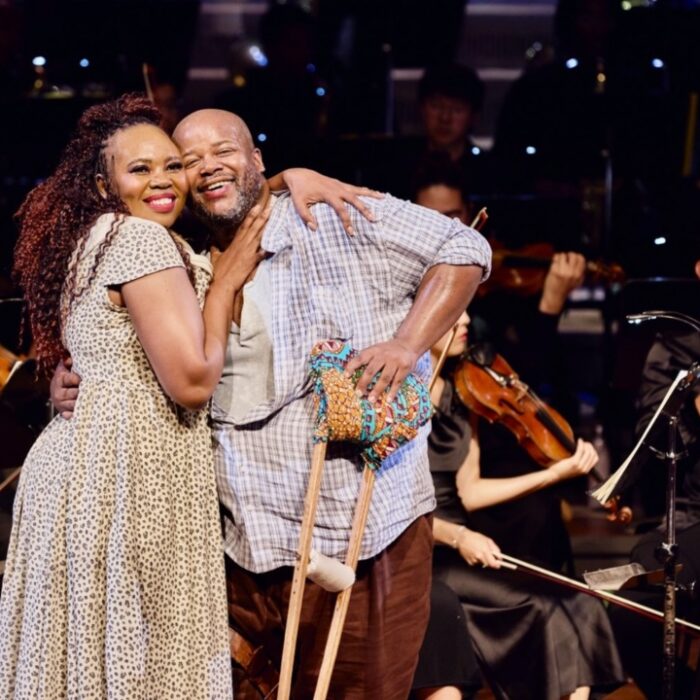
But I couldn’t help thinking that this work and this production could serve as a worthwhile study for any present-day student of theatrical effectiveness. “Padrona” may seem like a slim plot but it has telling changes of direction, effectively-sketched characterization, music that amplifies the developments without weighing them down, and a charming momentum – how to say so much so swiftly and economically about social status and personal affection in a one-act play (essentially). Servant Serpina (performed here with feisty energy by soprano Celeste Lazarenko) plays on her master Uberto’s unacknowledged affection to effect her rise to mistress of the house. Watching the small ensemble of Serpina (Lazarenko), Uberto (baritone Morgan Pearse), and Vespone (actor Gareth Davies), with their efficiently sketched characterizations was more than sufficient to hold an audience’s attention during the performance’s hour and a quarter.
Pinchgut promoted “Padrona” with an English title, “Maid Made Boss” which pithily sums up the plot, but it was sung in librettist Federico’s original Italian. Morgan Pearse’s vocal characterization conveyed a repertoire from resentful exasperation in his opening number, ‘Aspettare e non venire,’ ‘Waiting and no-one comes’, in Natalie Shea’s very clear surtitles, to speech-like detail in ‘E qua e là, e su e giù, e sì e no’ / ‘Everything is always contrary with you. When it’s here, instead it’s there; when up, it’s down; when yes, it’s no’) to the suave lilt of his duet with Lazarenko in their final duet (‘Contento tu sarai’/’Will you be happy? Will you love me?,’ when Uberto admits that he has loved his servant all along. But one could also have sworn that Pearse had read that book I saw many years ago in a bookshop in Leichhardt, Sydney’s Italian-restaurant belt: “How to Speak Italian Without Knowing a Word of the Language,” a satirical compendium of the unique Italian gestural language, so amusing was Pearse’s physical embodiment of the role.
Celeste Lazarenko presented a worthy sparring partner. You could say that “Padrona” is a pre-classical opera shorn decisively of ‘baroquery,’ but Lazarenko’s occasional moments of vocal ornamentation impressed even in their rarity, the slight coloring on the return of her number, ‘A Serpina penserete’ for example. And when Lazarenko and Pearse sang together, mostly in the recitative exchanges, their enjoyment of their respective roles was palpable.
Someone may look at the cast-list of “Padrona” and wonder what reward there might be in playing the part of Vespone. Amusingly, he’s a servant of even lower status than Serpina and a tool to be used by her in her plot to fan Uberto’s jealousy. But mute!
Yes, the silent character provides good opportunity for some third person humor – Uberto to Vespone: ‘She’s right. You don’t know what to say?.’ But Gareth Davies contributed amusing bits of busyness justifying the theatrical effectiveness of an operatic silent part, cheekily sneaking a bow, for example, during the overture when he is sweeping the stage before the other characters have made their entrance.
Pinchgut presented their previous production, Purcell’s “Fairy Queen,” in an actual theater, the Roslyn Packer in Walsh Bay in May. They returned to their regular venue at the City Recital Centre at Sydney’s Angel Place for this shorter offering. But set designer Lochie Odgers and lighting designer Morgan Moroney invented a wonderful theatrical space, complete with period-sympathetic footlights in this concert hall.
The Orchestra of the Antipodes consisting of five violins, single viola, cello, and bass, and theorbos, mandolin, guitars, and continuo, stood behind the raised platform of the set. This allowed the highlighting of the actorly side of this work, but still violinist Matthew Greco’s leadership, conveyed through fluid movement which complemented Helyard’s musical direction, contributed to the visual effect.
In his edition of the work, Helyard added two pieces of extra music. One of those, from “Adriano in Siria,” giving the audience the opportunity to enjoy some more Pergolesi; the other a concerto by Everisto Felice dall’Abaco, both works dating from around the time of “Padrona’s” first performance in the early 1730s. Perhaps the dall’Abaco was a bit long in proportion to the rest of the show (though, admittedly, the show was still only 70 minutes long!). But both interpolations served to remind us that even in the most light-hearted context, a Pinchgut production is the product of Helyard’s scholarship and love of Early Music.