Opernhaus Zürich 2025-26 Review: La Forza Del Destino
Anna Netrebko Triumphs in Valentina Carrasco’s New Production
By Laura Servidei(Credit: Monika Rittershaus)
“La Forza del Destino” has always been considered a transitional work in Giuseppe Verdi’s output, bridging the purely romantic operas of his early period and the mature works where his musical language became more dramatic, direct, and personal. It was composed on a commission from the Imperial Theatre in St. Petersburg, where it premiered in 1862.
The plot, based on a Spanish drama, is set around the 1740s during the War of the Austrian Succession. It centers on the ill-fated love between Leonora, daughter of the Marquis of Calatrava, and Don Alvaro, the son of a Spanish nobleman and “the last Inca princess” of Peru. The Marquis opposes their union, considering Alvaro unworthy of his daughter, which prompts the couple to elope. On the night of their escape, the Marquis discovers them. During the ensuing confrontation,
Alvaro’s pistol accidentally discharges, mortally wounding Leonora’s father. The two lovers flee but are separated during their escape. Leonora’s brother, Carlo, pursues them, convinced that both are responsible for his father’s death and the dishonor brought upon their family. The three characters are repeatedly brought together and torn apart by the whirlwind of fate and war. Leonora seeks refuge in a monastery, where she lives as a hermit in a nearby cave, secretly
supported by the Father Superior as she seeks redemption. Alvaro, meanwhile, lives as a monk in the same monastery, and the two remain unaware of each other for years.
War as the Sole Protagonist
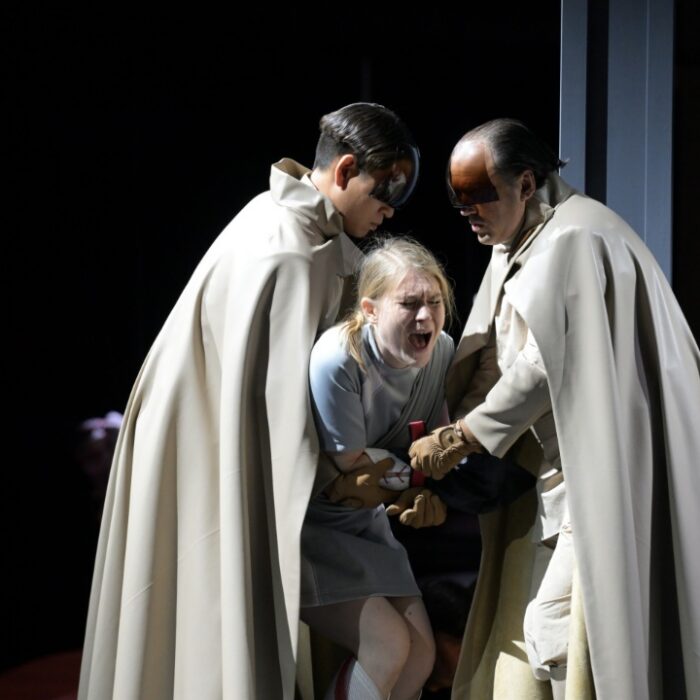
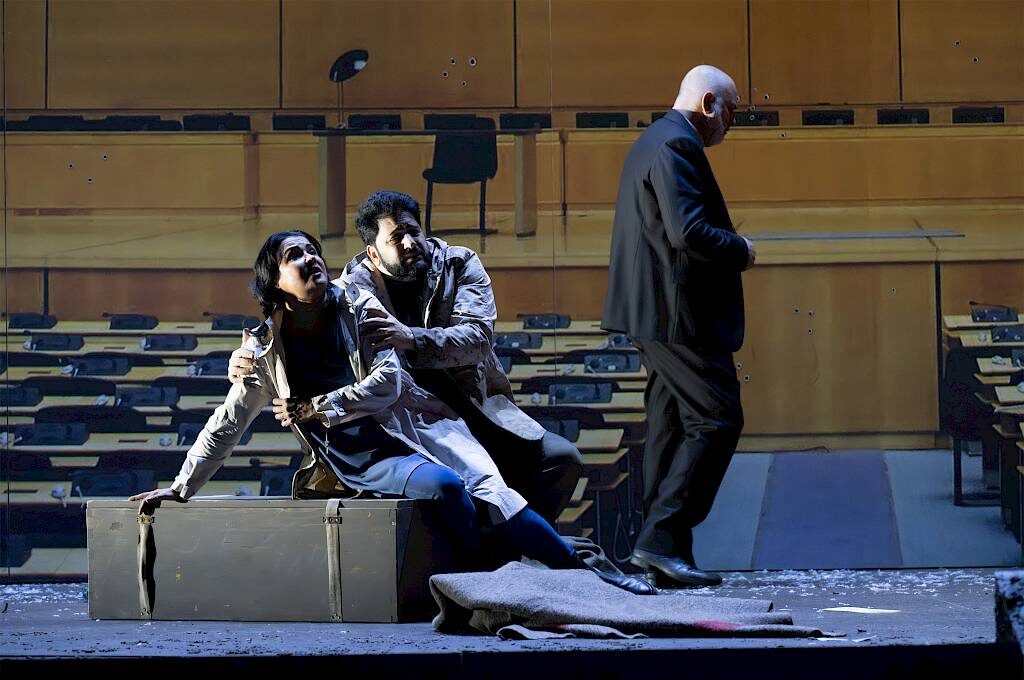
War is omnipresent in this opera, serving as a backdrop to the protagonists’ personal dramas. Director Valentina Carrasco, formerly of La Fura dels Baus, makes this her production’s sole and central theme. She updates the action to the present day, envisioning a Switzerland invaded by an unnamed army from the East. The country is devastated, and the sets, designed by Mariangela Mazzeo, depict iconic Swiss buildings destroyed by bombs—including the Zurich Insurance headquarters, the United Nations palace in Geneva, and the Davos Congress Centre. These sets were realized as gigantic, high-resolution images glued to wooden frames that were then physically damaged.
The Director’s Personal War Against the Libretto
While Carrasco’s idea of bringing the reality of war closer to the audience was not without merit, it was insufficiently developed to cohere with the libretto. A primary inconsistency arises with the characters’ allegiances. In the original, Don Alvaro and the Calatrava family fight on the same side for Spain against Austria. In Carrasco’s interpretation, however, Alvaro is part of the invading Eastern army, while Carlo is a Swiss/European defender. This introduces an unnecessary layer of conflict to an already fraught drama.
This change creates a further problem in Act three, where the libretto requires Alvaro and Carlo to fight side-by-side as friends, both under assumed names. To accommodate this, Carrasco’s staging has Alvaro murder a wounded enemy soldier to steal his dog tags and uniform, then inexplicably join the European forces he was just fighting against.
In the original work, Don Alvaro’s heritage as the son of an Inca princess is the basis for discrimination, rendering him unworthy of Leonora’s hand in the eyes of her father. He is repeatedly insulted with terms like “mestizo” and “mulatto,” and his blood is described as “tainted”. This racist motivation, which establishes Alvaro as an outsider in 18th-century Spain, is entirely absent from Carrasco’s production. The supertitles were even modified to avoid any such suggestion—a particularly notable choice given her stated claim in the program that “we don’t change the libretto text.”
The Score Prevails: Noseda in Command
The primary shortcoming of this directorial concept was its narrow focus on war, which overshadowed the other emotional layers of the story. As a result, the burden of conveying the protagonists’ tragic fate fell almost entirely to the music alone.
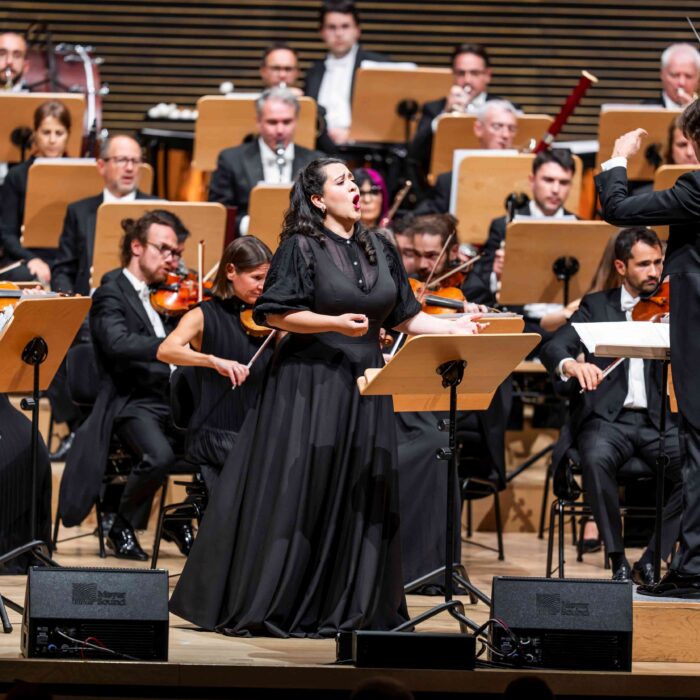
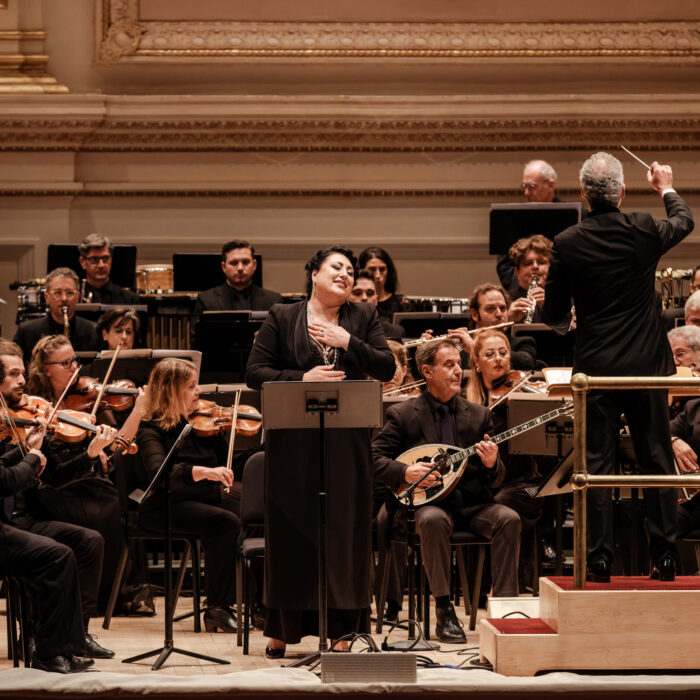
On opening night, Gianandrea Noseda rose to this challenge admirably from the podium. Leading the Zurich Opera Orchestra, he delivered a powerful and energetic reading of the score. His profound understanding of Verdi’s musical language was evident as he highlighted nuances in the orchestration with both class and expertise.
The Triumph of Anna Netrebko
Anna Netrebko returned to her signature role as Leonora, delivering a magnificent performance. Her voice seemed fresher and more brilliant than ever, full of youth and vitality. She demonstrated superb control, employing expert dynamics that spun a single vocal thread and enriched it with splendid messe di voce. Her top register was in excellent condition, with high notes that rang out, full of love or desperation. While her breathing technique may have seemed less solid than at her peak, it showed greater control than in recent years. The Act two scene at the monastery, where she becomes a hermit, was intensely powerful; both her prayer, “Madre, pietosa vergine,” and her duet with Michele Pertusi’s Padre Guardiano were deeply moving.
Unfortunately, director Carrasco’s choice to portray the monks as soldiers was echoed musically by conductor Gianandrea Noseda, the orchestra, and the chorus, resulting in a martial and uninspired rendition of their interventions. This decision stripped the opera of its religious and mystical dimension, significantly undermining the impact of “La vergine degli angeli,” one of the most intimate and mystical choruses Verdi ever composed.
The Men of Destiny
The role of Alvaro was sung by Yusif Eyvazov, whose generous tenor voice is well-suited to the spinto demands of the part, though it lacks the lyricism required for passages such as “O tu che in seno agli angeli.” His timbre, never blessed with innate beauty, has not improved with age; his most effective notes remain in the upper register. There, he was able to demonstrate his power, filling the theatre with beautiful, luminous high notes that stirred excitement and enthusiasm in the audience.
Leonora’s brother, Carlo, was performed by George Petean, whose velvety baritone possesses a fine Verdian quality. His high notes were secure and brilliant, and his legato was smooth. He proved thoroughly convincing as the relentless, vengeful brother, single-mindedly determined to end the lives of his sister and her lover.
A Strong Ensemble from Stroppa to Vorobyov
Annalisa Stroppa performed the role of Preziosilla, a kind of “army groupie” who follows the soldiers to encourage them in battle. Her character embodies the madness that accompanies war, suggesting that only folly can make its horrors tolerable. Stroppa’s powerful mezzo handled the high notes with ease, and her energetic, exciting interpretation made her “Rataplan” truly spectacular.
Michele Pertusi was an authoritative Padre Guardiano, his beautiful, smooth bass voice conveying the deep faith of the monastery’s leader. As Fra Melitone, the cynical and almost comical monk who constantly complains about everyone, Roberto Frontali delivered an engaging performance, though he resorted to speaking a bit too often, likely for comic effect. Nevertheless, his baritone remained precise and pleasant. Even in the brief role of the Marquis of Calatrava, Stanislav Vorobyov made a strong impression with his deep, resonant, and elegant bass.