Opernhaus Zürich 2025-26 Review: Giulio Cesare in Egitto
By Laura Servidei(Credit: Monika Ritterhaus)
To encounter Handel’s “Giulio Cesare in Egitto” is to step into a world where the grand sweep of history is refracted through the glittering prism of Baroque opera seria. The great Giulio Cesare (Julius Caesar) is acclaimed upon his arrival in Egypt and receives an unexpected and troubling gift from Achilla, Tolomeo’s (Ptolemy’s) advisor: the severed head of his defeated enemy Pompeo (Pompey), whom Cesare would never have subjected to such indignity. Yet Pompeo’s death serves the Roman emperor, and even more so the Egyptian royal siblings Cleopatra and Tolomeo, each of whom now sees a chance to secure sole power under Cesare’s protection. Pompeo’s widow Cornelia, however, swears revenge together with her son Sesto. A condensed version of the Alexandrian War follows, in which Cesare and Cleopatra prevail after various setbacks.
Composed for the Royal Academy of Music in 1724, this masterpiece transcends its ancient source material, transforming the political machinations of Ptolemaic Egypt into a deeply human drama of power, grief, and seduction. Although the plot revolves around Caesar and Cleopatra, its true heartbeat lies in the da capo arias, where passion is examined and emotion is shaped with architectural precision.
A Baroque Drama on a Cruise Ship
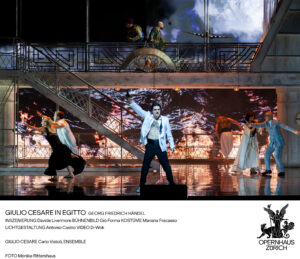
Director Davide Livermore distilled the convoluted plot into a clear, manageable story set at the beginning of the 20th century, in a world reminiscent of Death on the Nile, Agatha Christie’s famous crime tale. This gave Marina Fracasso the chance to design beautiful, elegant costumes in the style of the 1920s and 30s, with the ladies sporting gorgeous Lilian Heels two-tone shoes. The whole story unfolds on a luxurious cruise ship named “Tolomeo,” where Cesare arrives after defeating Pompeo on something like a state visit, singing his opening aria “Presti ormai l’egizia terra” as if at a press conference — its repetitive text cleverly explained by his dropping his speech notes and awkwardly improvising. The production’s tone is light and tongue-in-cheek, full of witty gags that Livermore handles deftly without tipping into vulgarity.
Livermore’s team, as usual, includes video projections by DWok, seamlessly integrated into Giò Forma’s sets and depicting sea and sky, the waves calming or raging in step with the music. In “Giulio Cesare,” Handel’s arias are less about psychological development and more about distinct “affects.” In this spirit, Livermore’s choice to stage many arias in the ship’s nightclub, with characters performing for a dancing crowd, seems unexpectedly apt.
Gianluca Capuano’s Electrifying Handel
Conductor Gianluca Capuano’s approach to Handel was, as ever, fresh, original, and utterly enthralling. His deep respect for the score did not translate into stiff formality or pedantic care; instead, his Baroque sound was warm, dynamic, and driven by an instinctive, visceral sense of rhythm. He led the orchestra La Scintilla in an exciting performance that felt almost spontaneous and explosive, though the orchestra’s delightful imitation of the singers’ da capo variations revealed the meticulous work behind that apparent freedom.
Carlo Vistoli – A Brilliant Emperor
Carlo Vistoli, one of the most sought-after countertenors of his generation, offered a flawless interpretation of the title role. His coloratura was sharp and precise, as he proved in a fantastic “Al lampo dell’armi” in Act Three, taken by Capuano at breakneck speed and followed by Vistoli without hesitation. His countertenor is strong, virile, rich in overtones, and capable of luminous high notes. He embraced Livermore’s vision with gusto, portraying a clever, manipulative politician always a step ahead of his foes. He was equally convincing in Cesare’s most emotional aria, “Aure, deh per pietà,” sung during a moment of misfortune in the war against Tolomeo. His messa di voce was exquisite.
Cesare’s most celebrated aria, “Va’ tacito,” is sung during his first diplomatic meeting with Tolomeo. This aria famously requires a solo horn (corno obbligato), a radical and innovative choice by Handel at a time when the horn was still associated with hunting rather than opera. Juan Bautista Bernat Sanchis, La Scintilla’s first horn, delivered a splendid performance on the notoriously treacherous Baroque instrument. His duet with Vistoli in the cadenza was charming.
Cecilia Bartoli’s Dazzling Cleopatra
Cecilia Bartoli, diva extraordinaire, lent her legendary mezzosoprano to the soprano role of Cleopatra. Her superb technique underpinned a splendid performance, showing complete command of Baroque style and a deep understanding of how to use its conventions to express an impressive range of affects. Her stage presence is unmatched — fearless and free of self indulgence. We saw her hilariously mock her brother Tolomeo in her first aria “Non disperar, chissà,” seduce Cesare in “V’adoro, pupille” as a café-chantant performer fanned by attendants, go to war dressed as a winged Victory, and mourn her fate when her brother defeats her army and takes her prisoner. She was perhaps at her finest in “Piangerò la sorte mia,” where her heart melting pianissimi became a single thread of pure, sweet sound. The resilience of her voice in the face of time is astonishing. She also wore a series of spectacularly camp costumes.
Tolomeo’s Seductive Malice
Tolomeo was sung by Max Emanuel Cenčić, whose countertenor seemed in excellent shape, its timbre as smooth and rich as ever — one of the most beautiful voices of the evening. His legato was ravishing in “Belle dee di questo core.” He appeared to relish bringing the villainous Tolomeo to life. When taunting a subjugated Cleopatra in “Domerò la tua fierezza” he used his precise, fast coloratura as a weapon against her. His performance was thoroughly captivating.
Cornelia’s Dignity, Sesto’s Fury
Anne Sofie von Otter, long admired as a Handelian artist, brought her experience and artistry to the role of Cornelia, Pompeo’s bereaved widow. Though her voice now shows signs of age, with some frailty in the middle register, her phrasing and dynamics were beautiful and deeply considered. Hearing a legend performing with such intensity and musical intelligence was a privilege. Sesto, Pompeo’s son, was sung by Kangmin Justin Kim, whose countertenor sounded edgy and tight at the top. His coloratura, however, was explosive and nearly flawless. His portrayal of the young man burning for revenge was impressive.
A Triumphant Voyage
Renato Dolcini, a specialist in early music, was luxury casting as Achilla, Tolomeo’s advisor. His phrasing and legato lent unexpected nobility to the rough, villainous character, making him almost sympathetic.
The cast was completed by Karima El Demerdasch and Evan Gray as Nireno and Curio, who handled their small roles admirably. The evening was an enormous success.