Metropolitan Opera 2025-26 Review: La Bohème (Spring 2026)
With “Bohème,” There’s No Such Thing As Timid Melodrama
By Chris Ruel(Photo Credit: Marty Sohl / Met Opera)
I’ve seen “La Bohème” many times, which means I usually know within a few minutes how it’s going to go. Puccini doesn’t ask for permission to rip your heart out; an unrelenting sense of tragedy is the hallmark of his work. At some point, the opera either grabs you, or it doesn’t, and when it doesn’t, you sit there thinking, okay… why isn’t this hitting me? Put another way: why am I not crying?
The Feeling That Didn’t Spread
That’s where I was during the Metropolitan Opera’s April 11, 2026, matinee, the second run of the production in the 2025–26 season. Angel Blue sang Mimì, with Adam Smith as Rodolfo. Amina Edris made her Met debut as Musetta, joined by Davide Luciano, Alexandros Stavrakakis, and Edward Parks. Roberto Kalb also made his Met debut on the podium. On paper, it all looked fine. Sitting there, though, I kept waiting for when “Bohème” usually turns the corner and starts to hurt.
It never really did. Nothing was falling apart. The singing was solid; the orchestra sounded good, and some moments were genuinely beautiful. But the sadness stayed contained, as if everyone involved were being careful with it. “Bohème” doesn’t reward that kind of caution, and by the end of the afternoon, I realized that was the problem I couldn’t shake.
The thing about “Bohème” is that it doesn’t give anyone a big moment to grab onto. There’s no scene where someone finally says the right thing, no argument that changes the course of events, no clear point where you can say, ah, this is where it all went wrong. Most of the time, people are just drifting along. They fall in love because it feels nice and pull away when it gets uncomfortable.
Mimì, especially, doesn’t push herself forward. She doesn’t demand attention or insist on being understood. She’s quiet, a little vague, easy to overlook. She appears, fades into the background, and by the time everyone realizes how much she mattered, she’s already slipping away. Nothing dramatic happens; it just runs out of time.
Since the story itself isn’t doing much of the emotional heavy lifting, the feeling has to come from somewhere else. If the performers don’t lean into it—if they stay careful, controlled—there’s nothing in the plot that forces the tragedy to land. The opera still makes sense, but it doesn’t hurt the way it’s supposed to.
In “Bohème,” the people onstage and the people in the audience are responding to the same tragedy at the same time. When it works, the sadness doesn’t stay contained within the story. It moves outward. You feel it because the characters feel it. That’s the mechanism. Tragedy in “Bohème” is contagious. It flows from the stage into the house, as long as the spigot is turned on.
In this performance, it wasn’t—not fully, at least.
The Production
Opening nights can feel a bit like dress rehearsals, and a Saturday matinee opening even more so. The pressure just isn’t the same as it is later in the week, when the house is full of opera buffs rather than families or dates.
This wasn’t about inexperience. These are familiar roles, and everything was in place. What was missing was risk. Timid is probably the right word.
Maestro Roberto Kalb brought a different energy. Making his Met debut, he was steady, clearly engaged, and visibly enjoying himself. The Met Orchestra responded well and sounded excellent.
The issue was alignment. Kalb’s energy in the pit didn’t always match what was happening onstage. At times, it was hard to tell where the imbalance lay — whether the orchestra was too aggressive or the singers were holding back. Either way, the result was the same. In the ensemble passages, especially, one could see mouths moving without always hearing the sound carry.
The quieter moments came off better. When things thinned out, the voices reached the house. But “Bohème” doesn’t live only in those moments. It needs the bigger ones to land, too, and that’s where this performance struggled.
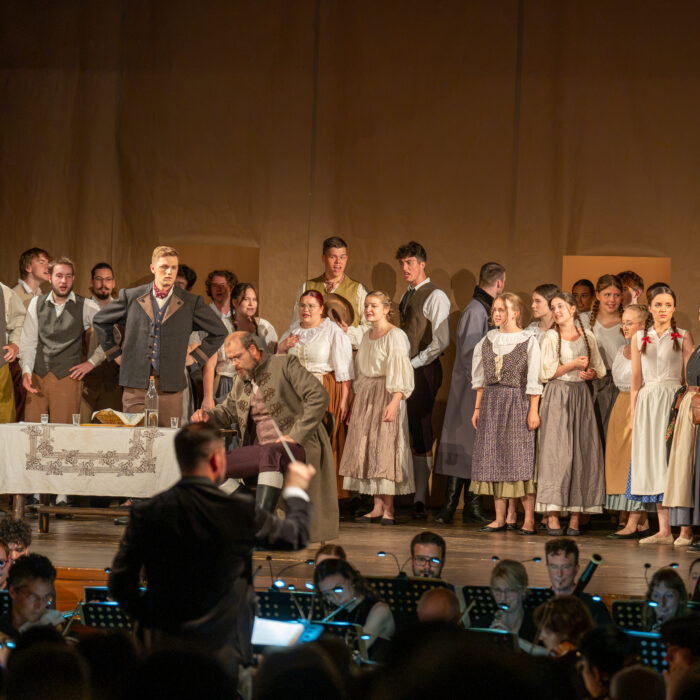
It’s also worth talking about the production because Zeffirelli’s “Bohème” isn’t subtle about what it is. This is “Bohème” as grand opera: enormous sets, crowds everywhere, animals onstage, a horse-drawn carriage rolling through Momus, winter laid on thick, and finally back to the tiny garret. You don’t have to imagine anything. It’s all right there.
When the performances are fully alive, that scale does a lot of the work. The noise and color of the outside world are juxtaposed against the smallness of the garret. As Mimì fades away, life outside the small room carries on; we’ve witnessed it in Act two. When the emotion matches the size of what’s onstage, the show delivers on its promise.
Here, the production was doing exactly what it always does — bustling, crowded, unapologetically literal — but the people at the center of it often felt swallowed by it. In the Momus scene, especially, my attention kept drifting away from the principals and into the slapstick. That’s fine when the story is burning hot enough to cut through all that activity.
Zeffirelli’s “Bohème” doesn’t generate feeling on its own. It assumes the singers will bring it. The sets, the crowds, the animals — all of that amplifies whatever emotional current is already there. On this afternoon, the world was fully built, but the tragedy never quite filled it.
Mimì
Angel Blue’s Mimì was defined almost entirely by fragility. The portrayal leaned hard into her as a waif — small, diminished, and passive — to the point where the character began to feel infantilized. There wasn’t much sense of Mimì as someone making choices, even quiet ones. She came across more as someone to be cared for than as a fully present person.
That approach took the tension out of the role. Mimì doesn’t need to be assertive, but she does need to feel present. She often felt reduced to an idea of innocence rather than a person Rodolfo could misunderstand or fail. Their scenes lacked spark, and without that, much of the emotional weight drained away.
There were also moments where the voice didn’t carry. Some of that went back to balance — Kalb was energetic in the pit, and the orchestra followed. Lines disappeared. When words or phrases get lost, the character thins out even more.
Rodolfo
Adam Smith sang Rodolfo with a strong, lyrical voice. There were instances when Smith pushed hard into the emotion, and the sound opened up nicely. But these were countered with high notes that felt held back. A few moments where Rodolfo usually lets go were approached more cautiously than expected, which softened the impact of those passages.
Onstage, Smith had presence, but his Rodolfo came across as more brooding than buoyant. Even in the garret scenes, where the energy is supposed to feel loose and chaotic, he often seemed a step apart from his friends.
That sense of tentativeness wasn’t just his. It showed up most clearly in his scenes with Blue, but it was part of a broader issue across the cast. The chemistry never quite settled. Duets and ensembles worked musically, but the sense of give and take was still developing.
Musetta
Amina Edris’s Musetta was the most clearly drawn character onstage, even if she never quite felt fully inhabited. From the start, she nailed the flirty edge of the role — the voice, the timing, the knowing tone. In the lighter moments, she was engaging to watch.
Where things got tricky was the turn the character is asked to make. Musetta begins as a flighty, attention seeking figure and then, almost abruptly, is meant to become the emotional conscience of the opera. Those feel like two different people, and that disconnect isn’t Edris’s fault. It’s baked into the piece.
That shift didn’t land. The emotional moments in the final act were never fully realized. When Musetta offers to sell her earrings to pay for medicine or a doctor. She suggests buying Mimì a muff — a line that usually cracks the dam — it passed by as another gesture rather than the beginning of tears.
The Friends
The Bohemians themselves were entertaining, and the casting among Marcello, Colline, and Schaunard worked well. They felt comfortable together onstage, which helped ground the opera whenever things threatened to feel too careful elsewhere.
Colline’s aria about his coat is often one of those moments that risks feeling silly — after all, he’s singing about a coat. This time, it turned out to be one of the surprising highlights of the afternoon. Alexandros Stavrakakis made it genuinely touching. The premise is still absurd, but he leaned into its sadness rather than its novelty, and it paid off.
Final Thoughts
What stayed with me most was the sense that none of this is set in stone. These are things that can shift as the run continues — connections can deepen, confidence can grow, and the emotional temperature can rise. “Bohème” shines when caution falls away and the sentimentality and melodrama come forward as the emotional engine. I hope that happens.
This matinee marked the 1,420th performance of “La Bohème” at the Met, a reminder of how deeply familiar the piece is to the house. Familiarity can dull things, but when the tap is fully open, the opera can still devastate. This afternoon stopped short of that — but the potential is clearly there.