Opera Forward Festival 2026 Review: The Knife Of Dawn
Kendall & McWatt’s Portrait of Pain and Hope
By Alan Neilson(Photo: Bart Grietens)
Martin Carter was born in 1927 in the British South American colony of Guyana. As a young man, he became involved in left-wing political activism and in 1950 helped set up the People’s Progressive Party, which in 1953 was voted into government. It was not long, however, before it came into conflict with colonial interests, causing the British to declare a State of Emergency. Carter, along with other activists, was arrested and jailed, where he went on hunger strike to protest against the abuses he suffered at the hands of the British authorities and in support of the Mau Mau rebellion in Kenya. Following his release, he had a book of poetry published called “Poems of Resistance from British Guiana” before being again imprisoned for taking part in a demonstration. In 1966, Guyana gained its independence, and Carter was to serve in its government until 1970, at which point he decided to leave politics and live his “life as a poet, remaining with the people.” He died in 1997.
In 2016, the composer Hannah Kendall and librettist Tessa McWatt premiered their short one-act chamber opera, “The Knife of Dawn,” at the Sackler Space in London, a work that focuses on a single day during Carter’s hunger strike while he was incarcerated by the British.
Unlike the vast majority of contemporary operas, it is a work that has proved itself to be very resilient, having been taken up by the Royal Opera, Covent Garden, for performances in 2020 and now by the Dutch National Opera as part of its Opera Forward Festival. It is not clear, however, why it was included as part of the festival. It is not a new work, and there is nothing about it that pushes at the boundaries of the art form, although it did dovetail neatly with the Opera Europa conference that was being hosted by the Dutch National Opera during the festival and, which, as part of its discussions, considered the difficulties faced by composers of new operas realizing second and third productions.
McWatt’s Strong Libretto Matched with Kendall’s Intense Score
McWatt fashioned her libretto using Carter’s letters, four of his poems and her own words into what was a sharply focused, intense piece that brought out the layers of his suffering. The hunger pains, the isolation, the imagined fears, desperation and delusions were all brought to the fore without relying on a sentimental sugarcoating to ease the audience through the experience. It was, however, far from one-paced. McWatt gave Carter space for reflection. We learn about his admiration for Quamina, a church pastor cum freedom fighter from the turn of the nineteenth century, about his love for his family and the Guyanese people and his determination to continue the hunger strike. And then there were his lines of poetry sprinkled throughout his monologue that captured the imagination.
Out of my time I carve a monument
Out of a jagged block of convict years I carve it.
The sharp knife of dawn glitters in my hand
Kendall’s score, written for violin, viola, harp and cello, was neatly matched to the dramatic tensions of the text, magnifying Carter’s pain and capturing his hopes and fears, while successfully creating an intense, oppressive atmosphere that pervaded the performance. Its mix of angry, jagged and gloomy melodies weighed heavily, creating a disconcerting effect, lightened only slightly by Carter’s underlying sense of hope.
The musical director, Robert Kahn, elicited a vibrant and dramatically urgent rendition from the Ragazze Quartet, which was situated at the side of the performance area, dressed in 1950s costumes and hairstyles.
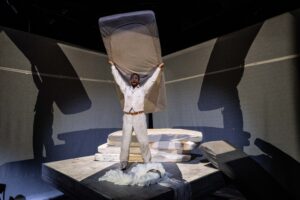
Gavin-Viano’s stage direction, aided by Julian Maiwald’s decor and Wes Broersen’s lighting, effectively transmitted the privations and claustrophobia of Carter’s prison cell, using only very simple materials. A small platform, measuring maybe eight square meters and standing a meter and a half above the floor, was used to represent Carter’s cell, which severely restricted his scope for movement. A pile of dirty mattresses lay on the floor and white curtains, representing the walls of cell hung along the back and to one side. The sense of space and atmosphere constantly changed by alterations in the lighting. Sinister shadows were also projected onto the curtained walls of the cell to add the oppressive atmosphere.
Sakhiwe Mkosana Emotionally Immerses Himself in the Rolek
Martin Carter, played by baritone Sakhiwe Mkosana, was dressed in a slightly disheveled white suit that immediately captured his status as an intellectual rather than just a simple rebel. It also drew attention to the dankness and humidity of his cell, which made his discomfiture palpable. Alone on the stage throughout the entire performance, he remained the center of attention. Even the presence of three significant female characters that appeared briefly in the shadows only reinforced his isolated state. It was a piece in which his words and his changing emotions remained at the forefront of the piece.
Mkosana’s identification with the role, both emotionally and vocally, was impressive. By the end of the performance he appeared emotionally drained. Every physical movement was sensitively crafted to express his frustrations, fears and of course, his dreams, in which he talked about his admiration for Quamina, his worries for his unborn child, and the suffering of his fellow countrymen. However, it was not simply a portrait constructed to present a series of single, one-dimensional emotions; even as he threw his mattresses off the stage in rage and frustration, his voice never betrayed hatred and was underpinned by an almost spiritual calm. There was, of course, plenty of pain, which he expressed physically, writhing or huddled up in a ball on the floor, and vocally through his expressive phrasing, which was sensitive yet forcefully connected to the meaning of the text. One had a genuine sense that Mkosana was plumbing the depths of Carter’s being; his craving for food was tangible, yet he worried that giving up the hunger strike would betray the cause of freedom. One could feel the weight he was carrying on his shoulders.
My hunger – my death – will be my people’s call to arms.
The three female characters, Janet Jagan, his political comrade, his unborn daughter, and a worker from the sugar plantation, were played by sopranos Sanda Audere and Roos van Herrewegen and alt Suzanne Verburg. Whether they were projections of his delusory state or a theatrical device used to express his thoughts was unimportant; it allowed the piece to rise above that of a monologue while introducing contrasting vocal textures that added to the musical interest. They asked him the fundamental question that lies at the heart of his actions: Will become a political martyr, or will he start to eat again so that his voice can be heard?
The performance lasted for approximately an hour, during which it covered a lot of ground and asked many pertinent questions about the human condition and its motivations. Certainly, it shone a light on Martin Carter’s life, but it also highlighted Man’s universal need for freedom and dignity, something that colonialism, in any form, cannot deliver.
“The Knife of Dawn” is a powerfully crafted work; however, it requires active participation on the part of the audience. Sitting passively watching the drama unfold may interest, provoke questions and evoke sympathies. It may even entertain, but the more one is prepared to identify with Carter’s position, the more it will reveal, for this is a work that has to be accessed on both an emotional and intellectual level.
It is and should be a painful piece of theater to engage with, even if hope finally triumphs in the end. One has to become Carter to fully understand.