Opéra Royal Château de Versailles 2025-26 Review: Theodora
By Jennifer E. PyronOpéra Royal Château de Versailles celebrated their 2025-26 season opening with Händel’s “Theodora” in the Chapelle Royale to a sold out crowd of locals and internationals.
The Chapelle Royale was completed in 1710 under the reign of King Louis XIV. It was the last chapel built at Château de Versailles and features Gothic architecture with dramatic illustrated narratives in honor of Saint Louis and the Holy Trinity. The chapel also includes a Clicquot-designed organ that adds extra depth and drama to the space. Light radiates through the chapel to transcendental effect and this hall is one of many breathtaking spaces that make Château de Versailles worth visiting and experiencing a live performance in.
The overture sounded magnificent in the Chapelle Royale! The audience watched conductor and lutenist Thomas Dunford lead the Ensemble Jupiter Choir with vivaciousness and vitality. His energy was electric and the playing of ensemble members made this evening a moment that one could never forget.
The murals of the Chapelle Royale were exposed in their nakedness by the brilliance of the lights. The gold paint shone brightly and the marble gave depth to the lightness. The finest details of this hall were on full display for all to see and get to know better while simultaneously taking in the full magnificence of one of Händel’s most beloved oratorios.
The opening aria features Valens’ “Go, my faithful servant, go.” Bass Alex Rosen as Valens performed with precision and magnetism. His voice resonated in the Royal Chapel. This set the tone for the entire evening’s stellar cast lineup.

The Chorus of Heathens’ “And draw a blessing down” followed Valens’ aria and featured the Ensemble Jupiter Choir and Orchestra in all their glory. Their voices and instruments enriched the space’s acoustics, making the night a landmark event and Händel’s masterpiece a boon for the Opéra Royal Château de Versailles 2025-26 season opening.
Act One, Scene Two’s aria,”The raptur’d soul,” showcased countertenor Hugh Cutting as Didymus. His voice and stage presence radiated in the stark light and gilded details of the Royal Chapel.
Tenor Laurence Kilsby as Septimius’ aria, “Descend, kind pity,” illuminated his bright voice, grounded in solid vocal technique and support. His voice had a beautiful timbre that balanced the blend of this cast’s voices very well.
Theodora’s opening aria, “Fond, flatt’ring world, adieu!” was heartwrenching. Mezzo-soprano Lea Desandre as Theodora performed with exquisite awareness and vocal agility in her role. OperaWire has reviewed previous performances by Desandre and Dunford and so to experience their performance of “Theodora” at Versailles was very special. The musical chemistry and vast intelligence both artists bring to their performance is unmatched. The joy they exude is historical!
Theodora’s aria in Act Two, Scene Two, “Oh! that I on wings could rise,” captivated listeners with Desandre’s vocal mastery. She also performed her aria in Act Three, Scene Two, “When sunk in anguish and despair,” with tonal colors that magnified her anguish and desperation. The following aria featuring Theodora and the Chorus of Christians, “Blest be the hand,” amplified Händel’s personal connection to this work and the message it carries forward from generation to generation.
Theodora and Didymus’ duet in Act Two, Scene Five, “To thee, thou glorious son of worth,” was another highlight of this special cast’s chemistry. Desandre and Cutting performed Händel’s work with utter brilliance and robustness. The couple was cherished by all, especially as they performed Didymus and Theodora’s duet in Act Three, Scene Six, “Streams of pleasure ever flowing.”
Mezzo-soprano Avery Amereau as Irene was unforgettable. Her voice was made for this role. Irene’s aria in Act One, Scene Four, “As with rosy steps the morn,” and her aria in Act Two, Scene Four, “Defend her Heav’n!” were two major highlights of the night. Amereau’s vocal timbre is unique and her vocal palette is vast. Her voice evolved throughout her performance as her dynamics and acting embodied her role’s determination.
Septimius’ aria in Act Three, Scene Five, “From virtue springs each gen’rous deed,” resounded in the Royal Chapel as Kilsby sang. Valens’ aria followed after, “Cease, ye slaves, your fruitless pray’r!” and Rosen’s bass created drama to impressive effect.
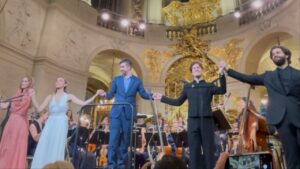
The final scene of Händel’s opera concludes with Irene’s aria with the Christians, “Ere this, their doom is past” and the Chorus of Christians “O love divine.” Dunford led the Ensemble Jupiter Choir and Orchestra into another realm of divine expression and uplifting resonance.
This was a most extraordinary night of musical bliss at the Château de Versailles’ Chapelle Royale!