Opéra National de Paris 2026-27 Review: Il Barbiere di Siviglia
By Andréas Rey(Photo: Paris Opera)
Opera lovers who came to Paris this mid-September were able to enjoy the return of Rossini’s “The Barber of Seville,” this time under the baton of Italian conductor Jader Bignamini. It’s not the first time Damiano Michieletto’s staging of this opera has taken place in the Opera Bastille; indeed, it closed out last season. So, does it stand the test of time? Let’s see.
Production Details
From the very opening, the first thing that caught my ear was the conductor’s fluid, sparkling, and rich approach. The timpani — always very delicate to handle, even more so in Verdi — may have sounded somewhat out of place. Nevertheless, the conductor maintained a very Mozartian style, which boded well for the rest of the production. Rossini’s relationship to Mozart — Mozart can be seen as both a response to and a transcendence of the seria and buffa operas, and Rossini as a response and a digestion of the Mozart style — would merit a study all on its own.
Seville’s “Barber” is perhaps the most Mozartian of Rossini’s operas, given so many elements — from its two-Act structure, to its nearly three-hour runtime, to the narrative elements such as the two symmetrical couples (Bartolo and Bazilio versus Almaviva and Figaro), as well as its characters (Rosina closely resembling Susanna and Bartolo resembling Count Almaviva), not to mention, of course, the reprise of the Count’s role and the humor, all of which may remind one of “Le Nozze di Figaro.”
Outstanding Cast
Another standout feature of this production is the vocal cast. Starting with the velvety timbre of bass Amin Ahangaran’s Fiorello during the opening scene. He was remarkable in his “Piano, Pianissimo,” and the servant Bertha portrayed by soprano Isobel Anthony, with her deep yet never heavy voice, who was remarkable in her “Che vecchio sospettoso!”
The minor characters are just as well portrayed as the supporting ones. Bass Adolfo Corrado’s Basilio, whose “La calunnia è un venticello” aria — with its deep yet mocking and fluid tone, and it’s supple acting — makes the character particularly compelling.
The male leads were no less interesting. The pairing of Count Almaviva and Figaro remains well-balanced throughout the production, even during their duets. Nevertheless, baritone Huw Montague Rendall’s Figaro held a slight edge over tenor Jack Swanson’s Count Almaviva, as he seemed more natural — less focused on his appearance and more immersed in his role. Undoubtedly, the young American tenor, who shrugged his shoulders during his aria “Non dubitate” — like a young Elvis Presley — overemphasized his heldentenor side, causing him to step a little bit out of character, even though he is a natural-born actor. Would the cast have benefited if the baritone — who has already played Mozart’s Count Almaviva — had taken on the role of the Count, and the tenor that of the barber, which might have added a touch of extra brilliance to the Count’s role? Let’s set this daydream aside and simply enjoy the baritone’s agility in his famous cavatina “Largo al factotum della città,” which was as joyful as it was light-hearted and, above all, virtuosic. And let’s also enjoy the tenor singing his own “Ecco, ridente in cielo” with brilliance, even if it could have been shinier.
Bass-baritone Nicola Alaimo’s Bartholo, for his part, was remarkable — undoubtedly more so thanks to his comic talent, already noted some time ago in his portrayal of Don Magnifico in “La Cenerentola” at the Opéra Garnier — than to his clear, firm voice, which leaned toward bel canto but, in its lightness, failed to sufficiently underscore the dark and tyrannical character of Bartolo. Still, let us note his aria “A un dottor della mia sorte,” during which he showcased his appreciable velvety timbre. It would be a good move for the Opéra Bastille to cast him as Dulcamara or Falstaff, or even — though more challenging — as Count Almaviva in “Le Nozze di Figaro.”
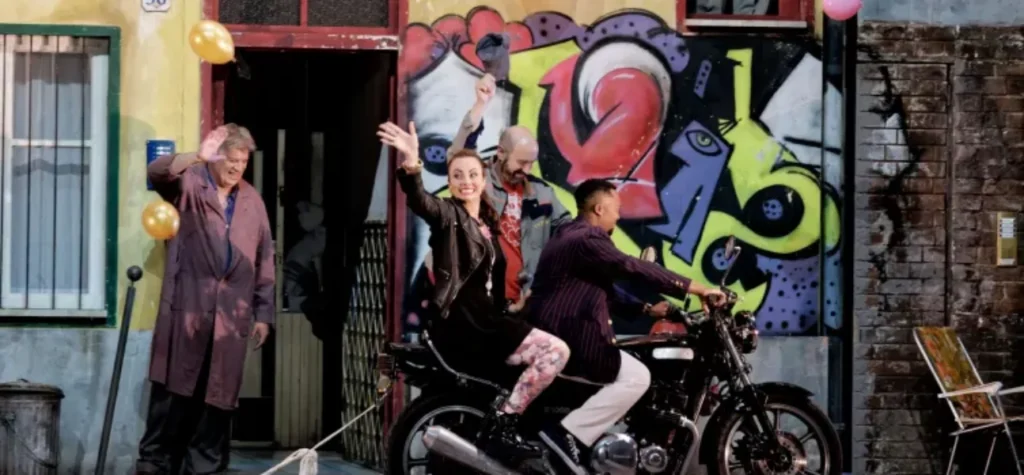
Lea Desandre as Rosina
The singer who drew the most attention was mezzo-soprano Lea Desandre as Rosina. Her character — cheerful yet firm, young but not silly — was a true pleasure to experience. She revealed all of Rosina’s personality and charm in her cavatina “Una voce poco fa” and by playing with her famous “ma.” More than just a remarkable Mozartian — having proven herself a first-rate Despina in Salzburg and a great Cherubino in “Le Nozze di Figaro” in the Palais Garnier — she skillfully drew from her experiences to embody Rosina. And, as with Figaro, while the American tenor performed his duets with her well, she maintained a slight superiority over him — that of substance over appearance.
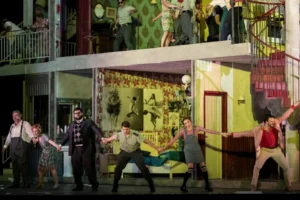
While this very Mozartian cast — each of whose members had previously performed, if not in “Nozze di Figaro,” then at least some other Mozart opera — had a few minors, easily forgettable flaws, the real problem with this production lies in the staging. The idea of setting the drama in an Italian suburb and acting as an Italian comedy film, is a very good one. The essential flaw — and by no means the least — is that the main action is constantly flanked from above, below, to the left, and to the right, by scenes of varying interest that constantly distract the audience’s attention, scattering it and requiring constant extra effort. This is all the more annoying because the main characters themselves are constantly on the move, which also requires effort — both for them and for the audience. This constant fuss, while amusing at first, eventually becomes tiresome and irritating.