Opéra de Paris 2025-26 Review: ‘La Cenerentola’
By Laura Servidei(Photo Credit: Julien Benhamou)
“La Cenerentola,” which premiered in Rome in 1817, was famously composed by Gioachino Rossini in record time — legend has it in just three weeks — and remains one of the finest examples of opera buffa in his oeuvre. Alongside its comic situations and eccentric characters, the score contains an undercurrent of melancholy and pathos that earned it the designation of dramma giocoso.
La Cenerentola: Humanity Without Magic
The story is based on Perrault’s famous fairy tale, albeit with several modifications: an evil stepfather replaces the wicked stepmother, and a bracelet takes the place of the lost slipper (for reasons of decency, since showing a young woman’s bare foot onstage would have been unthinkable at the time). Rossini and librettist Jacopo Ferretti also eliminated all magical elements, transforming the tale into a more human story about an unscrupulous stepfather who squandered his stepdaughter’s inheritance and treats her like a servant, partly out of malice and favoritism towards his own daughters, and partly to keep her submissive and prevent her from reclaiming what is rightfully hers.
Ashes Without Spark: Gallienne’s Production Revisited
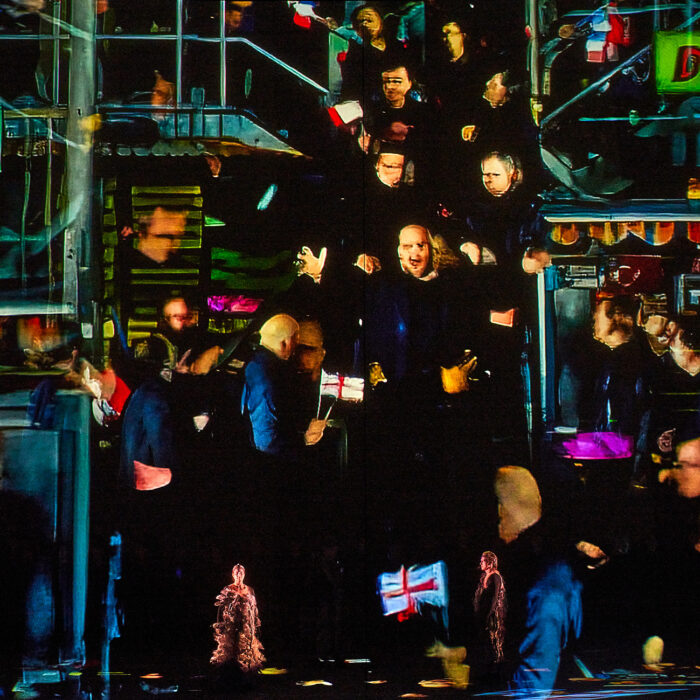
The Paris Opera is presenting a revival of Guillaume Gallienne’s 2017 production, the shortcomings of which have not improved with age. The central idea was to relocate the action to Naples, based on the rather flimsy justification that, “at a certain point,” there had been discussions about premiering the opera there, and to interpret the ashes in Cinderella’s name as the ashes of Vesuvius, the volcano overlooking the city. I learned all this from the program, because none of it was apparent onstage. The first act set depicts not Don Magnifico’s dilapidated palace but its exterior, so all the action takes place outdoors on a thick layer of volcanic ash. Characters appear from windows,
staircases, and doorways, which creates some movement, but they are often left standing aimlessly in the middle of the street, with no props and little to do. There is no charm, wit, or joy in this production. The heroine is humiliated and mistreated by her relatives with almost sadistic relish; Don Magnifico, instead of being a boisterous and small-minded buffoon, becomes an outright abuser who, on his first entrance, emerges not from the bed in which he has been dreaming of a solemn donkey, but from his room while paying off a scantily clad young woman.
When the Prince’s courtiers arrive to announce his imminent visit and his intention of choosing a bride, we get the evening’s only genuinely funny — if admittedly rather silly — idea: all the local women appear dressed as brides, including several brave elderly ladies and a conspicuously pregnant young woman who, in response to the shocked and judgmental looks of her companions, answers with perfectly idiomatic Italian gestures that essentially say, “Why not? I’ll give it a try!”
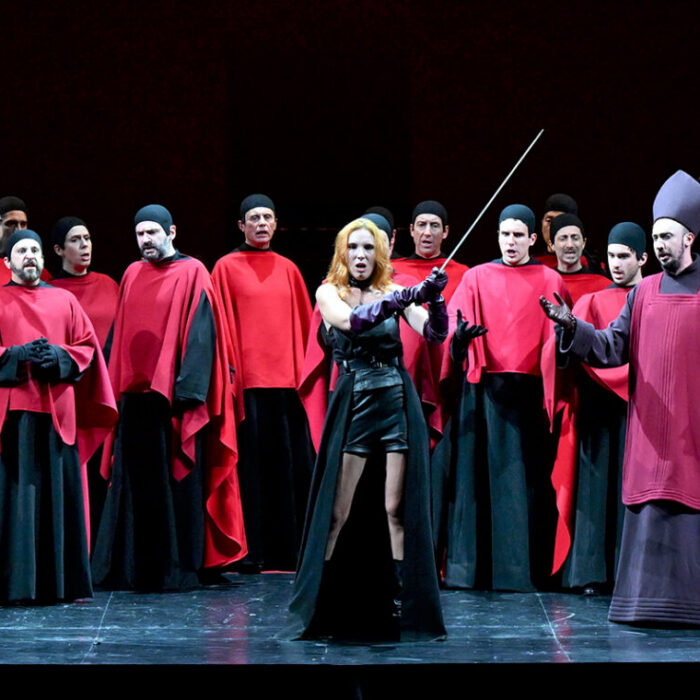
The Prince’s palace is represented by an immense room in shades of red and black, perhaps intended to evoke the mouth of the volcano, with the ashes compressed into an undulating floor. Once again, there are virtually no props and no discernible Personenregie; the singers are largely left to their own devices. Frankly, a concert performance would have been more enjoyable.
Enrique Mazzola’s Experienced Hand
Enrique Mazzola led the Paris Opera Orchestra in a detailed reading of a score he knows intimately. A specialist in the bel canto repertoire, he combines careful attention to orchestral dynamics with a firm sense of rhythm and meticulous support for the singers, particularly in the ensemble numbers. He perhaps had a tendency to take the slower passages at overly leisurely tempi, notably the opening section of the overture and Cenerentola’s song “Una
volta c’era un re.”
A Brilliant Paris Debut: Vasilisa Berzhanskaya
The title role was sung by Vasilisa Berzhanskaya, a seasoned Rossini interpreter. Her expertise was evident in her explosive yet impeccably controlled coloratura, enriched by tasteful and stylistically appropriate variations. The high notes were effortless and smooth, while the lower register was bronzed and velvety, never forced; the voice remained entirely natural and remarkably even throughout its range. Her exceptional vocal compass has led her to explore roles traditionally associated with sopranos, such as Norma, and a repertoire expanding into Romanticism (we will see her next season in the title role in “Anna Bolena” at La Scala). Her frequent excursions into more Romantic repertoire may have left some traces, and in the most introspective and melancholy ariosos she occasionally employed rubato and small portamenti that are not entirely idiomatic in this style. Nevertheless, her interpretation was consistently elegant, and in the final rondo, “Non più mesta,” she unleashed a dazzling display of vocal fireworks. A splendid debut at the Paris Opera.
Lawrence Brownlee’s Ideal Prince
Cenerentola’s Prince Charming — or Prince Ramiro, as he is called here — was played by Lawrence Brownlee, who has performed the role for decades and still possesses a tenor of remarkable freshness and agility. His coloratura was flawless, his phrasing intelligent, and he dispatched all the high Cs in “Sì, ritrovarla io giuro” with almost insolent confidence. His duet with Berzhanskaya, in which the two characters fall in love at first sight, was both tender and full of youthful excitement. He succeeded in portraying an elegant and dignified prince despite the leg brace imposed by the director to make the character appear more vulnerable (as explained in the program).
Huw Montague Rendall’s Entertaining Dandini
In this version of the story, the Prince and his valet Dandini exchange identities, with Dandini impersonating the Prince at the ball so that the real Prince, disguised as a servant, can better assess the prospective brides and choose a worthy wife. Dandini was sung by Huw Montague Rendall, whose baritone perhaps sits slightly too high for the role, as some of the lowest notes lacked projection. His voice was smooth and attractive, displaying considerable elegance, solid technique, and beautiful upper notes. His style was not always entirely idiomatic, and his coloratura occasionally lost definition, but his performance was lively and entertaining. He clearly relished the opportunity to play the cheeky valet intoxicated by his temporary royal status and was involved in several gags that were warmly received by the audience.
Nicola Alaimo Steals the Show
Nicola Alaimo was a magnificent Don Magnifico. Until quite recently, Alaimo himself was one of the finest Dandinis around, so it felt somewhat strange to see him in “La Cenerentola” without actually playing Dandini. He is one of opera’s great comic actors: his timing is impeccable, his gags never overdone, and he is consistently hilarious onstage. Every hiccup, gesture, and comic inflection is perfectly judged, and the most remarkable aspect is that he accomplishes all this without compromising the singing for a moment. His beautiful, velvety bass-baritone is always impeccably supported, his Rossini style remains unsurpassed, and his sillabato is simply glorious.
Adolfo Corrado appeared as Alidoro, the Prince’s tutor and the opera’s substitute for the Fairy Godmother. Alidoro has only one aria, but it is a notoriously demanding one. Corrado navigated it successfully, his bass powerful and endowed with an attractive timbre, if perhaps somewhat generic in color. His lowest notes occasionally sounded a little underpowered, but overall, his performance was convincing.
The cast was completed by Ilanah Lobel-Torres and Maria Warenberg as the stepsisters. Both were excellent in the concertati and contributed significantly to the success of the evening.