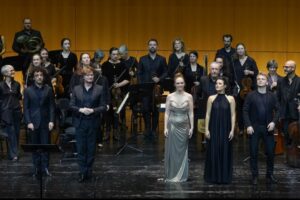
Teatro Real de Madrid 2026-27 Review: Riccardo Primo, Re d’Inghilterra
By Galina Altman(Photo: Javier del Real)
The evening of Oct. 21 at Teatro Real was wonderful in its intimacy. Handel and baroque music represent a form of opera entirely different from the familiar “hits” of the 19th and 20th centuries – plus a long-awaited three hours in which to switch off and recharge through beautiful, slightly otherworldly English music and magnificent arias and voices.
The plot of “Riccardo Primo,” premiered in the season of 1726-27, at precisely the moment of the composer’s naturalization as a British subject, deserves a brief political note. Richard the Lionheart, King of England, travels to Cyprus to collect his betrothed Costanza, who has ended up in captivity following a shipwreck, a prisoner of the island’s tyrant and ruler Isacio. Isacio is himself in love with Costanza, and instead of returning her to Richard he attempts to pass off his own daughter Pulcheria as the bride, taking advantage of the fact that Richard has never seen his intended. Pulcheria, however, already has a betrothed of her own – Oronte, Prince of Syria – and it is he who ultimately exposes the deception. All of this unfolds in the 12th century during the Third Crusade.
The intrigue of the libretto and its dramatic force are built on a double deception: Costanza, after the shipwreck, conceals herself under the name of the servant Dorinda; Richard arrives at the palace not as a king but as his own ambassador – and the entire second half of Act one turns on the fact that no one knows who they are actually speaking with.
But Handel deploys this device not for comic effect. He uses it to show how power and desire blind even the most perceptive person. Isacio, already suspecting that Dorinda is Costanza in disguise, continues to play both sides – promising to return the bride to Richard while simultaneously preparing the substitution of his own daughter. It seems that the convolutions of the plot and the composer’s design continue, across the centuries, to influence the very performance of the opera.
(Photo: Javier del Real)
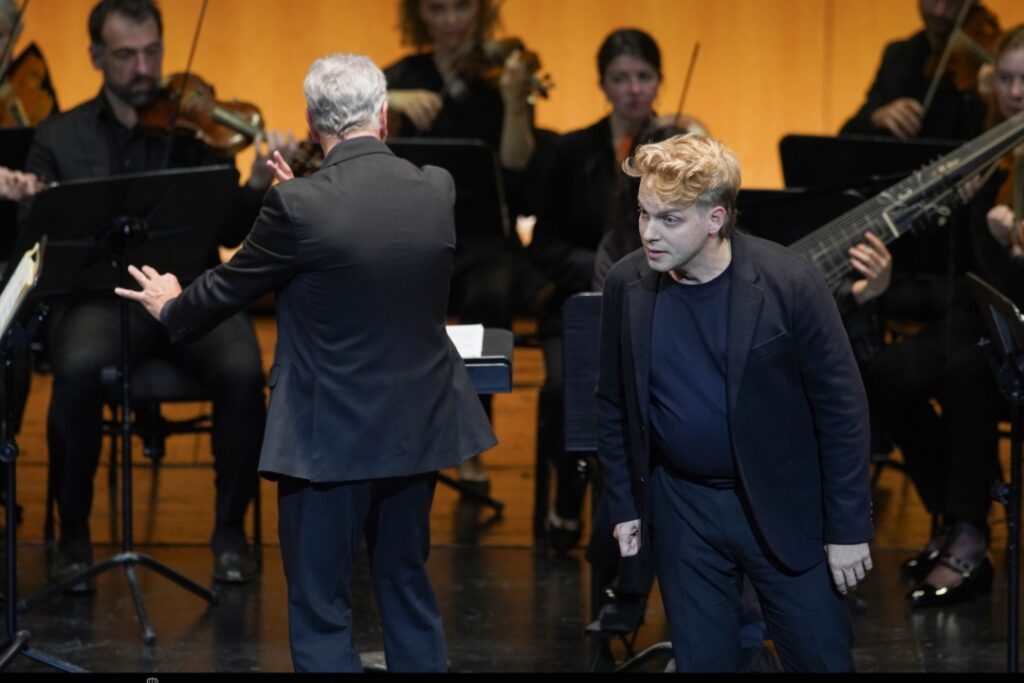
Hugh Cutting as Riccardo
The role of Riccardo was to have been sung by countertenor Jakub Józef Orliński, but he withdrew from the project before the premiere. From the very first performance on Oct. 14 in Dijon, then at the Philharmonie de Paris, and now in Madrid, the role has been sung by Hugh Cutting. By the time he appeared at Teatro Real, he had arrived with a fully formed and thoroughly rehearsed interpretation of the role, not a debut in it.
He sang with complete brilliance and earned more ovations than anyone else on stage that evening: filigree elaboration of the fioriture, baroque ornaments, a beautifully organic sense of breath. His voice was high and transparent while at the same time dramatically charged – capable of soaring upward and holding a dense, firm lower register, with an emotion and drama that read not only in the voice but in the face. The role of Riccardo is built on contrast: he was at once a warrior with fierce martial arias such as “O vendicarmi saprò con l’armi” and “Atterrato il muro cada,” and simultaneously a man capable of genuine tenderness and love. Cutting expressed this multifaceted personality with complete precision on stage, and his Ivanhoe-like appearance perfectly completed the portrait of an English king of the 12th century.
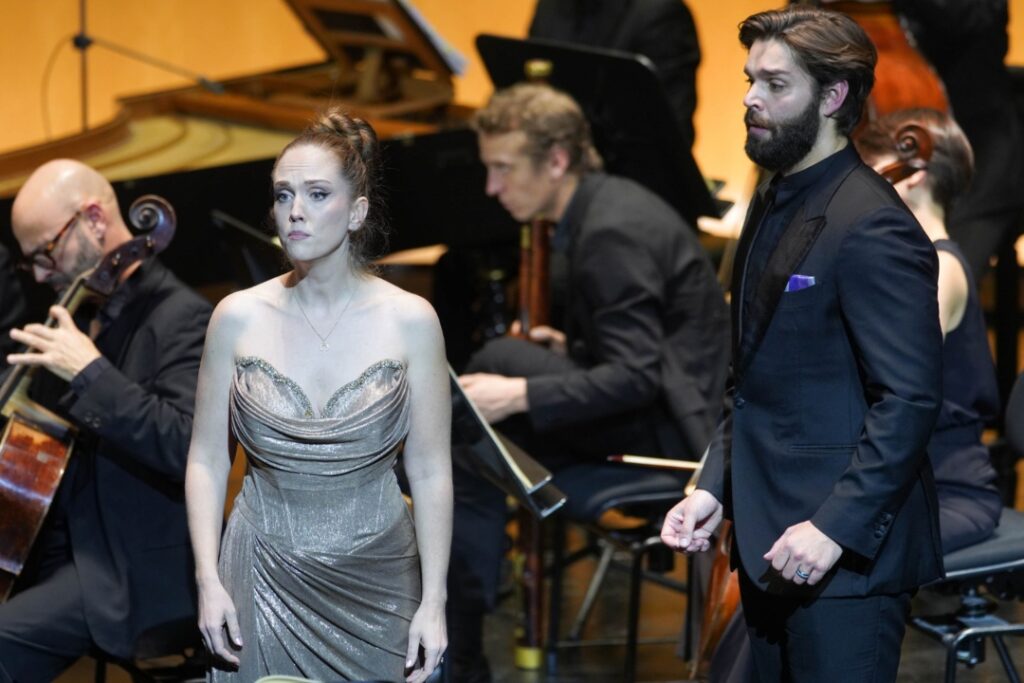
Mélissa Petit as Costanza
Costanza, his beloved, was sung by Mélissa Petit. She has a rich, saturated voice with splendid coloratura, capable of filling any theater’s volume – but in this role she showed the audience an entirely different dimension of herself: a filigree, intimate piano. Her performance was silvery, crystalline and pure, with warm amber overtones, and technically absolutely secure throughout. In this unexpected intimacy the full strength of her Costanza was revealed – a character who constantly teeters on the edge of despair, as in the arioso “Morte, vieni,” where the heroine calls on death over a solo transverse flute, and then blossoms into luminous elegy, as in the final aria “Il volo così fido” with its solo sopranino recorder.
(Photo: Javier del Real)
A word is worth saying about the role itself. Costanza in this opera is constructed differently from her rivals’ roles – there are almost no brilliant showpiece arias in it. Handel wrote the part for Francesca Cuzzoni, who was celebrated not for machine-gun coloratura but for an extraordinary softness of sound, pure intonation, and the ability to hold an audience with an astonishing pianissimo. The lyrical arias, the arias of grief and tenderness, demand minimum ornament and maximum cantilena, sustained line, and legato – and Petit has evidently set aside her customary bright virtuosity in favor of the more restrained facets of her voice.
Musical Intimacy Highlights
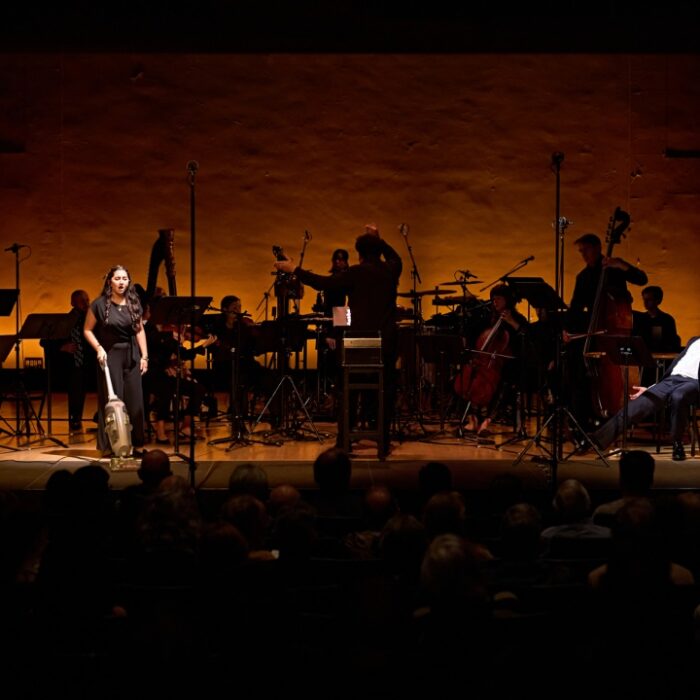
The format of the evening itself – a concert performance without staging or sets – amplified and underlined this intimacy: when singers stand before the orchestra, all the expressiveness of a role flows into the nuances of the voice, and Les Arts Florissants playing on period instruments produced a sound that was softer and quieter than their modern equivalents – the entire balance was built on intimacy rather than forcing.
Act two closed with a truly wonderful duet of Richard and Costanza, “T’amo, sì; sarai tu quella” – wonderful in its depth, delicate and tender. This is one of the genuine summits of the entire score, and the voices of Cutting and Petit here were perfectly fused in timbre, creating the sense that time had momentarily stopped and the vast hall of Teatro Real had suddenly contracted to the dimensions of an alcove. Petit’s voice opened fully in its intimacy and filigree piano, which worked not as a softening of sound but as a state of absolute closeness.
(Photo: Javier del Real)
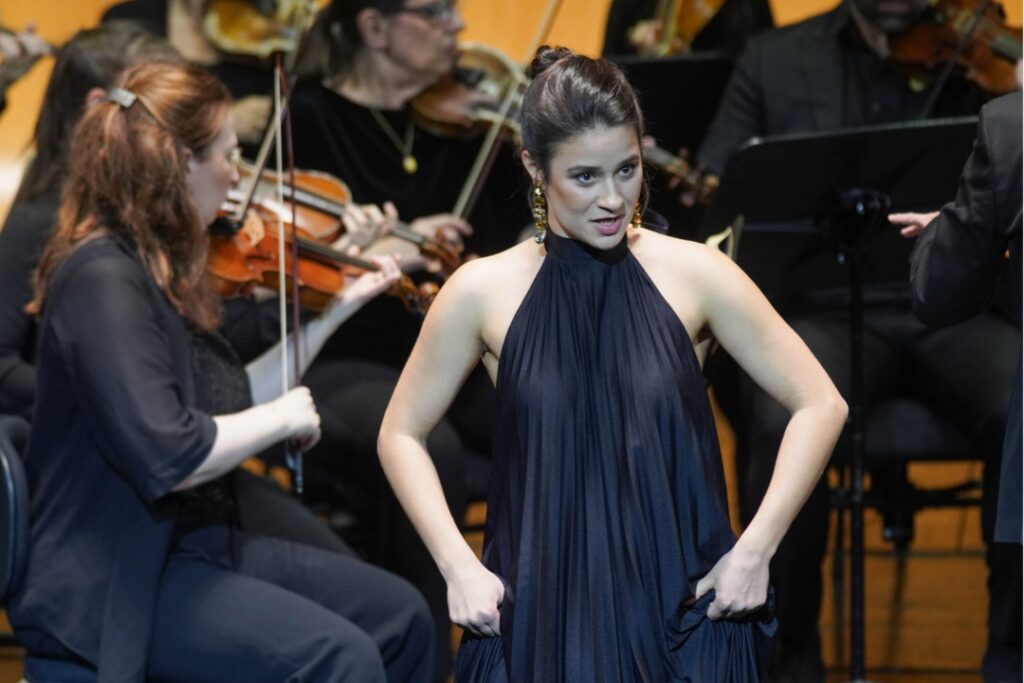
Juliette Mey as Pulcheria
The second star of the evening, mezzo-soprano Juliette Mey, performed the role of Pulcheria – Isacio’s daughter – burst onto the stage quite literally. With a very clear and bright voice carrying a wealth of virtuosic ornaments, she astonished the audience to the point of complete stillness, which broke at the end of the very first aria into loud applause. Mey is a laureate of the Queen Elisabeth Competition, winner of the Victoires de la Musique Classique in the category “Révélation artiste lyrique” 2024, an alumna of the Jardin des Voix Academy of William Christie and Paul Agnew. Her vocal training allowed her to ignite an audience’s attention with freshness and vivid accents.
The role of Pulcheria was written by Handel with a psychological depth rare for a secondary heroine, and contains perhaps the most vocally demonstrative sequence of arias in the entire opera: first she dutifully agrees to participate in her father’s scheme in “Vado per obbedirti,” but within a single scene, having learned the details of the deception, she undergoes a genuine emotional rupture in “Ah padre! ah, Cielo!” – literally asking her father why he is pushing her toward dishonor. The most brilliant and memorable moment on the stage of Teatro Real was the aria “L’aquila altera,” in which a proud eagle teaches its chicks to look directly at the sun: in Mey’s performance it sparkled from first note to the last, leading with perfect dramatic logic to the final duet of Riccardo and Costanza.
Andreas Wolf as Isacio
Pulcheria’s father, the tyrant Isacio, also sang with complete conviction. The role was performed by German bass-baritone Andreas Wolf, a regular member of Les Arts Florissants. His voice was powerful and resonant, with a beautiful bronze timbre, and his vocal resources were on a large scale – fitting the portrait of a tyrant possessed by rage and a thirst for destruction, which Handel gives him in the aria “Nel mondo e nell’abisso,” where he confesses in fury that he would sooner see Costanza dead than have her disobey his will and be given to another. Yet Isacio is a father, not a cartoon villain: he explains his insistence through love, not calculation, and so the role demands not only aggressive power of sound but also dramatic credibility, which Wolf demonstrated to us with impressive command.
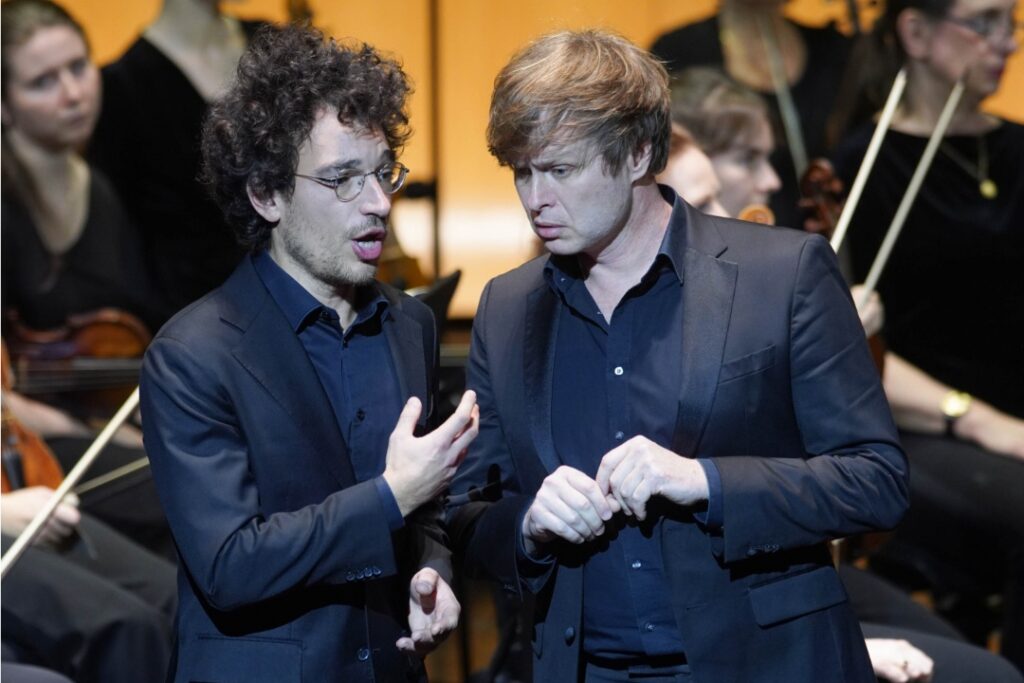
(Photo: Javier del Real)
The Hidden Jewel of the Night
Pulcheria’s betrothed Oronte, the second countertenor of the evening with a soft, beautiful timbre, was the true hidden jewel of the night. Even in concert performance he played with wonderful commitment and presence, and one genuinely wanted to root for him. The role was performed by Paul Figuier, a graduate of the Paris Conservatoire and the Centre de musique baroque de Versailles. He had a vocal line of rare refinement, a wide range, and impressive dynamic possibilities; his voice was softer and warmer than that of the title hero, with a light brightness at the very top which, by contrast with the denser sound of the role of Riccardo, worked with exact precision for the dramatic architecture. The two countertenors on stage sounded genuinely and completely different from each other: one a warrior, the other a lyric and a romantic – like Onegin and Lensky, each fighting for his beloved without any misunderstanding between them.
Alex Rosen as Berardo
There remained the brother – more precisely, the cousin and guardian of Costanza, Berardo. The role was performed by American bass Alex Rosen, a graduate of the Juilliard School who made his debut with Les Arts Florissants under the direction of William Christie. He sang with a clear, saturated timbre – his voice deep, velvety, and compelling. Even though the role of Berardo is modest in scale and contains only a single aria, “Dell’empia frode il velo,” Rosen was impeccable in it and remained a thoroughly convincing confidant throughout the entire evening, despite the modesty of the role itself.
Paul Agnew & Les Arts Florissants
A separate word for the orchestra and conductor. Paul Agnew had the decisive voice here and led Les Arts Florissants with genuine historical authenticity. He is the strictest of baroque purists, and the French school – to which both Les Arts Florissants and Mélissa Petit belong – is in general more restrained, preferring elegance, the finest pianissimo nuance, and nobility of sound over extravagant vocal fireworks.
The ensemble is rightly considered one of the gold standards of period performance, and on stage that evening it was beautifully clear why. Accents placed with precision and taste, the rhythmic energy of the baroque music never sagged for a single second, the brass sounded simply magical – spacious and with that special soft brightness that period instruments give, without the familiar density and hardness of modern metal.
The sopranino recorder in Costanza’s final aria deserves an enthusiastic separate mention – its rare timbre in combination with the voice created a sensation of sound floating in the air, which is precisely the sensation for which this aria was written. The percussion worked with sharp dramatic purpose, substituting for the visual effect of a scene change and supplying in the battle and storm scenes the necessary weight and tension, never becoming mere noise.
“Riccardo Primo” occupies a special place in Handel’s operatic catalogue. It is his only opera built on the story of an English monarch, and it was written not simply for its own sake but for the coronation of George II in 1727. For the premiere at the Royal Academy of Music, Handel assembled the star trio of his age: the castrato Senesino in the role of Riccardo, and two rival prima donnas, Faustina Bordoni and Francesca Cuzzoni, whose real-life rivalry on stage fed into the musical dramaturgy as well. The historical basis here is almost decorative – the Third Crusade provides merely a pretext for the intrigue – and at the center lie far more universal things: deception and the treachery of a ruler against love and faithfulness to oneself, which prove stronger than a throne.
In the opera’s final scene, fully in keeping with the spirit of the coronation year, Handel makes Riccardo I not an avenger but a magnanimous ruler: he defeats Isacio, grants him his life, and gives Cyprus to the newlyweds Pulcheria and Oronte, who from the very beginning were victims of someone else’s scheme. The most virtuosic and jubilant aria of the entire evening – in accordance with the generic canon of baroque opera – falls to the character who suffered most, and here that is Costanza’s “Il volo così fido,” brilliantly completing the moment of her final liberation and triumph.