Irish National Opera 2026-27 Review: Testament
Mezzo-Soprano Sharon Carty Produces a Role Defining Performance
By Alan Neilson(Photo: Patrick Redmond)
In 2011, Colm Tóibín’s play, “Testament,” premiered at the Dublin Theatre Festival. The piece required only a single actress, who, cast as Mary, recalls the life of her son, Jesus, as she remembers it. It is a very personal recollection, one that does not always correspond to his life as presented in the gospels. Fast forward to 2026, and the Dublin Theatre Festival decided to stage another production of “Testament,” also by Tóibín, but this time as an opera with music composed by Tarik O’Regan and performed by Irish National Opera. It is not, however, a simple representation of the play, for Tóibín, following on from its success, decided to turn it into a novella entitled “The Testament of Mary,” which, although retaining the basic premise of the narrative, contains significant differences, most notably through the inclusion of additional characters. It is this book that was used as the basis for the opera.
The Son of God or a Mother’s Son
The Bible does not give Mary a voice. Despite her significance, she remains silent. We have absolutely no idea as to her thoughts, opinions and emotions. But if she could speak, what would she have said? “Testament” is Tóibín’s imaginative and, at times, surprising response.
The opera is set years after Christ’s crucifixion. Mary is now an elderly woman, still clearly traumatized by her son’s crucifixion, and is reflecting upon the meaning of his life and death. It is not, however, a detailed chronological account; rather, it is a selection of well-known events, that start with the raising of Lazarus from the dead and climaxing with Jesus’ death and resurrection. Nor is it presented as a simple monologue; the boundaries between memory and the actual events themselves become blurred. While she may describe and comment on what has happened, they quickly morph into the event itself, in which Mary finds herself reliving them, along with all their emotional pain.
Anyone who was expecting a saintly Mary devoted to Jesus as the Son of God, who died upon the cross so that Man may be saved, would have been quite shocked. Of course, she was as devoted to her son as any good mother would be, especially a son who had had to endure the humiliation and suffering of a crucifixion, but she did not remain to watch it all play out; the pain was too much for her to bare. When she is pursued by his followers to confirm that he was resurrected, she resists. She refuses to endorse their view of her son and concludes that all the pain “was not worth it.”
Memories often play tricks. While they may often resonate strongly, they can often become disorganized, confused, and exaggerated and may even include fabrications or deliberate deletions. As we age, so the tendency increases, and this is the state in which Mary is presented. After bringing Lazarus back from the grave, she moves on to the Wedding at Cana, yet according to the Bible it actually preceded Lazarus’s resurrection. But who is to say she is misremembering? Is it more a statement about her own truth, about Mary defending her view of the past, which has been appropriated by her son’s followers? Thus we come to the heart of the opera: who is it that has ownership of the past? Tóibín has placed Mary, the mother of Jesus, in opposition to his followers, and by extension, to the present-day Church, which had organized protests outside the theater before the performance.
Sharon Carty Captures Mary’s Struggle When Dealing with Jesus’ Life and Legacy
Tóibín’s Mary is presented as a woman who has suffered much and who is refusing to let others control her son’s legacy.
She was performed by mezzo-soprano Sharon Carty, who produced a gripping performance of a devastated woman who has been completely overwhelmed by the events to which she has been subjected. Not only has she experienced the agonies of observing her son’s excruciatingly painful death, but she also has had to deal with a lot of skepticism and anger. Would a crowd who has just witnessed Lazarus return from the grave comprehend what has just happened in front of their eyes and celebrate joyfully?
More likely, they would be frightened and distrusting. Mary became an outsider. Often, she was pushed to the sides of the stage, alone with her grief, which Carty expressed in heartrending terms. At Cana, she watched the events unfold at a distance, ignored by the celebrating crowd. Unsurprisingly, she frequently became short-tempered, demanding to be heard. Yet, at other times, she appeared to be completely cut off from her emotions, unable to give words to her trauma. Rarely, did she descend to wild histrionics. While recalling the crucifixion, she physically re-enacted the scene; she could not dissociate her pain from her son’s. No wonder she resisted other people’s efforts to dictate the narrative, to present him as the Son of God: for her, he was simply a much-loved son that had been misunderstood and unjustly victimized by others.
It was a dominating performance from Carty, a role for which she was perfectly suited. Her use of her voice was beautifully managed to present Mary’s shifting emotions, in which she mixed deep pain, suffering, and grief with anger and even traces of paranoia, using colorful, dynamic, and emotional inflections to create layers and nuances of emotions that Mary was unable to prevent from surfacing.
There were six other characters who made appearances, comprising Lazarus, his two sisters, and three of Jesus’ followers.
Lazarus, performed by Maksym Lozovyi, was a non-speaking role. Nevertheless, he made quite an impression: dirty and disheveled, he wandered vacantly about the stage as if lost, showing no joy at being brought back from the grave.
His sister Martha was played by Deirdre Higgins, who made a positive impression with a well-sung performance that highlighted her pleasing tone and strong upper register with a piercing quality that she used to express her own emotional torment. Her unnamed other sister was given an attractive, understated performance by mezzo-soprano Sarah Luttrell, whose vocal beauty, characterized by her warm vocal coloring and secure, calm, yet expressively sensitive delivery, impressed.
The three followers of Jesus, John, Paul, and Markus, were not always a mild, meek bunch. They were aggressively committed to their agenda of promoting Jesus as the son of God, thereby putting them on a collision course with Mary. Together they produced engaging, pleasing harmonies, particularly when deliberately trying to intimidate Mary.
Paul and Markus, performed by tenors Oisín Ó Dálaigh and Ben Escorcio, put in strong, committed performances, but it was baritone David Kennedy as John who stood out. He possessed a particularly beautiful voice with a warm, burnished timbre that he used with intelligent sensitivity in declaiming his lines. He was also part of one of the opera’s more attractive musical moments, along with Higgins and Luttrell, for a trio, in which their voices combined beautifully to create pleasing colorful contrasts.
Strong Direction & Staging from Rachel Hewer and Her Team
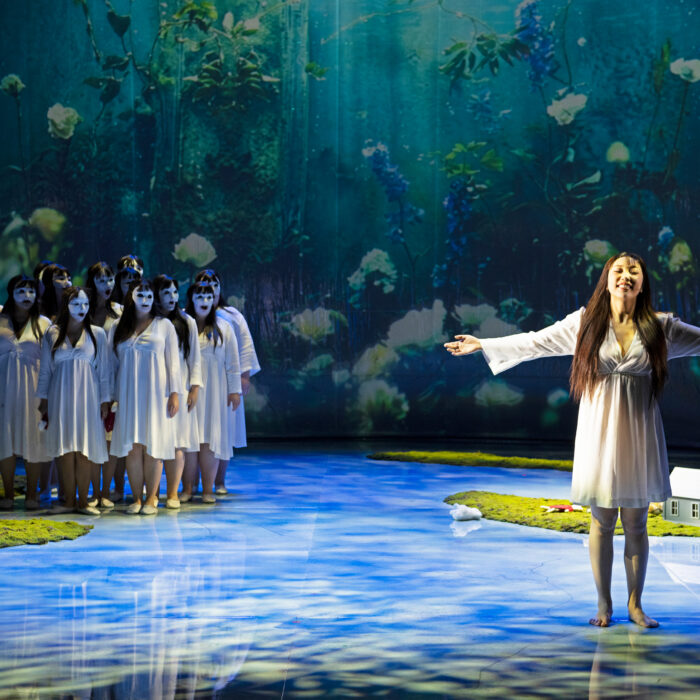
The director, Rachel Hewer, along with her team comprising scenographer Francis O’Connor and costume designer Joan O’Clery, created a simple, calm staging that captured the ambience of the period, even though it did not slavishly attempt to reproduce a biblical setting. In fact, it actively blended aspects of the modern with the past. While the costumes were superficially taken from period, the use of pastoral shades for the chorus and soloists apart from Mary, who wore dark colors, possessed a modern aesthetic. The use of a large, inclined mirror above the stage was used to present a variety of perspectives, which, in the crucifixion scene, proved to be quite spectacular.
Individual scenes were imaginatively presented and allowed for a clear understanding of the underlying themes of the piece. Mary was initially gagged, drawing attention to the fact that she has been silenced. Only when it had been removed could her testament begin! Having a couple of scribes sitting near to the front of the stage was also a nice touch in that it drew attention to the significance of recording events.
The wedding scene at Cana was wonderfully presented, although the inclusion of a dance scene was only partially successful; while the slow-motion movements worked, its poorly choreographed almost mechanical movements did not convince. The fact that Mary was distanced from the celebrations again highlighted her alienation from the crowd. The brutal crucifixion scene was cleverly distorted so that it was Mary, and not Jesus, who was strapped to the cross, thereby capturing her identification with her son’s pain and suffering. Jesus then appeared, but as a child, reinforcing Mary’s happier memories of him. Towards the end of the opera, the black cross that now lay in a corner of the stage was lit by the words ‘Son of God’ along its two beams. Mary, however, continued to resist such an interpretation.
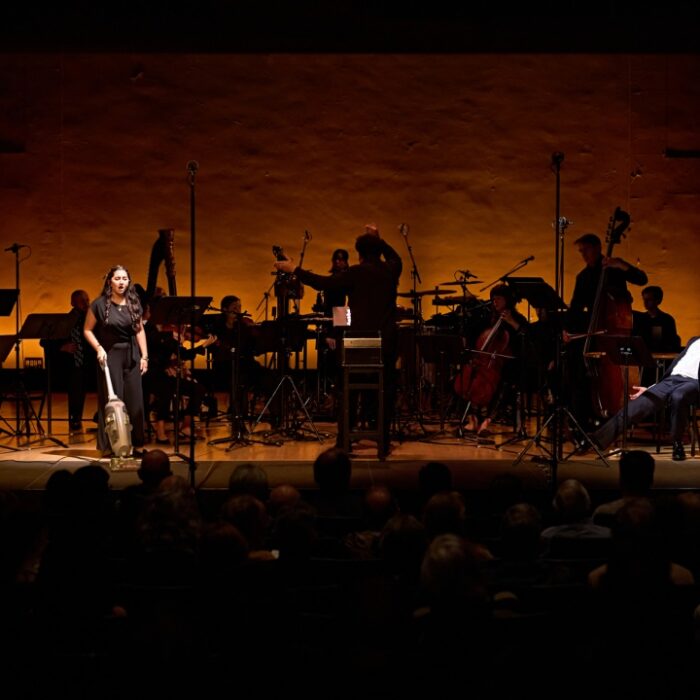
At the insistence of the composer, Tarik O’Regan, the musicians were situated onstage. Hewer did a fine job in integrating them into the drama and regularly had them moving around the stage, interacting with singers, and occasionally placing them center stage to show off their skills. They were also costumed to fit in with the rest of the cast.
A Well-Constructed Score that Meets the Dramatic Needs of the Libretto
O’Regan’s score is a typical example of many contemporary works. Its focus is primarily on promoting the drama through the creation of a suitable musical atmosphere, revealing the emotional and psychological depths of the characters and, of course, highlighting its key elements. To this end, he selected an interesting array of instruments for a small ensemble, with many opportunities for the musicians to shine, to which he added occasional electronic sounds. He moved between tonal and dissonant passages, often full of disjointed, unsettling music, but was also at ease incorporating accessible melodies, such as the dance music.
By the nature of the drama, however, the emphasis leant towards the unsettling, notably so during the crucifixion scene, which was aggressive, jagged, and dynamically and rhythmically uncomfortable. He was also attentive to the singers, particularly Carty, for whom he produced clear lines that could easily be understood. Moreover, it was also an accessible score, one that the audience could relate to. On the negative side, however, it had a generic quality about it; there was little in the score that stood out or will remain in the memory. It would be difficult to distinguish it from many other similar scores that share the same general approach in writing an opera. Despite this criticism, it was a successful piece overall and played its part in creating a powerful drama.
Elaine Kelly, who was positioned alone in the pit, produced an energetic, dramatically forceful reading from the ensemble of seven musicians, comprising violin, viola, cello, flute/piccolo, clarinet, mandolin, and accordion, and successfully brought out the rich textures of O’Regan’s score.
“Testament” runs for approximately 80 minutes and is a powerful piece — an excellent vehicle for a mezzo-soprano to show off their abilities as a singer and actress. It challenges one’s understanding of the past while at the same time draws attention to the ownership of a narrative. Specifically, it makes one confront their own ideas about Mary. Tóibín offers up a possibility, not a truth; he challenges us to think again about what is all too easy to take as gospel.