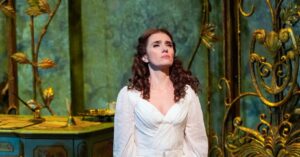
Metropolitan Opera 2025-26 Review: La Traviata (Cast B)
Ermonela Jaho as Violetta Gives Performance of a Lifetime
By Jennifer E. Pyron(Photo: Ken Howard / Met Opera)
The Metropolitan Opera presented this season’s “La Traviata” with a second cast on May 6th, 2026 for its 1,066th performance of Verdi’s masterpiece. Conductor Marco Armiliato led the cast of all-stars including soprano Ermonela Jaho as Violetta Valéry, Edyta Kulczak as Flora Bervoix, Jeongcheol Cha as Marques D’Obigny, Dwayne Croft as Baron Douphol (Graduate of the Lindemann Young Artist Development Program), Paul Corona as Dr. Grenvil, Scott Sculy as Gastone, Kang Wang as Alfredo Germont (Graduate of the Lindemann Young Artist Development Program), Hannah Jones as Annina, Patrick Miller as Giuseppe, Lucas Meachem as Giorgio Germont and more.
The production by Michael Mayer and Revival Stage Director Jonathon Loy featured set design’s by Christine Jones, costume designs by Susan Hilferty, lighting designs by Kevin Adams and choreography by Lorin Latarro.
OperaWire reviewed the season’s first cast back in March, starring Lisette Oropesa and Luca Salsi. In a rare followup to such an exquisite opening run, this second leg proved to be above everyone’s expectations.
Ermonela Jaho as Violetta Valéry
“La Traviata’s” titular role, Violetta Valéry, demands vocal precision mixed with intelligent acting that blends with Verdi’s music. This role is the crux for bringing to life the drama unfolding on stage. Soprano Ermonela Jaho is no stranger to this level of craft and currently leads the opera world as being one of the greatest in this role of our time. Her performance on this particular night showcased her fine attention to detail and nuance that began before she entered the stage and sang her first note. On this rare occasion, Jaho revealed the magic that happens when a singer IS the character and sings from this place of “lived-in” experience. Her voice was tethered to the complexities of Violetta’s life as an independent woman snared by the chain of a stagnant world dominated by the male perspective. While the developing love story between her and Alfredo exists to mirror her vulnerability, Jaho dove head first into what it vocally sounds like to live as a woman made conscious to her own reality and the environment she struggles to survive in.
Her opening phrase, “Dell invito trascorsa e gia l’ora,” was full of high energy and ringing top notes especially as she sang, “D’altre gioie qui fate brillar.” It was from this particular moment that she decided her vocal fate for the remainder of the night. Her clear and bright tone brilliantly resonated into the back of the hall. Her middle range was grounded in her vocal agility especially in “Sempre Libera” and “Ah fors’è lui” and this fine level of vocal adaptability is what’s needed to make this role unforgettable. And it was.
In addition to her voice, Jaho gave a performance that felt original and renewed. Despite this production’s stage setting remaining stagnant, Jaho’s voice made this “Traviata” come to life and develop into a new revelation for this heavily performed soprano role.
Another highlight that was the tipping point for the night, was while she sang “Teneste la promessa” and “addio del passato.” In this aria, Jaho delivered every note and word from her soul. She exemplified how a singer must anticipate the most crucial moments in an opera with care, thoughtfulness, and guttural instinct under the high pressure for delivering excellency in their craft. Jaho’s performance was a catalytic breakthrough. As a result, Verdi’s music came to life in a gut-wrenching way that dissolved any notions of a blinded fantastical love story. What remained were the bones of a woman torn to pieces by her environment that “kept” her. Jaho’s performance held a light in this place of knowing, leaving the audience breathless.
Her captivating presence and vocal excellence were the greatest highlights of the night.
Kang Wang as Alfredo Germont
Tenor Kang Wang’s voice during his opening aria, “Libiamo nè lieti calici (Brindisi)” set the standard for his role’s capacity to sustain the audience’s attention and illuminated his vocal agility, as well. Wang’s bright voice was supported by his warm timbre and excellent breath support. This made his lyrical voice clearly resonate throughout the Met’s hall and his expressiveness came across as genuinely engaging. There was a tenderness in Wang’s delivery that created a blossoming chemistry with Jaho’s Violetta, resulting in their combined ability to tug at the heart strings of the audience.
“Che fai?..nulla” was a quintessential moment when the audience felt the tension coming to a head between the couple. Wang’s vocal palette made this scene multidimensional. He was bent on his knees in submission to the falling curtain of the couple’s reality, while also engaged with the notion that love remained between them–an unspoken hope for better days. Wang’s voice never faltered even at the height of his emotions, instead he leaned into his diaphragm and dug up the guts for his role’s underlying intentions–simply to love and to be loved in return. It was this level of conscious alignment that continued to feed the minds of listeners. He made Alfredo human, not a fantasy.
“Se una pudica vergine” was heartbreaking between Jaho and Wang. Violetta’s peaceful release from her pain and dying body was surrounded in love more than imaginable by Alfredo. Wang turned this scene into an evolution for his role and his voice. One could feel the sense of release in him as he said her name one last time. This one moment became what he wanted the most, unconditional love and resolve in his knowing. Wang’s performance was a masterpiece.
Lucas Meachem as Giorgio Germont
Baritone Lucas Meachem rounded out this cast’s trifecta with an undeniably powerful performance. His Germont battled against the carefree will of Jaho’s Violetta and made the tension in this opera feel climactic. Meachem’s skillful pacing in this role is what sets him apart from most. His acting and emotions developed over time and shifted at the right time–in short, his role intentionally kept the time and this was his greatest power of all. He knew time was on his side.
Meachem’s voice during “Di provenza il mar il suol” was monumental. His thoughtful attention to detail for the Italian language paired with his bel canto studies made this moment stand out the most. Another highlight was during the duet, “Pura siccome un angelo” when he sings about his own daughter and why Violetta cannot continue with Alfredo so as not to spoil the family’s reputation. Vocally, Meachem is well-rounded and this role sat well in his tonal palette. The audience made it clear they were very pleased, as well.
More Cast Highlights
Mezzo-soprano Edyta Kulczak as Flora Bervoix was lively in her role. Her voice during “Avram lieta di maschera la notte” and “Di Madride noi siamo mattadori” was full and bright with expression that resonated throughout the Met’s hall.
Mezzo-soprano Hannah Jones as Annina sang with conviction and made the scenes with Jaho that much more impactful. Jones’ voice is made for bigger roles and I am looking forward to celebrating her star on the rise.
Jeongcheol Cha as Marques D’Obigny, Dwayne Croft as Baron Douphol, Paul Corona as Dr. Grenvil, and Scott Sculy as Gastone rounded out this stellar cast with excellent singing and acting in their roles.
Cara Seymour and James Whiteside as solo dancers, along with the entire dance troupe did amazing work in the space they were given on stage. Their sequence was uplifting with Verdi’s music and made this production fun to watch.
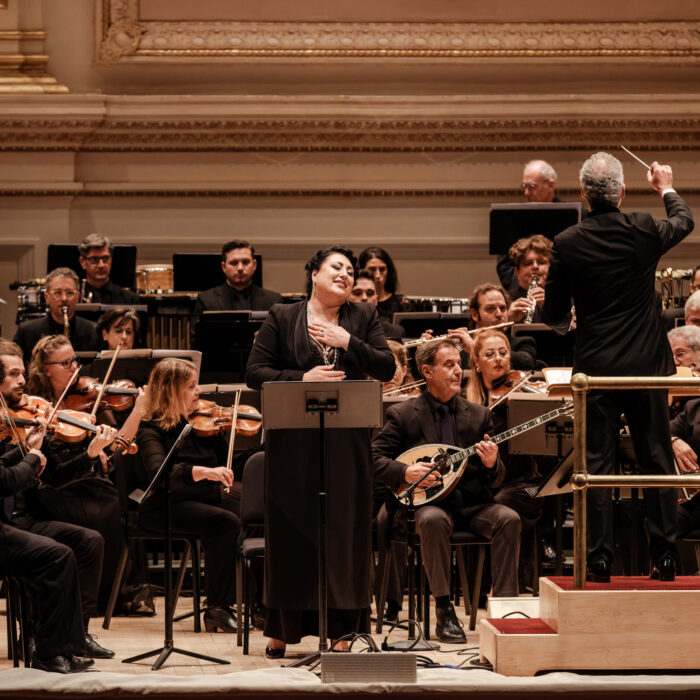
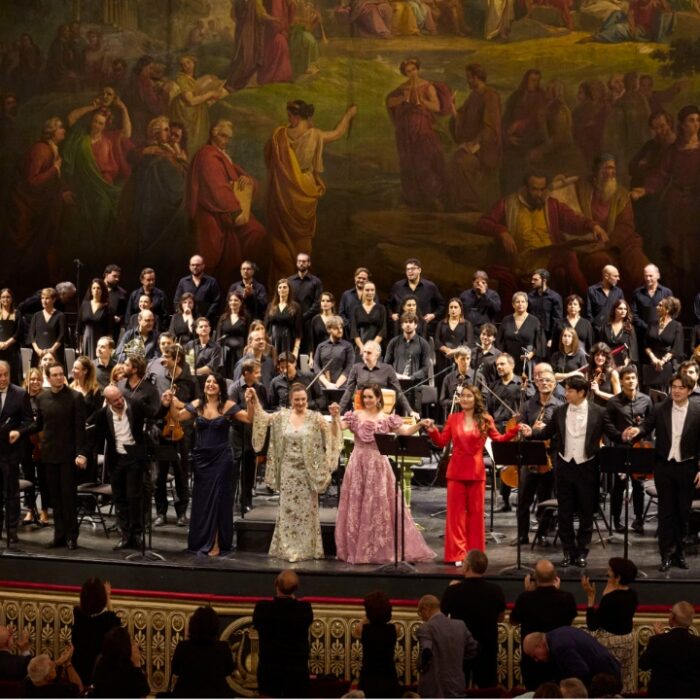
Conductor Marco Armiliato and the Met Orchestra and Chorus celebrated “Traviata” on this particular night, allowing the spotlight to fall on the lead singers that left unforgettable impressions.