Environmental Operas Reshaping Our Ideas Of The World
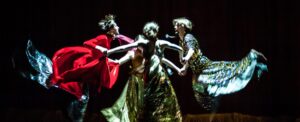
By John VandevertPhoto Credit: Valeriya Landar/Opera aperta
The themes of environmentalism, conservation of natural resources, sustainability, and ecological welfare abound in contemporary discourse due to the increasingly unstable nature of Earth’s condition and humanity’s persistent inability to regulate the actions of the apathetic. Composers of every age, capacity, and style have come forward to voice their views on the matter. From the 1950s till today, such themes have found a footing in the opera space. Britten’s “Noye’s Fludde” (1958) was among the earliest. Later, Christopher Brown’s “The Split Goose Feather” (1979) launched a UK-based trend of community-based operas with environmental themes that has continued to today with Rachel Portmen’s “The Water Diviner’s Tale” (2022) and Noah Mosley’s “The Wish-Gatherer” (2023).
To celebrate Earth Day, I wish to explore two recently premiered operas concerning environmental themes. While there are many others — too many to adequately include in one article — I will list some other ecologically-minded operas at the end the article, if my reader wishes to learn more. In many respects, the environmental turn in opera is intimately associated with the wider posthuman turn in social discourse, where the human-nature relationship is being interrogated with an awareness of the mutualities between both. Operas like Stuart MacRae’s ‘“Anthropocene” (2019) and projects like the Global Science Opera (GSO) argue that the age of the human is over. As we become ever-more aware of how dependent humans are on nature, we evolve, and it is this step that is contemporary opera’s next big venture. In this vein, let us look at two of my most favorite recent operas that deal with a highly topical theme: humanity not as a leader but a team player.
Roman Grygoriv and Illia Razumeiko: “GAIA-24. Opera del mondo” (2024)
Described as a “contemporary geohistorical opera,” Ukrainian composers Roman Grygoriv and Illia Razumeiko wrote the opera as a meditation on the symbiotic dynamics between the universe, nature, and humankind, with an incisive look at how cultural and political contexts affect the relationship. The work’s main theme is the impact of the Russian invasion on Ukraine, specifically the destruction of the Kakhovka Dam, and the ecological damage of Putin’s actions. It first premiered in Kyiv on May 10, 2024, at the International Center of Culture and Arts. Programmed by Opera aperta, the opera resembles less a traditional opera than a pastiche-like jukebox opera, featuring selections from both classical, folk, and non-classical music to tell its environmental story. Given its freshness, it remains to be seen what the future looks like for this opera, but it joins the lauded list of similar operas, including “The Mothers of Kherson” (2025) and Mykola Lysenko’s “Aeneid” (2025).
Jacinth Greywoode: “White Raven, Black Dove” (2025)
Commissioned by White Snake Projects, a Massachusetts-based company focused on giving voice to opera composers historically starved of a voice, Jacinth Greywoode’s opera takes an intermedial approach to the discussion of two central issues for contemporary US culture: racial inequality and climate change. It premiered in September 2025 and was, by all accounts, a rich affair, being full of multi-elemental theatrics and featuring a score of tasteful quotative moments. The plot centers around two birds following the Sixth Extinction, otherwise known as the Anthropocene extinction: the human-fabricated extinction of living things. The two birds attempt to collaborate and construct a healthier future. Taking full advantage of the technological innovations made in opera in recent decades, especially the use of computer imagery and animation, Greywoode also tells the story of existential battle through his deliberate meta-destruction of music history itself — Neo-Classicism fights classical Serialism while European Romanticism spars with Western pop music.
Others Environmental Operas
In no particular order, one would recommend Uljas Pulkkis’ “All the Truths We Cannot See” (2020); Elizabeth Clark’s “Seeds Under Nuclear Winter” (2021); Sivan Eldar’s “Like flesh” (2022); Sir David Pountney’s “Masque of Might” (2023); Ellen Reid’s “The Shell Trial” (2024); Beniamin Baczewski’s “Jezioro Popiołów” (2025); and Cecilia Livingston and Duncan McFarlane’s “Parelios” (2026).
Opera companies great and small have contributed to keeping environmentalism on society’s lips. In 2024, the New York City-based group American Opera Projects launched their initiative The Climate Opera Project, a collation of four operatic shorts on ecological themes. Other projects like the Environmental Opera Research Conference in 2022, held in Helsinki, Finland, discussed the growing need for infrastructural focus on sustainability and actionable steps to make contemporary opera more environmentally friendly. This is a pertinent point, considering the vast quantity of resources that opera requires. Further initiatives include “Project Butterfly,” which “[creates] a new attitude towards sustainability in theatre and opera houses by exploring new green practices related to opera production and circulation.” A ground-breaking achievement in this regard is Malmö Opera in Malmö, Sweden, whose opera house is the first sustainability-verified opera house in the world.
Watch
Categories
Special Features