Opera Forward Festival 2026 Review: Les Enfants Terribles
Soprano Eva Rae Martinez Shines in an Engaging Performance
By Alan Neilson(Photo: Joost Milde)
Amsterdam’s Opera Forward Festival played it safe with a staging of Philip Glass’s “Les Enfants Terrible,” not that it was any less enjoyable for the fact. Glass’s operas can, with their mix of strong, thought-provoking narratives and accessible, exciting and energetic music, almost guarantee to bring in the audiences. And this was certainly the case here.
Written in 1996 as a dance opera for Theatre Casino, Zug, Switzerland, it has proved itself to be one of Glass’s most regularly performed operas, partly, no doubt, due to its small cast and the need for only a piano accompaniment, which makes it ideal for touring companies. In fact, this production is a collaboration between the touring company Opera Zuid and Nederlandse Reisopera with Dutch National Opera.
A Layered Narrative Offering Interpretative Scope
Based on Jean Cocteau’s novel of the same name, the narrative follows the relationship between Paul and Elisabeth, a teenage brother and sister, whose lives are intimately intertwined. They have turned their shared bedroom into a private world of their own, full of paraphernalia with symbolic meanings to which they are closely connected and which reinforces their relationship. They indulge in a private ‘game,’ a fantasy world with its own internal rules, in which they torment, provoke and challenge each other. Both had to have the last word. They are fused together by an emotional umbilical cord, the actions of one impacting the other. Following the death of their mother, the two children inherit the house and are thus free to indulge themselves without guidance or the need to grow up and so become trapped in a permanent state of adolescence with all its associated behavior, in which shame does not exist.
There are also other characters who impact upon their world. There is Gérard, Paul’s devoted friend, who loves Elizabeth, and there is Agathe, whom Elizabeth met while working as a model and who bears an uncanny likeness to Paul’s school friend Dargelos, who almost killed Paul with a snowball. The four move into a large house together, and the tensions and behaviors one would expect from four marginalized teenagers living together are realized with devastating consequences.
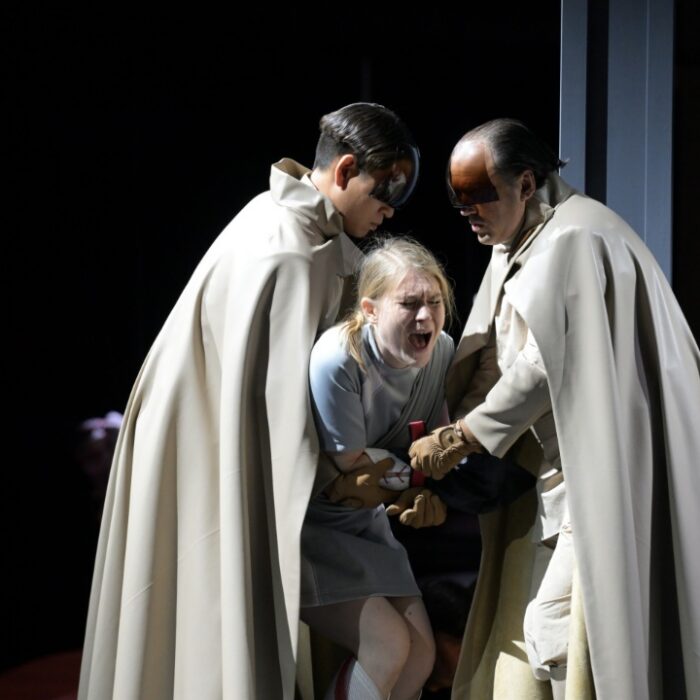
It is a complex, multilayered work laced with symbolic meanings that offers the stage director plenty of possibilities on how to present and interpret the narrative, with a wide choice of themes that could be developed, including toxic sibling dependency, maladjusted or stifled adolescent development, and drug addiction, along with Freudian and other psychological motivations. Béatrice Lachaussée, supported by set and costume designer Jorine van Beek, decided on a clear, lively presentation of the storyline that touched on and hinted at the undercurrents that motivated the teenagers’ behavior to create a thought-provoking and gripping piece of theater.
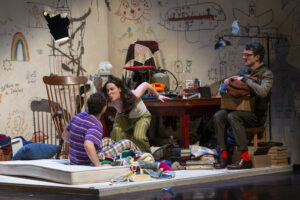
The sets, which basically consisted of a bedroom in the teenagers’ mother’s house, followed by a larger bedroom in the home into which the four adolescents moved after Elizabeth’s husband died. The rooms were exactly as one would expect; they were untidy, cluttered with a wide variety of junk items, and not particularly clean-looking. Each had their own sleeping space, often on the floor, and a general sense of chaos weighed heavily over the stage. It added up to a suffocating environment, in which the characters’ lives became a shared experience with little space for privacy.
Lachaussée drew realistic portrayals of the characters from the singers. Even if they possessed certain distorted character traits, they were wholly believable. The onstage world was therefore one that was easy to engage with. The relationships between the characters were brilliantly crafted to reflect their adolescent natures, although in the case of Paul and Elizabeth it was taken to an extreme to reflect the power of their mutual emotional dependency.
In all, it proved to be an engaging, psychologically convincing reading that hinted at darker motivations while remaining focused on the fundamental essence of the drama. It did not attempt to explore some of its more obscure possibilities and thus did not become diverted from the drivers that built the momentum that culminated in an emotionally powerful death scene.
A First-Class Performance from the Pianists
The work is written for three pianos, which were positioned two to the left of the performance space, played by Nicolas Krüger, the musical director, and Leonardo Moyano Ortiz, and one to the right, played by Daniel Ruiz de Cenzano Caballero. And what a fascinating experience it was to watch them coordinate and mold their performances; not only did they create a perfectly integrated sound but they were also sensitive to the dramatic nuances of the drama. Listening to Glass’s driving, mesmeric, repetitive rhythms, which helped propel the narrative forward, was a delight, and the balance with the singers was precise and emotionally connected throughout the evening.
The four singers engaged enthusiastically and identified convincingly with their characters; however, while all four produced pleasing vocal performances, it was the two female singers that impressed.
Soprano Eva Rae Martinez produced an emotionally strong and psychologically layered portrait as Elizabeth, one that brought out her jealous, dependent, competitive and self-absorbed nature. Her singing was clear, articulate and expressive, underpinned by her beautifully nuanced phrasing and an upper register that she used to successfully carry her febrile outbursts. Beyond the high emotion, she was also able to display the beauty of her voice, which lay pleasingly on the ear.
Baritone Ismael Correa Ulriksen, playing the role of her brother, Paul, undermined his otherwise successful interpretation by failing to moderate the level of his voice to the size of the theater; he was far too loud, at times almost ear-splittingly so, and it noticeably detracted from his overall performance. His ability to fashion his relationship with Elizabeth was nevertheless well developed; together they were playful, fractious, envious, manipulative and demanding. His feelings for Agathe were convincingly displayed, as was his friendship for Gérard.
Unfortunately, Steven van der Linden, playing the role of Gérard, suffered from the same failing; his singing was also far too loud. Yet despite this and his forceful projection, he successfully captured his character’s shy, malleable nature.
Mezzo soprano Aaike Nortier played the roles of Elizabeth’s friend Agathe and the mysterious figure of Dargelos, although the connection between the two characters was not really explored and were presented as two independent people. Nortier produced well-crafted readings of the characters and showed off her vocal qualities to good effect, in which her piercing upper register and the flexibility of her voice caught the attention.
Overall, this was thoroughly entertaining and well-presented production, one which sparked the imagination without pushing ideas and perspectives that could have distorted the performance. The young cast acquitted itself well, despite some overenthusiastic singing from the tenor and baritone, while the three pianists were simply superb to the point of being a performance in themselves.