Opera Meets Film: Review for Robin Norton-Hale’s ‘La Bohème’
By Mike Hardy(Photo: La Boheme movie still press image)
There’s no denying it. Italian opera, or ANY opera in another language for that matter, loses something, intrinsically, when it’s sung in English. Additionally, operas performed as a motion picture for cinema lose something more, by necessity, the artists having to mime to a pre-recorded rendition, negating the true passion and emotion of the moment.
So, on paper, this cinematic offering by award winning director, (Artistic Director and CEO of English Touring Opera), Robin Norton-Hale, to be screened in cinemas from March, shouldn’t really work. But…somehow…it just does. The film is adapted from her Olivier Award winning stage production from 2009.
Consistently ranked as one of the top 10 most performed operas worldwide, Puccini’s “La Bohème” with its enduring, massive popularity stems from its relatable story of young love, heartbreaking emotional depth and accessible melodic score, is frequently touted as the ideal “first opera.”
Traditionally set in the Latin Quarter of Paris around the 1830s-1840s, the story, (based on Henri Murger’s novel “Scènes de la vie de bohème”), depicts the impoverished lives of young artists Rodolfo, Marcello, Schaunard and Colline along with their trials and tribulations. It has subsequently been re-written to be set in such diverse stagings as onboard a spaceship, in a cancer ward where the protagonists had HIV, on a tower block rooftop and on the streets underneath a Paris bypass, to name but a few.
Production Details
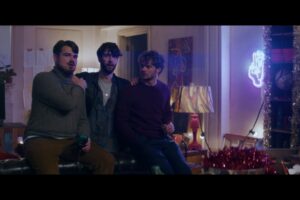
This ambitious project sees the bohemians living their lives in modern day East London, something which cinematographer Jack Edwards, with the aid of award-winning editor Sylvie Landra, captures with remarkable beauty and vividness. The bustling pubs, streets populated by police & ambulance sirens, open parks, Clapton, London Fields, Ridley Road Market and Broadway Market all captured beautifully, lending unquestionable authenticity to the production.
Setting a 19th century opera in modern times was never going to be an easy task and inevitably, significant changes need to be made to afford it any credibility. Some changes are simple, like substituting Schaunard’s violin for a guitar to enchant Socrates the parrot to death with his playing, (although why in the modern day anyone would hire a guitar player to strum away until their parrot drops dead isn’t really elaborated on). But this scene was considered essential enough to not only be included, but to be staged and filmed, with the added twist that the attractive partner of the ‘eccentric Englishman’ who hired Schaunard appears to be having a ‘thing’ with the musician.
The ‘garret’ here isn’t actually a top floor attic but a lower-level student flat, where budding writer Rodolfo, artist Marcello, guitar playing Schaunard and (presumably philosopher) Colline exist. The TOP floor in this adaptation is reserved for Mimì who is a Ukrainian who “cleans rich peoples’ houses” and whose flower making appears to be referenced by her needlework skills.
Of course, those things which have no real modern parallel are simply left out here; Parpignol the toy seller, invariably accompanied by hordes of excited children, would hold little logic by appearing in the second act, here set in a traditional English pub rather than the ‘Café Momus.’ Likewise, there is no marching military band at the end of the act.
Act three is, understandably enough, devoid of any singing milkmaids, peasant women or customs officers, and the ‘Tavern’ here is the local pub where Musetta appears to work and where we find Marcello painting an advertising hoarding.
In the final act, Colline’s famous act of benevolence is portrayed with the selling of his silver cigarette case rather than his traditional overcoat.
Questionable Choices
So far, so plausible, although there are some production conundrums that couldn’t really be convincingly resolved, to my mind at least. The first act sees Rodolfo burning pages of his manuscript in a wastepaper bin as a means to provide warmth; hugely unrealistic given that he writes on, and (presumably) saves his work to a laptop and their flat is well served with electricity. That said, it could be argued that there was no other way of denoting or rewriting this pivotal, establishing scene.
Again, in the final act, Musetta removes her earrings and leaves with Marcello to sell them in order to procure medicine for the ailing Mimì. Perhaps in Norton-Hale’s view, the National Health Service really IS on its last legs and such methods of acquiring medication are necessary. Which kind of brings it nicely to the fact that Mimì is dying from Tuberculosis, so what remedy her friends thought suitable to ask for and treat her with is anyone’s guess. Whilst statistics suggest that there is, indeed, an increasing incidence of this disease in the UK, fatalities are not common and it isn’t really conceivable that Mimì or her friends wouldn’t have sought medical intervention at a much earlier point in the disease. Indeed, for me, this oversight is accentuated further by the fact that Schaunard resorts to dialling the emergency services only towards the very end of the film, way past the point when any other rational person would have otherwise done so.
The libretto, naturally, was going to require a huge makeover, interspersed with modern day epithets, (I counted two renditions of ‘bullshit’, at least the same number of ‘crap’ and a ‘bastard’.) Presumably, in order to garner a lower age film certification, it was decided to avoid the more extreme, but probably more credible, forms of profanity!
For no other reason than to, (presumably), lend the project added gravitas or legitimacy, the film also features a number of established actors, relatively minor ‘stars’ of television and film, including Nigel Hastings, (“Four Weddings and a Funeral”), and Ruth D’Silva, (“Ted Lasso”) among others. Whilst their talents are inarguable, their contributions here do little by way of enhancement. But I’m being pedantic here. Because this movie WORKS, in huge part due to the quality of the acting and the singing.
Per Director Robin Norton-Hale, “Alice Farnham recorded the orchestra in advance; the singers sang at this recording session so that the tempi and interpretation was what they and Alice wanted, but the singers were recorded on a different track which was then removed from the recording. Then, on set, the pre-recorded orchestra was played for the singers to sing along to live, and it is that live, on-set singing that you hear and see in the film. To achieve this, on set Alice had to conduct along to a video of her conducting the pre-recorded orchestra, so that the live on-set singing was exactly aligned with the orchestra. A remarkable accomplishment and a credit to Alice Farnham and the on-screen artists for producing what I believe to be an unprecedented piece of cinematic opera production.”
Musical Highlights
Royal Conservatoire of Scotland graduate and 2024 Kathleen Ferrier Award winner Matthew McKinney plays Rodolfo with remarkable charm and sensitivity. Boyishly handsome and endearing, he sings with an exquisite, lyric tenor instrument that possesses a wonderfully rich resonance throughout the registers. His enchantment by, and his adulation of Mimì is wholly convincing. Likewise, his interaction with his fellow bohemians exudes genuine laddish bonhomie. His keynote aria and duets were exemplary, despite their translation to English with their out of place rhetoric, taking the high ‘C’ at the cessation of his duet with Mimì and showing convincing emotion with his fourth act duet with Marcello. It is to be hoped that this film catapults his career into the next level because his voice deserves to be more widely heard.
Soprano Lucy Hall sings the role of Mimì, Rodolfo’s love interest. She appears to be noticeably a tad older than her beau yet conducts herself with youthful innocence and sings with a palette of creamy rich, colours. Her third act engagements with firstly, Marcello and then Rodolfo were particular powerful yet poignant. Whilst listening, surreptitiously, to Rodolfo and Marcello’s exchanges, she switched convincingly from annoyed exasperation with Rodolfo’s faux complaints to fearful concern when realizing the potential gravity of her illness. Her ‘farewell’ aria to her lover was divine. A wonderful, cogent performance and another voice deserving of a wider audience.
Samoan baritone Benson Wilson plays a characterful Marcello with great stage presence. Moreover, he sings with a mellifluous, often dreamy, enveloping tone. Big, handsome and charismatic, he was a standout in all his scenes: comedic with Rodolfo and the gang in Act one, jocular and dominant in the bar scene in Act two and both compellingly enamoured and truculent in Act three with his love, Musetta. He sung a beguiling duet in the final act where he laments her loss.
Schaunard is played by equally charismatic baritone Mark Nathan who gets to grips with a real life parrot, strumming his guitar for it before poisoning it, aided and abetted by the attractive partner of the ‘eccentric Englishman’ who hires him. Vocally impressive, he gave a splendid rendition of how he completed his engagement to his friends who were more concerned with eating and drinking the spoils of his success.
The group was completed by Edward Jowle in the role of Colline; unusual in that Jowle is a baritone and Colline is ordinarily, famously sung by a bass. No matter, he presents a proudly gay character here, wonderfully camp and amusing; his famous final act aria, to my ear slightly less mournful and impactive because of the higher, lighter fach, but accomplished, nonetheless.
More Musical Details
Special mention must go to English-Japanese soprano Julia Mariko in her role of Musetta. She plays the gregarious party girl to absolute perfection, a positive tour-de-force with a melting yet bright, warm, silvery soprano voice. Described in the IMDb film puff as a “social climbing sex bomb,” Mariko is inarguably beautiful with a commanding presence. She is the belle of the pub ball where she attracts the attentions of all with her table dancing antics and sweet, expressive vocal line when she delivers her famous “Waltz” aria. The film gives greater focus to her spat with Marcello in the third act than is normally experienced, where Rodolfo and Mimì’s promises to remain together until the spring take second place in this enactment. This makes for a far more rousing and emotional interplay than the staged opera facilitates, where all the characters usually appear on stage together. It enables the camera to delve deeper and reveal a much more nuanced relationship than the light, jocular version normally presented in the theatre. Musetta’s storming off in a rage, before pausing to light a cigarette and break down in tears is hugely emotive, a credit to both actress and director.
Kudos, also to Nicholas Morris as Alcindoro and Pauls Putnins as Benoit, both vocally replete and suitably lascivious in their roles.
Rather than a traditional full symphony orchestra, this production features a “new interpretation” of Puccini’s score with a modern orchestration by Jonathan Dove. Towards the beginning of the film, the orchestra ensemble gathers on a rooftop overlooking the city before commencing Puccini’s famous, opening bars. Rather than “modern orchestration” or a “new interpretation,” to my ears what was rendered was a slightly curtailed and modified version of the original score rather than anything radically new. Still, Puccini’s music is inarguably exquisite and there’s nothing here that detracts. The orchestra also serves as a poignant symbol at the end of the movie when it packs away, leaving the forlorn Rodolfo contemplating his lot.
In conclusion, and as someone who adores “La Bohème,” I have to say that despite its foibles, this is still a little bit of magic. Will it prove to be a success? I truly hope so. For those engaged in the film, especially the artists, deserve greater recognition and wider audiences to witness their talents.
Would I recommend this to someone as an introduction to opera? Probably not, but only because I would want a newcomer to see the work as Puccini wrote it, to the libretto he commissioned and approved. But it would probably be a close second choice, and I would be MORE than delighted to be proved wrong and for it to enthral someone to this wonderous, joyous art.