Barockwerk Hamburg 2026 Review: Pharao Tubaetes
By Mengguang Huang(Photo: Valentin Daniel Preissler)
The annals of Baroque opera are filled with lost masterpieces—works that once dazzled European courts only to be silenced by shifting musical fashions. While the period ensemble Barockwerk Hamburg performs only a few times a year, their contribution to resurrecting rare Baroque gems is peerless. They have become the primary champions of Carl Heinrich Graun, an effort that audiences witnessed again at the Hamburg State Library Atrium.
Graun’s 1735 opera “Pharao Tubaetes” follows a remarkable journey from its origins as Apostolo Zeno’s 1724 Indian-themed libretto Gianguir in Vienna to its final Egyptian adaptation in Brunswick. Seeking a theme for a school exercise, rector Johann Samuel Müller translated the text into German and shifted the setting to Egypt to satisfy the Enlightenment-era fascination with hieroglyphs. In this biblical-era drama, the rebellious Prince Ramesses challenges his father, Pharaoh Tubaetes, for the throne while secretly loving the captive princess Nitocris. Disguised at court, Nitocris seeks bloody vengeance for her family’s murder. Amidst intrigues led by the scheming Asaf and the wise Hermes, the conflict escalates into warfare. However, the narrative is ultimately dominated by the powerful female leads; through the selfless mediation of Queen Zama, the cycle of revenge is broken. This leads to a grand reconciliation, proving the women’s moral superiority over the impulsive male protagonists.
Presenting such a work was a challenge: with no modern scores or recordings, the audience entered uncharted territory. To bridge this gap, the production utilized a detailed visual presentation featuring Baroque stage designs, using text and live narration to clarify the complex plot. By strategically compressing the German recitatives, the performance accelerated the narrative pace, focusing the evening’s energy on Graun’s true brilliance—the virtuosity and emotional depth of his spectacular arias.
Stellar Cast
In the title role, Matthias Vieweg portrayed a Pharaoh Tubaetes who was far from a one-dimensional ruler. He captured the deep-seated indecision of a ruler who, as the libretto suggests, is often weak-willed and reliant on his wife’s counsel. In his Act three aria, “Nel mio cor stanno a consiglio,” Vieweg masterfully navigated the battle between revenge and love, illustrating the monarch’s inner turmoil as both a sovereign and a father. His voice anchored the production, providing a grounded contrast to the high-stakes rebellion led by his son.
Terry Wey as the rebellious Ramesses was the production’s emotional lightning rod. Wey’s countertenor navigated Graun’s technically demanding high-wire acts with a ferocity that matched his character’s testosterone-fueled impulsiveness. We saw this early on as he rejected the counsel of Hermes, declaring his love for the Alinda (Nitocris) over his duty to the crown. Wey was particularly effective in the battlefield scenes of Act four, where his aria “Sù à pugnar forti guerrieri” transformed vocal virtuosity into a call to arms, capturing a young man desperate to prove his worth through steel and song.
The male rivalry was sharpened by Matthias Dähling as Asaf. Using the same vocal range as Ramesses, Dähling effectively competed musically, portraying a favorite who ruthlessly exploited his influence over the Pharaoh to further his own marriage prospects. His Act two aria, “Mi dirai, spera?” was a chilling display of manipulative charm. Mirko Ludwig as the wise minister Hermes, provided the production’s moral compass. As the only tenor, Ludwig’s voice stood out as a beacon of reason. His intervention in Act three—pointing a sword at the Pharaoh to “protect” him from his own son’s wrath—was a shocking dramatic turn that Ludwig executed with a perfect blend of urgency and gravitas.
Musical Highlights of the Night
However, the evening truly belonged to the women, whom Graun positioned as the intellectual and emotional drivers of the plot. Sarah Hayashi, stepping in as a last-minute replacement, gave a powerhouse performance as Nitocris. She inhabited a character driven by a bloody thirst for revenge for her murdered family. Her arias were structural marvels—unpredictable and complex—reflecting her internal struggle between her oath of vengeance and her genuine love for Ramesses. A standout moment occurred in Act two with her rendition of “Vanne… si… di al mio diletto.” This aria, notable for its irregular structure, saw Hayashi skillfully navigate a whirlwind of conflicting emotions. Her voice darted between hesitant pauses and sudden bursts of resolve. By the time she reached her Act four duet with Wey, “Placide a miglior vita,” her voice had shifted from the sharp edges of fury to a sublime, tender loyalty.
Complementing this was Hanna Herfurtner’s portrayal of Zama, the Pharaoh’s second wife. Herfurtner embodied the ideal of virtue, a rational and generous presence amidst the courtly chaos. While the men postured, Zama acted as the architect of peace. Herfurtner’s lyrical soprano shone in Act four as she pleaded for mercy for her stepson, proving that her character’s sincere love was the only force capable of breaking the cycle of violence. Her performance underscored the libretto’s subtle commentary: that the stability of the state rests on the wisdom of its women.
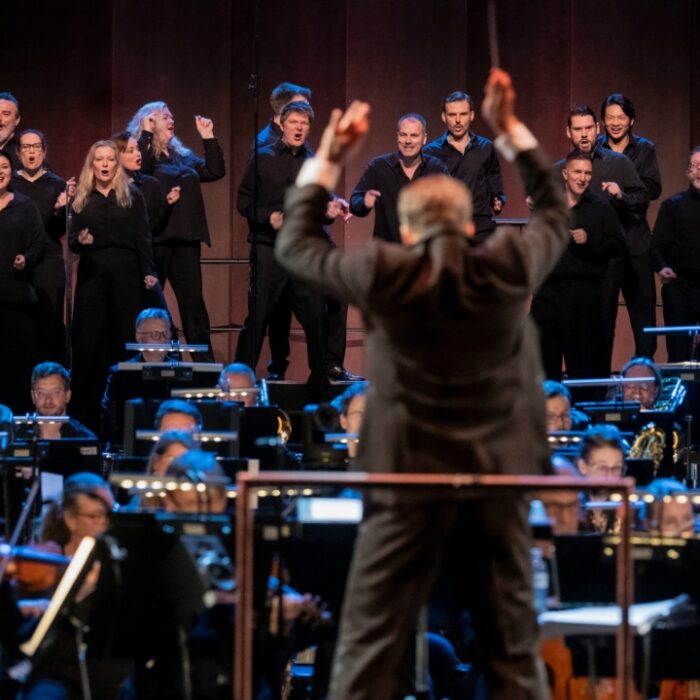
Under conductor Ira Hochman, Barockwerk Hamburg masterfully captures the so-called “Empfindsamer Stil,” stepping into a delicate supporting role that allows the vocalists’ sensibility to flourish. The strings and baroque oboes create a transparent texture, while the rhythmic pulse of the theorbo, bassoon, and twin harpsichords provides the essential harmonic anchor.
The preparation for this performance clearly involved extensive archival research and meticulous desk study, therefore there could be no better performance venue like Hamburg State and University Library. Without traditional scenery, the singers utilized the atrium’s two floors for dynamic movement, delivering an emotionally direct performance through voice alone. While this concert-version trimming was highly efficient in showcasing the drama, the transition from the soul-stirring Act four duet between Ramesses and Nitocris to the final lieto fine felt somewhat abrupt. One can only hope that a future, unabridged CD release will allow the complete dramatic arc to breathe in its full glory.
Categories
Reviews