Orchestra I Pomeriggi Musicali 2025-26 Review: Mozart’s Mass in C Minor
By Bernardo Gaitan(Photo: Lorenza Daverio)
The Grosse Messe, or as it is known, the Great Mass in C minor, K. 427 by Wolfgang Amadeus Mozart occupies a singular place within the sacred repertoire. Monumental, deeply expressive, and paradoxically unfinished–much like his Requiem–the work emerged during one of the most intense periods in the composer’s life.
The personal and professional context was complex and ultimately prompted him to begin the composition. On the one hand, he had just freed himself from the rigid hierarchy imposed by Archbishop Hieronymus von Colloredo in Salzburg in order to pursue a freelance career in Vienna. On the other, although he had only recently married Constanze Weber, the union had created family tensions, particularly with his father, Leopold Mozart.
In a well-known letter from January 1783, Mozart mentions having made an intimate promise: to compose a Mass and present it in Salzburg once he could bring his wife there. Although current musicological studies debate the extent to which this was truly a formal vow, what is certain is that the work arose from a deeply personal impulse rather than from a commission. This fact is particularly significant considering that in the Vienna of Emperor Joseph II a more sober form of liturgical music was being promoted, making the creation of a missa solemnis of such dimensions rather unusual. Mozart brought an incomplete version of the work with him when he visited Salzburg in 1783. There, on October 26, some sections were performed at the church of the Abbey of St. Peter rather than in the cathedral, due to the tensions with the archbishop. On that occasion, Constanze herself sang the soprano solo part.
Musical Highlights
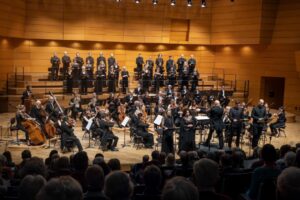
Within the framework of its 81st concert season, Orchestra I Pomeriggi Musicali presented this colossal work at the historic Teatro Dal Verme in Milan, entrusting the performance to a conductor who needs no introduction and who understands the style perfectly: Diego Fasolis. The Swiss maestro distinguished himself through a finely balanced combination of stylistic rigor and expressive energy. Fasolis, a specialist in the Baroque repertoire, highlighted the contrapuntal dimension of the score with clarity while never sacrificing the theatrical vitality that Mozart constantly infuses into the writing.
His clear and disciplined baton guided the Orchestra I Pomeriggi Musicali effectively, eliciting a transparent and flexible sound. Particularly notable was the work of the woodwinds in the “Et incarnatus est,” where the dialogue among flute, oboe, and bassoon achieved an almost chamber-like transparency. The strings, for their part, maintained a highly effective rhythmic tension in the more dramatic choral passages, especially in the “Qui tollis.” Il Coro della Radiotelevisione Svizzera demonstrated strong technical solidity, with precise articulation and balanced sections: an essential element in a work where the choral fabric constitutes one of the structural pillars.
As is customary with Fasolis, he addressed the audience briefly at the beginning of the concert. He explained that because Mozart left many orchestral sections unfinished, the work breaks off after the “Credo,” as he never composed the “Agnus Dei.” For this reason, Fasolis decided–so as to provide a traditional closing to the Mass format–to include the “Agnus Dei” from the opera Thamos, König in Ägypten (Thamos, King in Egypt), composed by Mozart in 1774. In Fasolis’s words, “it is an operatic aria for bass, and with its Commendatore–like style it seems particularly suited to the dark times we are currently living through worldwide.”
Illuminating Cast
The quartet of soloists delivered work of a very high level. Soprano Lydia Teuscher stood out especially for the elegance of her vocal line and the natural ease with which she navigated the demanding coloratura of the “Laudamus te.” In the “Et incarnatus est” she offered one of the most moving moments of the evening, with a luminous emission and refined musicality that blended perfectly with the solo instruments. The second soprano, Rosa Bove, highly expressive, contributed a warm and well-projected timbre, delivering a solid performance particularly effective in the duets and ensembles of the “Gloria,” where the homogeneity between the two voices proved especially successful.
The tenor Moritz Kallenberg displayed a clear vocal line stylistically well suited to the Mozartian repertoire, while the bass Johannes Weisser appeared only in the final Benedictus and in the “aria di baule” proposed by Fasolis to fill the gap left by the missing Agnus Dei. In both, he contributed solidity and depth in the lower register, with precise diction and a vocal presence well integrated within the ensemble.
In the hands of Fasolis–and with a vocal, orchestral, and choral ensemble of such high quality–the event proved a complete success. After generous ovations for all involved, the imposing and vibrant double fugue concluding the Hosanna was performed as an encore.