Scottish Opera 2025-26 Review: The Great Wave
By Alan Neilson(Photo: Mihaela Bodlovic)
The most anticipated performance of Scottish Opera’s 2025-26 season has to be the world premiere of the Japanese composer Dai Fujikura’s new opera “The Great Wave,” with a libretto by Harry Ross. In the months leading up to the opening night, the British media carried numerous articles about the work, including an interesting interview with the composer on BBC Radio 3. Expectations among the audience were high for the opening night of what was a sold-out performance.
Production Details
The great wave in question is the instantly recognizable woodblock print entitled “The Great Wave off Kanagawa” by Katsushika Hokusai, which depicts a gigantic blue wave dwarfing small brown boats overlooked by a snow-capped Mount Fuji in the background. The opera itself uses the iconic print as the center point to construct a narrative that reflects upon the artist’s creative drive along with significant aspects of his life and philosophy.
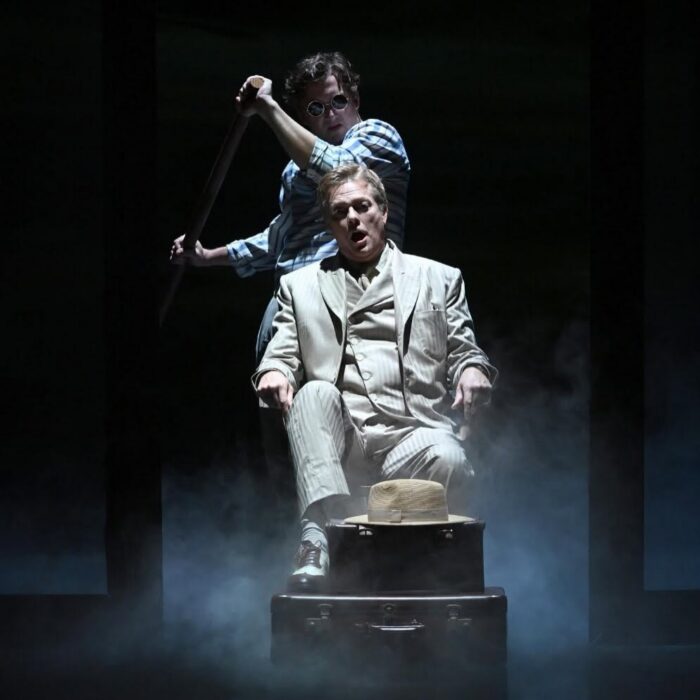
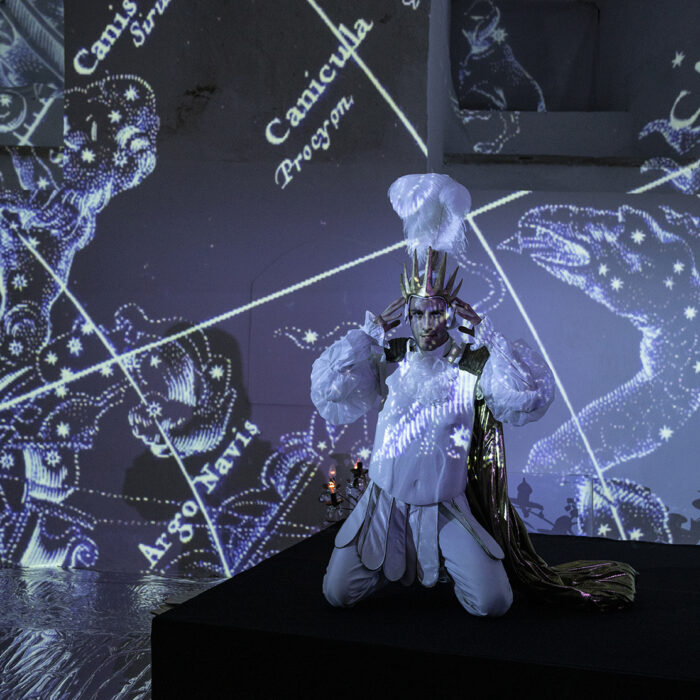
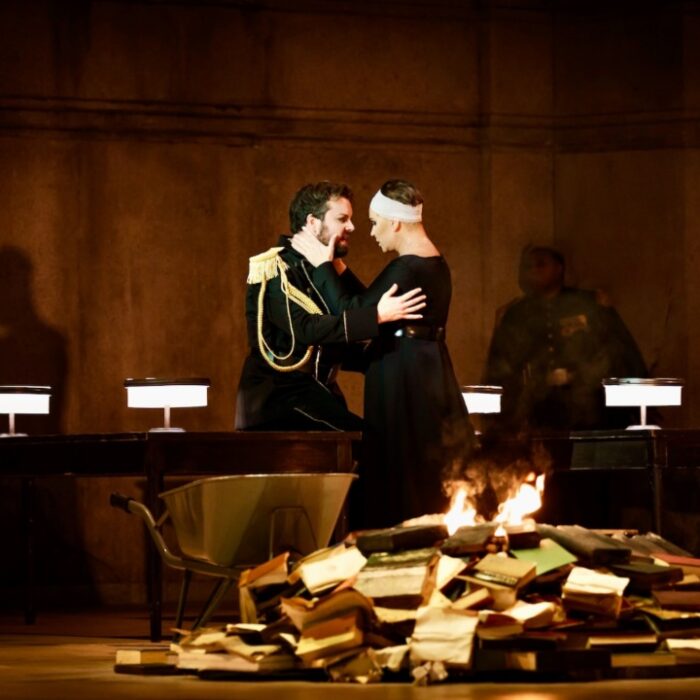
The piece, consisting of five acts, divided into 13 scenes, takes a nonlinear approach, beginning with Hokusai’s funeral. It then travels back in time to highlight the events and conditions that shaped the approach to his work before arriving at the final scene in which Hokusai, facing the prospect of his death, passes on his paintbrush to his daughter, Ōi, to continue the ongoing artistic journey. Although the selected incidents are taken directly from Hokusai’s life, which include his misfortune in being struck by lightning, trading illegally with the Dutch trade mission, the destruction of much of his work in 1839 by a fire that destroyed his studio in Asakusa, and his struggles with debt, it is not, however, a literal retelling. Rather, Ross added a fictional layer, not just by imagining the dialogue, personality traits, and emotions of the included characters but also through the addition of two poetical dream sequences that provided a surrealist aspect that successfully opened up deeper insights into Hokusai’s character and motivations.
It proved to be very successful in exploring Hokusai’s character and his relationship to his art. It portrays him as a man sustained by his painting; it is the source of his joy, the center of his life. Other factors, such as money and security, were shown to be of little importance despite the obvious negative consequences. Yet, even if he suffered physical privations, he remained an optimistic, happy character, buoyed by his art. He was a man always pushing at the boundaries and determined to fulfill his ambitions. His constant refrain was his desire for “another 10 years” of life. He coached his daughter to follow in his footsteps so that the artistic journey could continue.
Yet, dramatically, it was not particularly successful. For sure, there were moments that sparkled and gripped the attention, such as Hokusai’s Act one dream sequence, in which he imagines himself battling the wave off Kanagawa, and the Act three confrontation scene between his grandson and his creditors, but generally it lacked momentum and the dramatic tension necessary to sustain one’s full interest over the course of the performance. And it was Fujikura himself who has to shoulder much of the responsibility!
The work was written for a standard symphony orchestra with the inclusion of a shakuhachi, a traditional Japanese longitudinal wooden flute, played by Shozan Hasegawa, which successfully connected the music to the opera’s Japanese context with a dash of local color. It also added a textural quality that enriched the sound and by allowing Hasegawa the freedom to interpret the music in his own way, it provided the music with a level of interest and a frisson that may have been missing.
Miyagi and Stanford’s Brave Attempt Fails to Overcome the Work’s Shortcomings
The conductor, Stuart Stratford, elicited a sensitive and balanced reading from the Scottish Opera Orchestra, in which the sound of the natural world, in the form of storms and the turbulence of the raging sea, was convincingly depicted that was wonderfully contrasted with the sound of the ebbing and flowing of the tide that underpinned sections of the music. Certainly, the music in itself was reasonably successful. However, dramatically, it was too restrained and failed to support the text; too often it erred on the side of understatement, and Fujikura appeared reluctant to bring scenes to a satisfying conclusion, allowing them, instead, to meander listlessly and dull their impact. The work would have benefited from a little pruning.
The director, Satoshi Miyagi, did a fine job in constructing each scene and allowing the significance of Hokusai’s famous prints to dominate the narrative without forcing the point. In the lead-up to the interval, a magnified picture of “The Great Wave off Kanagawa” was presented on stage for the first time, dwarfing the characters standing in front and revealing its power and energy in its full glory. Other prints by the artist were also used in the production, including more images of Mount Fuji and his pornographic work, “The Fisherman’s Wife and the Octopus.”
His direction was successful in capturing the personalities of the characters, particularly that of Hokusai, whose fun-loving, carefree approach to life was perfectly contrasted with his dedication to his art, and his decision to include the spirit of Hokusai allowed him to view his own funeral and watch his artistic life unfold, giving the production an added dimension that illuminated the artist’s motivation and personality.
The chorus scenes were expertly managed and choreographed by Akiko Kitamura. The storm scene in Act one, for example, was visually excellent: holding umbrellas, the chorus moved forward, bent against the wind, then was propelled backward, superbly capturing the strength and violence of Nature. Likewise, boatmen used their oars to create a visually captivating scene.
The staging, with sets designed by Junpei Kiz and costumes by Kayo Takahashi Deschene, was largely monochromatic, which allowed the Prussian blue-colored Great Wave to achieve its full impact. The black and white costumes were inspired by traditional Japanese clothing, with Hokusai and Ōi dressed in blue during the later scenes.
However, there were certain failings, none more so than in the final act in which the large paper tiger and dragon from Hokusai’s second dream appear and were paraded around the stage, crowded with the characters, chorus, screens, and a picture of the great wave in the background. Certainly, it had the potential for a colorful and visually exciting episode, yet it appeared chaotic and uncoordinated and very different from the well-crafted scenes from the previous acts.
Overall, Miyagi’s staging did prove to be largely successful, although he was unable to counteract the lack of tension that regularly surfaced owing to the meandering musical passages that resulted in periods of disinterest.
Ohyama Creates a Compelling Portrait of the Artist
Unsurprisingly, most scenes were dominated by baritone Daisuke Ohyama, who was cast in the role of Katsushika Hokusai. He created a convincing portrait that clearly brought out his love for his art and for his daughter and his disregard for money and material possessions in general. Yet, it was other aspects of his character that he managed to convey, such as his sense of humor, his positive outlook on life, and the joy he found in other people’s company, that ensured he was depicted as more than just a cipher for the artist; he was a fully fleshed-out personality. Ohyama’s versatile vocal expressivity conveyed his almost wholly positive emotions, which quickly endeared him to the audience. There was also a comedic element to his interpretation, which he displayed with his over-the-top, mocking attempt to borrow money from his agent that allowed him to show off his ability to mimic. There was, however, one small negative criticism in that his voice occasionally lost focus.
Hokusai’s daughter, Ōi, was interpreted by soprano Julieth Lozano Rolong, portraying her as a loving daughter, devoted to her father and to his art, while also following a career in art herself. She possessed a bright, fresh-sounding voice that rode freely across her upper register, and although it exhibited a strong, piercing quality, it was never unpleasant and successfully conveyed her feelings.
Bass Edward Hawkins was double-parted in the roles of the Merchant Patron, Takai Kōzan, who offers Hokusai a new studio following the fire that destroyed his old one, and the role of his original publisher, Eirakuya Tōshirō. They were two very different characters, which Hawkins expertly brought alive with his clear, well-defined acting and expressively well-crafted singing: his Tōshirō was sympathetic and good-natured, while his Kōzan was hard-headed and tough.
Tenor Shengzhi Ren was also double-parted in the roles of the Sweetshop Owner and as his publisher, Nishimuraya Yohachi. Singing with clear articulation and a pleasing, sympathetic lilt, he created two clearly defined, distinct characterizations.
Tenor Luvo Maranti, in the short period in which he was on stage, made a strong impression as Hokusai’s anxious and frightened grandson trying to flee his aggressive creditors, in which he displayed quality, coating his voice with the necessary agitation and fear.
Mezzo-soprano Chloe Harris was cast in the relatively small role of Koto, Hokusai’s wife. A relatively minor part with little impact, Harris, nevertheless, managed to catch the attention with an expressive, articulate and well-balanced performance.
Collin Shay‘s pleasing countertenor delighted in the role of the Dutch merchant, Dr. Philipp Franz von Siebold.
Overall, “The Great Wave” is not dramatically strong enough to sustain interest over the entire evening, although it still has much to admire. Certainly, the text has enough to sustain a shorter score. However, Fujikura created a piece that branched out to create long reflective and atmospheric passages that, beautiful as they may have been, encouraged the mind to wander from the narrative and thereby undermined the dramatic tension. To an extent, and not wishing to overstate the case, there were suggestions of influences from more slow-moving theatrical traditions, such as the Japanese Nōh plays, which can prove challenging for some members of the audience.