Ópera de Oviedo 2025-26 Review: Rigoletto
Abstract Minimalist Production Clearly Follows the Libretto with Deep and Detailed Stage Direction by Susana Gómez
By Mauricio VillaOpera de Oviedo chose to finish the year 2025 with a new production of “Rigoletto” and a stellar cast of singers that made these performances difficult to forget.
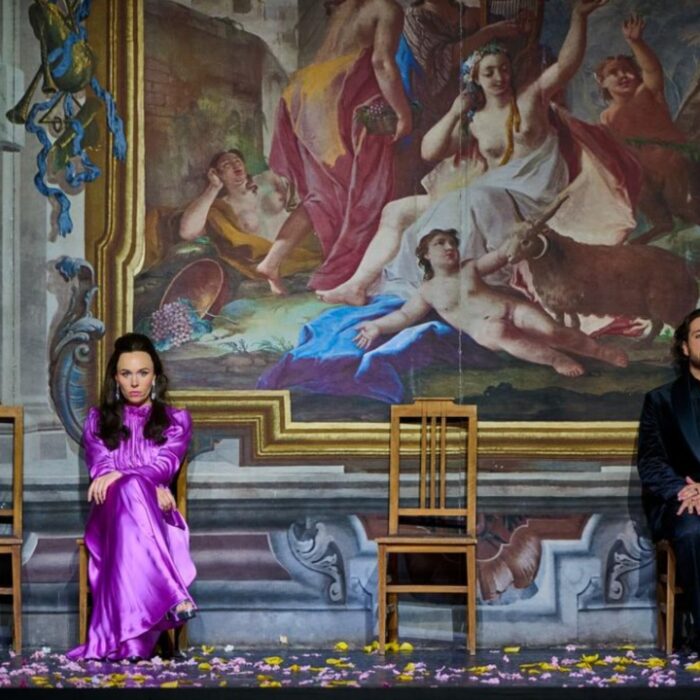
The new production was signed by the Spanish female stage director Susana Gómez, where being a female stage director is very difficult and rare in Spain. She is also Artistic Director of Real Teatro de Retiro de Madrid (a second theatre belonging to Teatro Real where they perform opera, dance and festivals in small format and specially dedicated to a young audience). Her CV is immense. She studied Philosophy, Music and theatre, and has directed more than thirty productions including Opera, Zarzuela and Theatre. Gómez translates, adapts and writes librettos. Between 2014 and 2023 she was associated stage director with the famous company La Fura dels Baus. Why have I taken interest in her trajectory? Because only someone so prepared and with such a vast, multifaceted experience could make a minimalistic and abstract production of “Rigoletto” so powerful, truthful and emotional.
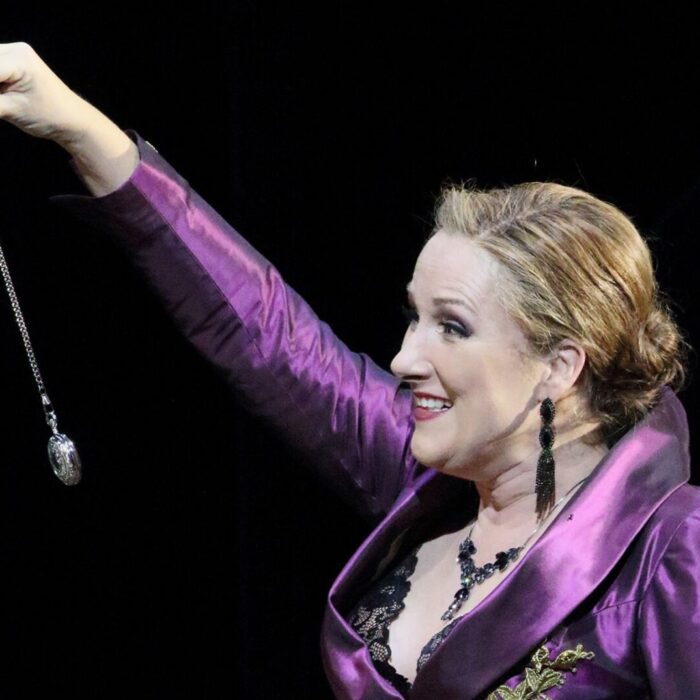
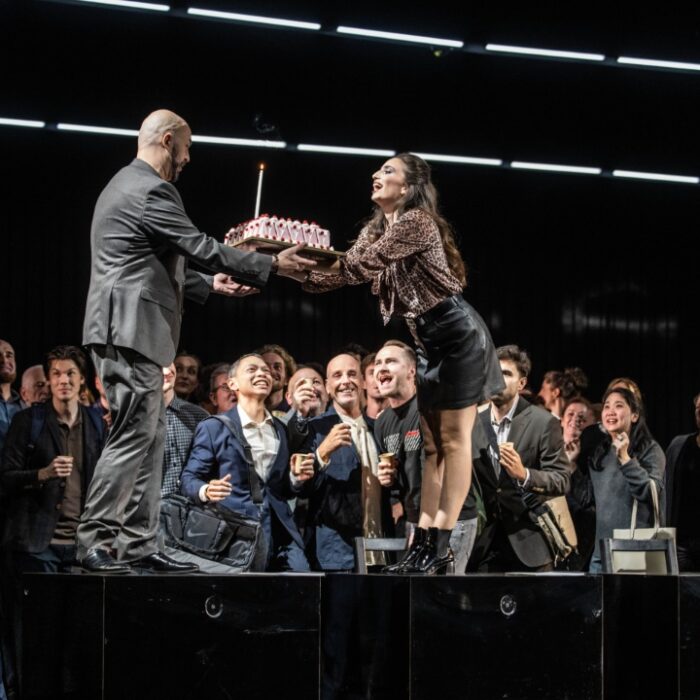
The stage was an inclined rectangle with minimal elements for each scene. It was “pure theatre.” Every single action was directed and meaningful from the effeminate choir to the soloist. The staging was so powerful that it was hypnotic. Gómez showed how a modern abstract production can be made by being respectful to the music and the libretto, and what is more: understandable. But one needs great talent to be able to achieve that, something that Gómez has and that most stage directors today do not.
Ernesto Petti as Rigoletto
The young baritone Ernesto Petti portrayed the titular role, Rigoletto. He succeeded with his emotional performance and perfect singing. He has a rich voice, with a warm and dark timbre, steady vibrato, secure high notes (up to high A natural) and a mesmerizing volume and projection. I wouldn’t expect someone this young (he is not even forty) could carry the weight of the whole dramatic arch and the tradition that this role possesses. But he is very talented, his instrument so rich and his projection so powerful that he succeeded in all the demands the role requires. If one listened to his singing while closing their eyes, or watched him in elaborate make-up (as was the case) they might say he is around fifty five years old.
He performed his entrance lines with determination and clear intentions. He avoided the “cliché mannerism” that is usually linked to this role. His reaction to the curse was believable and his duet with Sparafucile, “Quel vecchio maledivami,” was thrilling and measured. His first aria, “Pari siamo!” was a full display of different vocal colors and dynamics. The final traditional interpolated high G sounded powerful and secure. His first duet with Gilda, “Figlia! Mio padre!,” showcased his bel canto background through his lyricism, phrasing, mezza voce and use of dynamics. His singing was impeccable, including legato lines, mezza voce, strong high notes and dynamics. His acting was very convincing. When he screamed his daughter’s name, “Gilda…Gilda,” after finding out she had been kidnapped, one might have felt how he was breaking down. His first “Ah! La maledizione!” was hair rising and terrific.
His entrance in the second act, “La ra la ra la ra!,” was pathetic, cynical and full of sorrow, still containing strong emotions, until “Ah! Ella è qui dunque” when a burst of fury and rage filled his voice. He sang “che? –adesso non ridete?” with a hoarse menacing sound. He began his aria “Cortigiani vil razza dannata” with full rage and hatred, delivering two strong high G’s in “Se dei figli difende l’onor.” But he changed to abandonment and disappointment in “Ah! Voi tutti, a me contro,” begging desperately to the courtesans about his daughter’s whereabouts. He was in full abandonment and sorrow for the rest of the opera, where Petti used all his bel canto resources to sing long legato lines in mezza voce, always keeping the sense of misery, rejection and punishment. He begged for forgiveness in “Miei Signori,” singing with desperation and deep sorrow while keeping the legato and delivering a secure G flat. He was completely broken and desperate. He managed to portray all of the different feelings Rigoletto goes through in the same aria without compromising his vocal technique and high notes. He was lamenting and extremely sad in his duet with Gilda, “Ah! Solo per me l’infamia,” returning to rage for the final “Vendetta” where he asked for vengeance. He coronated this final piece with a strong and secure high A flat.
The third act is shorter for the baritone and has several moments to rest. The difficult task is to reach the final act with a fresh voice, especially if, as Petti did, the baritone sings all the traditional interpolated high notes like the F sharp in “All’onda!” or the high A flat and A natural of the final “La Maledizione!” which Petti delivered with desperation, huge projection and secured pitch. Despite the high notes, the difficulty of the final act is in the acting. Rigoletto has to navigate through another big dramatic arch of emotions. He begins feeling secure and strong with his revenge. He suddenly becomes dubious and frightened when he is on his way to the river with what he believes is the dead body of the Duke and then hears his singing, “La donna è mobile” from far away. He ends up with deep sadness, guilt and pathos as his revenge was turned around and it is his daughter dying in his arms instead of the Duke. Petti was very emotional in the final scene, showing strong deep emotions and a variety of vocal colors while keeping his singing impeccable. He was a great Rigoletto. It was amazing to experience a young singer mature enough to portray an old man who lives such an emotional rollercoaster of strong different feelings.
Celso Albelo as the Duke of Mantua
The role of the Duke of Mantua is very difficult to cast. If one takes away the high notes interpolated by tradition it doesn’t go higher than B natural, and just a single one is written. But the tessitura is hard, as it is always navigating in the passaggio zone and there are multiple ascensions to B flats. Therefore, it is mostly performed by leggero tenors, or young singers at the beginning of their careers. The problem is that it demands a strong centre and low register in some sections too, something that light voices lack. But the lyrical tenors who have performed the part, struggled with the high tessitura of the role.
Celso Albelo as the Duke of Mantua, has an exceptional voice and solid bel canto technique. He debuted with this role in 2006 and has performed it more than 200 times during nineteen years. His voice sounded as fresh as when he began his career, although his volume and projection might have increased. He did not compromise his high register, which goes up to a high F. He sang in full voice with chest resonance (and not with head or mixed voice as leggero tenors do). In fact, he still sang the high D in his cabaletta in act two. The note is so strong that it carried easily over the orchestra in forte (only leggero tenors dare to hit this note, but they lack the power to surpass Verdi’s fortissimo and therefore it can’t really be heard). Very few tenors, or I must say only Alfredo Kraus, have performed this role for nineteen years. Albelo’s voice has the timbre and volume of a full lyric tenor with the high register of a leggero and that is something completely unusual. What is more, he was able to sing decrescendos, mezza voce and pianissimo through his whole register, including the risky passaggio zone and high notes. Although he has a long and important career, I believe he has been clearly underrated and deserves more international attention.
Albelo sang the entrance Ballata, “Questa o quella,” with extreme facility, delivering the high B flat appoggiatura effortlessly and in perfect pitch (a note that most tenors skip) and the first diminuendo a mezza voce of the night (there were much more to come) in the A flat, “Un altra.” He sang the traditional interpolated B flat with astonishing projection and squillo. The high tessitura, written constantly in the passagio zone of his short minuet with Countess Soprano was no problem. The tenor sang with expansive, long legato lines and sweetness. His volume and projection were so powerful that during the ensemble scenes, “Quel l’ira che sfidi…,” with Rigoletto, the choir and the orchestra in forte, his voice and words were perfectly audible. The entrance to his duet with Gilda, “T’amo,” was performed with determination and in full voice, but the line “Ah! Inseparabile…” was performed with a soaring mezza voce. The duet was a lesson of true bel canto, showing the tenor’s background. He sang every dynamic written in the score, so his interpretation was a constant contrast between forte and piano. He also sang with an exquisite delicacy and easiness during the feared line, “d’invidia agli uomini…” which demands fraseo in several B flats (a line which repeats twice and where most tenors strangle). The final cadenza of the duet in a soaring mezza voce was really beautiful. He sang with lightness, “Addio, addio…,” coronating the end with the traditional D flat which carried over the voice of the soprano, hitting the same voice and the orchestra in forte.
He began the recitative of his second aria, “Ella mi fu rapita–Parmi veder le lagrime,” full of rage. He sang in forte and with a secure low register (as some lines resolve to a low D). And suddenly, he used his whispering mezza voce to fulfill with sweetness the long line, “E dove ora sarà quell’angel caro,” which is written in the passaggio zone. He kept singing the long legato lines that express his love for Gilda with an astonishing breath control. Fortissimo and rage came back again with the second “Ella mi fu rapita,” but he changed again to sing “dolce,” as written in the score for “lo chiede il pianto” with his soaring mezza voce in the dangerous passaggio zone. I could write about each line of his aria, but he kept singing with the same precision, emotion, sweetness, mezza voce, and long legato lines, making his arias sound easy and beautiful. He sang effortlessly the traditional interpolated high B flat. I have never heard this aria performed with such perfection and emotion for life before. The subsequent cabaletta, “Possente amor mi chiama…” was ardent and full of ringing A naturals. After singing it twice, as written, he coronated the end with a thunderous secure high D natural.
He sang the famous aria “La donna è mobile,” making it sound easy and light, delivering an impossible diminuendo in the repetition of “Muta d’accento…” and finishing with a strong sustained high B natural. The high tessitura of the quartet, “Bella figlia dell’amore,” was no problem for the tenor who kept his high bel canto standards. He ended his performance with a final high B natural while off stage and was heard as if he was singing right in front of the audience.
Albelo’s interpretation of the Duke of Mantua is the best I have ever heard in my life.
Alexandra Nowakowski as Gilda
Gilda was portrayed by Alexandra Nowakowski. She has a lirico-leggera voice, with a dark timbre and modest volume which increased as she ascended into her tessitura. Her high notes were really thunderous (up to an E flat). She was an impeccable Gilda, accomplishing all the demands of this role: legato lines, staccato high notes, cadenzas and dynamics. Her interpretation of her first act duet with Rigoletto, “Figlia! Mio padre!” was a lesson of excellent vocal technique and the successful intention of creating a stronger character. I’m sure Gómez wanted to give Gilda more entity and dignity, as it is usually just played as a naïve innocent girl. Her dark timbre and strong projection helped her build a stronger and more believable character. (The role is traditionally performed by lighter voices). Her interpretation of her first aria, “Caro nome,” was impeccable, with a clean attack of high notes including high B natural, D flat and E flat. Her wise use breath support gave contrast between the short notes and expansive lines. She delivered sparkling and easily sustained high notes, along with a perfect cadenza (she sang the traditional one) with staccato high notes up to E flat, a soaring high B natural sustained in pianissimo and a clean long trill in her final note.
The nature of her voice enabled the soprano to sang her second aria, “Tutte le feste al tempio!” (which has a central tessitura) with dramatism and sorrow, using her lyrical resources and her dark projected voice. She coronated the “vendetta” with a thunderous high E flat.
In the third act she used all her resources: lightened the voice, staccato and pianissimo high notes for the quartet, “Bella figlia dell’amore.” Her full lyrical dramatic voice for the “tempesta” and long legato lines plus sustained pianissimo B flats in her dying scene, proved she had accomplished perfectly all the vocal and dramatic demands of the role.
More Cast Highlights
The veteran bass Roberto Scandiuzzi has performed for decades in major opera houses and all the principal roles pertaining to his voice. Although the role of Sparafucile is very short, it is not easy at all. The Italian bass accomplished all the demands of the role, with a fresh sound and steady vibrato. He proved his excellent vocal health. Scandiuzzi performed his entrance duet with mystery and darkness. His voice was steady and secure, and he delivered a mezza voce E flat in “Sparafucile….,” as well as ending the duet with a long and sonorous low F. His voice was present in the third act during the ”tempesta” scene where he delivered a perfect high F sharp (an extreme note for a bass). He finished his part with a sonorous low E flat in “Buona notte!.” Sandra Ferrández was a sensual and strong “Maddalena” in her short interventions in act four.
Óliver Díaz began the overture with a very dramatic pesante tempo, giving emphasis in keeping tension in the music rather than big volume. Despite emotional or artistic intentions, he kept a perfect balance between the voices and the orchestra sound. Every voice could be heard at all times during the performance. He played with contrast in tempi, for example, the fast tempo at the beginning of “Cortigiani” to the pesante slow tempo at the end of the aria. He mostly chose extreme tempi and he offered a complete version of the score (without any cuts), but managed to finish the opera in about two hours which is the common duration. The intervention of the Orquesta Sinfónica del Principado de Asturias and the male section of the Coro Titular de la Ópera de Oviedo was brilliant.
This abstract minimalist production clearly followed the plot of the story with a deep and detailed stage direction by Susana Gómez, along with a stellar cast of singers, especially Ernesto Petti as Rigoletto and Celso Albelo as one of the greatest Duke’s of Mantua.