Opéra de Nice Côte d’Azur 2026-27 Review: The Merry Widow
By Robert Adelson & Jacqueline Letzter(Photo: ©Dominique Jaussein, Opéra Nice Côte d’Azur)
A Not So Merry Performance Context
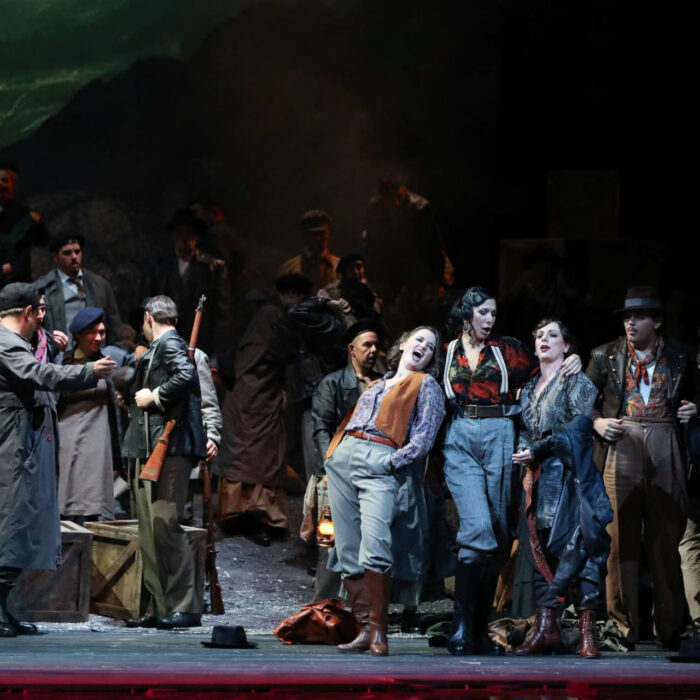
After all, it was Friday the thirteenth… But Benoît Bénichou‘s production of “The Merry Widow” seemed to have had a dark cloud hanging over it ever since it was first presented at the Opéra de Nice in December 2021, amid the chaos and uncertainty between two Covid lockdowns. As Bénichou explained in a pre-performance interview, the Opéra de Nice contacted him again at short notice earlier this year, hoping to give the production a second life. Unfortunately, the original sets had been destroyed, and there was insufficient time to build new ones. Bénichou’s ingenious solution was to transform the opera house itself into a stand-in for the dilapidated embassy of Pontevedro, the fictional principality in which the opera takes place.
As the audience took their seats, the curtain was filled with video projections depicting various Wall Street crashes from 1929 to 2008, establishing the atmosphere of financial distress that drives the plot. Baron Mirko Zeta, portrayed with considerable comic flair by Philippe Ermellier, strolled through the auditorium, mingling with audience members, who were treated as guests at a party hosted by the Pontevedran embassy. One of the boxes nearest the stage had been converted into a laundry room, complete with a washing machine. Spotlights repeatedly swept across the audience, reinforcing the idea that spectators were themselves part of the spectacle. However, as this continued throughout the pre-performance period and during the intermission, it had the less welcome effect of repeatedly blinding them.
Before long, the boundary between fiction and reality began to blur. Operawire readers will already know that the artists of the Opéra de Nice Côte d’Azur voted to strike two weeks earlier, threatening the performances of “The Merry Widow” scheduled for November 11, 12, and 13. The first two performances were indeed cancelled, and even just hours before the third was due to begin, its fate remained uncertain. In an unexpected prelude to the performance, members of the orchestra and chorus took to the stage to explain their precarious financial situation and appeal to the municipal administration to negotiate with them. One singer recounted the moving story of a fellow chorus member facing eviction because his modest salary was insufficient to cover his rent. It was a sobering intervention, and one that lent an unexpected poignancy to an operetta whose plot revolves around money, privilege, and the precarious fortunes of a small European state.
A Modernized French Version, With Mixed Results
Less than four years after the opera’s 1905 premiere, a French translation of the German libretto by Victor Léon and Leo Stein appeared. Finding this version dated, Bénichou adapted it for contemporary audiences. He also retained many of the character and place names from the original German version. Pontevedro remained Pontevedro, rather than becoming Marsovie, and the Merry Widow remained Hanna Glawari, rather than Missia Palmieri.
Bénichou also customized the dialogue to suit his cast, which featured baritone Semyon Antakov as Count Danilo. Antakov’s Russian accent was sufficiently pronounced to inspire additional lines explaining that Danilo held dual Russian and Pontevedran citizenship. In this reimagining, Hanna, sung with brio by soprano Perrine Madoeuf, returned to Pontevedro after a career as a Hollywood starlet. Consequently, Danilo and Hanna frequently switched between French, Russian, and English in their spoken exchanges. The idea is amusing, and Madoeuf’s imitation of an American accent was particularly convincing. But the linguistic games soon became tiresome. Their unpredictable shifts made it difficult to follow the dialogue without constantly consulting the surtitles, something that should hardly be necessary in an operetta—especially one sung in French for a French-speaking audience. The problem was compounded by the frequent loss of audibility when singers moved toward the back of the stage. Many lines spoken by the secondary characters were similarly lost.
At the heart of “The Merry Widow” is the chemistry among its central duo: Hanna and Danilo. However, presenting Hanna as a superficial socialite and Danilo as a young macho figure reduced the relationship to a rather one-dimensional encounter, missing the emotional depth of a more mature couple whose shared past and lingering affection give the story much of its appeal. A short video about their relationship opening the second Act did little to develop their characters further.
Nevertheless, Antakov offered some vocal pleasures. His resonant timbre was particularly effective in Danilo’s drunken scene in Act two. In Bénichou’s interpretation, the Act three scene at Maxim’s becomes an alcohol-induced erotic dream, in which Danilo imagines the Grisettes dancing with neon lights that bear a curious resemblance to the light sabers of Star Wars. However Bénichou’s clever idea was not executed in a sufficiently convincing manner to be understandable.
Strong Individual Performances, Uneven Musical Balance
Faustine de Monès as Valencienne was a particular highlight, combining excellent vocal projection with a sparkling stage presence. In the role of Camille, young tenor Paul Germanaz also showed considerable promise, with an appealingly light upper register, especially evident in his Act two romance, “Hors de la tige un bourgeon vert.”
Nicolas André‘s emphatic conducting drew generous waves of sound from the musicians of the Orchestre Philharmonique de Nice. Yet his enthusiasm sometimes came at the expense of the singers, whom the orchestra frequently overwhelmed, particularly when they were positioned downstage. Whether the problem lay primarily in the conducting or in the balance between pit and stage is difficult to determine, but the result was often unfortunate.
An Evening in Which Reality Outshone the Fiction
Ultimately, this “Merry Widow” was an uneven affair. Bénichou deserves credit for finding an imaginative solution to the practical difficulties of reviving a production without its original sets, and the transformation of the opera house into the Pontevedran embassy offered some entertaining theatrical possibilities. Individual performances, especially those of de Monès and Germanaz, also provided genuine pleasures. But the sometimes cumbersome dialogue, unconvincing central characterization, and uneven vocal-orchestral balance prevented the production from achieving the sparkle and emotional appeal that make Lehár’s operetta so enduring.
On this Friday the thirteenth, the most compelling drama was not entirely onstage. Watching a fictional bankrupt principality struggle to preserve its wealth while the very artists bringing that story to life were pleading for a more sustainable future for their own institution did not leave the audience indifferent.