Carnegie Hall 2026-27 Review: Aigul Akhmetshina & Jonathan Palmer Lakeland
Rising Mezzo-Soprano Stuns with Resplendent Program
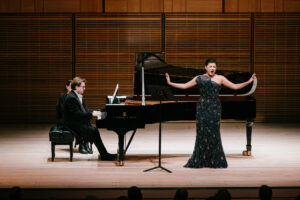
By Logan MartellOn Nov. 11, 2026, mezzo-soprano Aigul Akhmetshina made her debut at Carnegie Hall, delivering a wonderfully-passionate lineup of art songs, arias, and jazz standards bound by the theme of love in all its forms. The last few years have seen the Bashkir artist appear on prominent stages around the world, with her rendition of the title role in the Metropolitan Opera’s “Carmen” being lauded as one of the true highlights in the otherwise-panned production. Joining Akhmetshina onstage was pianist Jonathan Palmer Lakeland, who made for a stunning compliment for the mezzo while displaying some virtuosic moments when he stepped into the spotlight.
Opening the program with the theme of first, or innocent, love, Rachmaninoff’s “Morning, Op. 4 No. 2,” made an endearing selection for its natural imagery of the sunrise and its affectionate framing of dawn and day as lovers. Akhmetshina’s command of her lower register provided an excellent starting point for her energy to make a slow but certain arc, much like the rising sun, as her voice built to deliver calm but very warm, trailing phrases which left an open impression that nicely connected into the following “I wait for thee, Op. 14, No. 1.” Immediately contrasting with the imagery of falling night, there was a poignant longing in her voice that really helped to complete the picture of an inexperienced, vulnerable lover, especially as it built into her last repetitions of “I’m waiting for you!” With “I Loved him,” she relished in the sensory nature of Balakirev’s text as the rising passion was backed by lapping chords which built with splendid urgency as the narrator is swept up in romantic memories and expectation.
This first section was carried with much of this energy as Akhmetshina showcased great, nuanced colors along with her expertise in the Russian text. The second section explored the idea of a wounded, more desperate love, continuing the Russian selections with Rimsky-Korsakov’s “Enslaved by the rose, the nightingale (Eastern Song) Op. 2, No. 2.” The mood of somber chords and minor trills was finely met with Akhmetshina’s calm, but charged pianissimo’s for the opening phrase as she evoked the titular songbird, with her ensuing grievous weight beautifully relating its underlying anguish.
The next piece, Carlos Gustavino’s “La rosa y el sauce,” made a fine transition into Spanish as Akhmetshina outlined the floral imagery of bereavement with poignant sostenuto measures which really drove home the sense of woundedness. One moment I found particularly powerful was Kurt Weill’s “Je ne t’aime pas” where the languid passages of yearning and enduring disappointment shattered as Akhmetshina’s feelings boiled over; her voice at times flowed from an entrancing misery, to a depleted, conversational register, to phrases where she seemed in the midst of breaking down entirely, all adding up to a stunning rendition of this selection.
Shifting back to Spanish for Elena Roussanova’s “Femme Fatale,” Akhmetshina utilized a relaxed quality which worked beautifully with her lower instrument as the phrases musing on the nature of love carried with much introspection on her part before they swelled into fits of passionate urgency towards her beloved. Phrases like “Love, please stay!” were molded suitably to fit the narrator’s overactive emotions and made a fine bit of drama to savor in this already compelling selection. Wrapping up the first half on a sensational note was Astor Piazzolla’s “Yo soy Maria” from “Maria de Bueno Aires.” Taking up the tango beat from the lower reaches of the keys, this alluring selection kicked up into a driving showcase of self-love and inner power as she mused on all the things she embodied as a woman. Lakeland’s wonderfully-nuanced playing was nearly set aflame as he tore through the accompaniment with virtuosic flair.
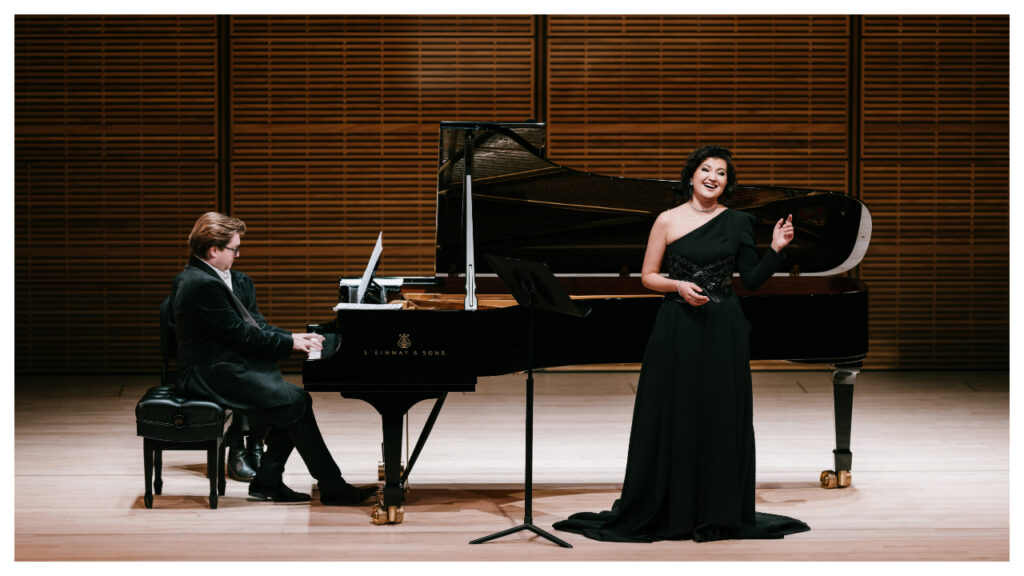
Photo Credit: Fadi Kheir
The second half of the program traced a more hopeful arc, beginning with a fresh and humorous energy with Benjamin Britten’s “Tell Me the Truth About Love.” Akhmetshina’s rendition carried with a warm, attentive bearing that helped her bring much humor and charm from the amusing phrases like “Does it look like a pair of pyjamas or the ham in a temperance hotel, does its odor remind one of llamas or has it a comforting smell?” While there was the occasional moment where her diction suffered due to how dense the text can be, this selection did not fail to endear the audience through its ease and levity. The next song, the Gershwins’ “The Man I Love,” was a gorgeous and elevated take on this jazz standard, with Akhmetshina’s rich and affectionate airs imbuing ample color to the phrases of an unknown lover but very certain love.
The latter half also saw the world premiere of “The temple bell stops,” composed by Lakeland. Setting the music to text by Japanese poet Matsuo Basho, this new work explored themes of stillness and introspection through its observational imagery of echoes, fragrances, and brief but meaningful touches of natural beauty, backed by bright and open chords and musical figures in the piano reduction.
As the program neared its end, Akhmetshina and Lakeland treated the audience to two musical theater pieces. The first, “Somewhere” from Bernstein’s “West Side Story,” translated beautifully to Akhmetshina’s opulent voice, letting her excel through the lingering phrases of hopeful uncertainty and take them to truly stunning heights. Last on the bill was “People,” from Julie Styne’s “Funny Girl.” Akhmetshina’s conversational approach nicely bloomed with classical beauty as she touched on the effect that others have in our lives, wonderfully extolling love in its manifold forms to make for a poignant encapsulation of the songs and moods we heard through the evening. After the concert, the duo delivered three encores, one of which drew from Akhmetshina’s Bashkir heritage in a charming tribute to her roots.
Wednesday’s concert made a stunning debut for Akhmetshina in one of America’s most hallowed venues. The selections themselves came together to explore the theme of love in ways which were very interesting, thanks to its composition of both established and newer works, while Akhmetshina and Lakeland’s artistry was nothing short of breathtaking.
Only time will tell what future has in store for Akhmetshina, but if Wednesday’s recital was any indication, the young mezzo-soprano will no doubt continue to astound audiences worldwide with her soulful and nuanced interpretations.