Metropolitan Opera 2026-27 Review: Jenůfa
Tenors Shine in Uneven Metropolitan Opera Production Premiere
By Francisco Salazar(Photo: Evan Zimmerman / Met Opera)
On Nov. 16, the Metropolitan Opera opened a new production of Leoš Janáček’s “Jenůfa,” which opened at the Royal Opera House in 2021.
When the production first opened, it was hailed as intense and gripping but was also criticized for being heavy-handed and distracting.
The results at the Met were no different, making for a disappointing evening.
Flat & Distracting
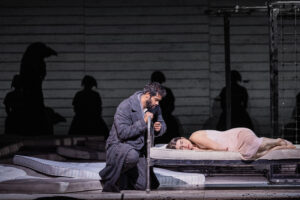
In his second production at the Met, Claus Guth, who is known for his philosophical and conceptual approach, set the opera on minimal sets with white brick walls and a shutter screen to open each act. Act one takes place in a workhouse, with women laborers in the background, while Act two takes place in a cage made up of the bed frames from Act one; here, women are dressed in black and surround the back of the set, while a giant raven overlooks the cage. The mattresses are strewn together to create the landscape of the outside world, evoking a treacherous terrain and signifying Jenůfa’s sin. Finally, Act three is a simple, empty space with flowers covering the ground. It’s the Act where we can actually focus on the singers. However, it is also an example of too little, too late.
The biggest issue with this production is that it looked empty and unfinished on the massive Met stage. It didn’t help that there was a black screen on top of the white wall and that you could see the backstage light board, making the experience less immersive. Then there was the background women who simply looked like they were taking up space and barely featured into the action, which took place downstage. The ballet in Act three came off as scattered and poorly distributed, throwing the dancers to one side of the stage. Moreover, there was constant frenetic movements from everyone, which diverted attention from the poignancy of the music, oftentimes feeling unmotivated.
I will concede that the idea of Jenůfa and Kostelnička being locked up in a cage in Act two was interesting and symbolic, but the bars in front of the performers made it hard to see them. The Act one ballet was memorable and well-choreographed and gave Asmik Grigorian a chance to show her graceful and flexible dance skills. The final image of Jenůfa and Laca outside the shutter screen was also powerful as it symbolized Jenůfa finally breaking free of her captive state.
Having seen videos of this production, it felt like this mise-en-scène was designed for an HD recording rather than a massive auditorium like the Met.
Uneven
Nina Stemme returned to the Met in the role of Kostelnička. While the soprano easily draws you in with her stage presence and her intensity, the voice lacked flexibility and sounded worn out. This was especially clear in Act two, which is the character’s big moment. Stemme tried to soften her voice in some moments with a piano sound, but it was in her plea aria to Steva, “Toz jenom vejdi,” that the legato phrasing sounded disconnected, especially as she ascended to the highest reaches of her voice. Stemme performed the aria with great expression, but the sound was patchy and lacked in cohesion.
In her famed monologue, “Co chvíla,” Stemme’s soprano turned thick and she struggled to rise to the top. She also lacked flexibility with the rhythm lines and at some points, when the vocal line called for extended phrases, her sound was labored and overly effortful. However, one has to give Stemme credit for her emphasis on the text and how she accented certain lines and emoted others to express the dramatic desperation of her character. Her best moment of Act two was the finale as she cursed Števa, bringing weight to the moment. Stemme’s third Act was also stronger as you could sense her remorse in her final solo “Odpust’ mi jenom ty.”
In the title role, soprano Asmik Grigorian brought technical precision with tasteful dynamics. However, her interpretation of Jenůfa lacked in emotional pathos. After seeing her two previous times, what was most striking about her performance here was that she repeats similar habits onstage from opera to opera. Grigorian is very active onstage. She moves around a lot. In some roles, this works well, but over the course of a performance, so much movement can often lack in clear motivation or intention, creating diminishing returns. The result is a performance that ultimately gets stuck in one gear. This is what happened throughout this performance. Grigorian’s “Prayer” in Act two was gloriously sung with sublime piano phrasing and intense fortes. However, her constant moving about the stage during this section detracted from the moment. Her vocal highlight was “Odešli. Jdi také!,” where Grigorian sang with a pure voice that slowly built to a passionate finale.
In the role of Grandmother Buryja, Elena Zaremba brought an imposing force to the stage with vocal potency that was nonetheless a bit wobbly and lacking in clear intonation.
Highlights
There were some positives to the evening, especially with the two tenors. Ryan Capozzo sang the role of Števa with a clarion voice and brought some vocal swagger to the text and to his jagged and accented lines, especially in the Act two duet with Stemme.
Sean Panikkar was also a standout as Laca, bringing a heroic tenor to the role. He sang with a shimmering and bright voice that was aggressive in the first Act and then caressing toward the end of the second Act when he convinces Jenůfa that he loves her. His voice also had a great palette of colors that featured ardent high notes and soft pianos, especially as he started the final duet of Act three where he relished the legato and crescendoed to a thunderous fortissimo. His rhythmic lines in Act one were also dispatched with force and incredible skill.
Kevin Short, as the Mayor, and Eve Gigliotti, as the Mayor’s Wife, brought an energetic stage presence, while Jazmine Saunders, as Jana, showed off a bright voiced lyric soprano. Erica Petrocelli was also outstanding as Karolka.
In the pit, Tomáš Hanus had a successful Met Opera debut. He easily brought the orchestra to its highest intensity, especially in Act two and then softened the ensemble for the charming folk music of Act one and Act three. Then there was the ethereal quality at the opera’s finale that was shaped into a momentous climax. The Act two violin solo during Jenůfa’s prayer was also phenomenal in drawing delicacy and virtuosity all at once.
At the end of the evening the audience cheered, but the enthusiasm was nowhere near other Met nights. Like the energy in the room, the performance seemingly lacked in inspiration. Hopefully that comes in subsequent performances.