The Croatian National Theatre in Zagreb 2026–27 Review: Carmen
By Karlo Radečić(Photo: HNK Zagreb)
The new operatic season at the Croatian National Theatre in Zagreb started in September with the fourth edition of the Zagreb Opera Festival. Along with the final opera gala, this year the main program included a performance of “Aida” by the ensemble of the Zagreb Opera and one performance each of “L’Italiana in Algeri” and “Lakmé,” performed by the ensembles of the Polish Royal Opera and the Maribor Opera, respectively.
Although the scale of the festival is modest in comparison with major European opera festivals, it is important for the local audience as an extension of the Zagreb Opera’s regular repertoire. The highlight of the new edition of the festival was an outstanding opera gala (September 20), which featured soprano Marigona Qerkezi and tenor Piotr Beczała, alongside three soloists who are members of the Zagreb Opera ensemble – mezzo Sofija Petrović, baritone Ljubomir Puškarić, and bass Luciano Batinić.
Beczała was in excellent form and his voice, interestingly, seemed more fresh than four years ago, when he was a central figure of a similar opera gala at the Zagreb Opera. This year the audience was perhaps even more mesmerized by the lusciousness of Marigona Qerkezi’s soprano and her admirable technical command. They both performed five arias (the last one as an encore) and were united for a trio from “Aida” and duets from “Tosca,” “Andrea Chénier,” and, during the last of the three encores, “O soave fanciulla” from “La Bohème,” at the end of which both delivered an exquisite high C.
After such a successful concert, the first premiere of the company’s operatic season, that of Georges Bizet’s “Carmen,” led by the same conductor, Pier Giorgio Morandi, seemed rather disappointing.
“Carmen” Without Stereotypes?
In his own words, director Pier Francesco Maestrini wanted to free the characters, especially Carmen, of some of the stereotypes typically attached to them. Was Carmen’s famous Habanera in Act one on opening night (October 23) completely devoid of eroticism and sensuality, musically immanent to its chromatic melody, as a consequence of such directorial inclination or because of Sofija Petrović’s vocal incompatibility with the title character’s nature? Whatever the reason, for most of the first two Acts, such a tamed, unspirited Carmen failed to convince.
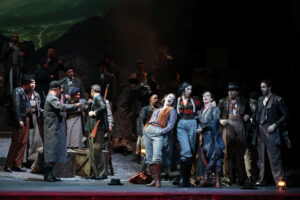
The director met the expectations of those preferring a traditional interpretation only on the surface. Yet, to engage a set designer, Juan Guillermo Nova, and a costume designer, Cristina Aceti, who are capable of producing attractive stage props and costumes, here designed to represent Spain of the mid-20th century, is only to set a frame for what should be the director’s intense work with the soloists and chorus members. On opening night, however, Act one was for the most part unusually undramatic and passionless, even during the scene of the uproar in the tobacco factory. Although at the beginning of that Act, Davor Nekjak’s charismatic and vocally nuanced interpretation of Moralès set up just the right temperature. Similarly undramatic was the fight between Don José and Escamillo in Act three.
What was intended to appear attractive was sometimes clumsily executed, as in the case of Don José arriving on the stage on a motorcycle in Act one, while dancing the choreography of Matilde Rubio at Lillas Pastia’s tavern in Act two lacked precision. As a means of compensation for the lack of elaborate scenographic elements, video projections were used, with the exception of the tavern in Act two. While the projection used in Act three for representing a rocky place outside the city seemed convincing (admittedly, it resembled Scotland more than Spain), the one used in Act four to depict a bullring looked rather cheap. Apart from being alluded to in the soldiers’ costumes, the political implications of setting the opera in mid-20th-century Spain were not worked out.
Unfortunately, the director undermined the pivotal moment at the end of the opera. In fact, he did it twice – by making Don José beat Carmen to death with a brick instead of impulsively stabbing her, which provoked some laughs in the audience, and especially by making him kill Zuniga, with the pistol given to him by Carmen, at the end of Act two. These changes by no means elevated the title character and at the same time made the complex character of Don José seem boringly one-dimensional.
Not Enough Passion
The premiere did not start much better on the musical side either. The Zagreb Opera’s chief conductor Pier Giorgio Morandi specializes in the Italian repertoire. He has conducted “Carmen” in opera houses as distinguished as the Metropolitan Opera and the Vienna State Opera and is known to the Zagreb audience for his passionate approach, so it was surprising to hear a lukewarm performance of the opera’s celebrated prelude. There were some imprecisions in the orchestra, as well as in the chorus, for example at the end of Habanera’s two verses, and some problems with the coordination of the stage and the pit. In general, the opening night performance sounded under-rehearsed. The singing of the children’s chorus was at a high level.
Morandi was not particularly successful in bringing all the colors of Bizet’s score to life, but he managed to achieve a dramatic arch above the important duet of Micaëla and Don José in Act one and some fine playing in the orchestral interlude between the second and third Acts, where the first flute and the first clarinet stood out. While the first two Acts often seemed unexpectedly uninspired, things were more consistently warming up later, perhaps more in the third than in the last Act. Morandi opted not for the original opéra comique version with spoken dialogues, but for the familiar version with recitatives composed after Bizet’s death.
An Uneven Cast
In the title role, Sofija Petrović was vocally most convincing during the song with castanets at the beginning of the duet with Don José in Act two and Carmen’s solo in the Card Trio with Frasquita and Mercédès in Act three. Her technical command of the role was never in question, but, in my opinion, for most of the first two Acts she simply wasn’t Carmen. And it has nothing to do with avoiding the cliché of the femme fatale. If musically Habanera is completely devoid of sensuality, and Carmen seems cold while singing the well-known seguidilla, then something is obviously not right. Part of the problem might be in Maestrini’s direction (or the lack of it) and Carmen’s ugly costume in Act one. In the last Act, Petrović finally appeared in a traditional red dress, and it seemed to inspire her, together with Bizet’s music, both vocally and in terms of acting, in the direction of a more passionate interpretation.
When it comes to solo pieces, the most satisfying singing of the evening came from Giorgio Berrugi in Don José’s Flower Song in Act two and Darija Auguštan in Micaëla’s aria in Act three. Berrugi was vocally solid, if insufficiently passionate throughout the evening, and there was never a genuine attraction between his Don José and Sofija Petrović’s Carmen. On the other hand, Darija Auguštan’s full lyric soprano was heard to its best advantage in Micaëla’s gorgeous duet with Don José, “Parle-moi de ma mère,” where she delivered some convincing and well-projected high notes. In the third Act she was especially poignant in the finale, reprising a theme from that duet. Contrary to the director’s intentions in portraying her character, as explained in the program booklet, in this production Micaëla’s costumes make her look as traditionally naïve as ever.
It was a pleasure to hear the delicate phrasing of Leon Košavić’s noble baritone in Escamillo’s short dialogue with Carmen in Act four, “Si tu m’aimes, Carmen.” But his interpretation of the famous Toreador Song in Act two, “Votre toast, je peux vous le rendre”” was lacking in vocal brilliance and stage charisma.
In the beloved quintet in Act two, Josip Galić’s Dancaïre, a pillar of stability, and Josipa Bilić’s Frasquita, with well-projected high notes, stood out. In the rest of the uneven cast Mercédès was sung by Iva Krušić, Remendado by Lovre Gujinović, and Zuniga by Lobel Barun.
Some productions of “Carmen” tend to deal with the questions of the representation of race, class, and gender in this famous opera, but it seems audiences around the world still prefer a traditional reading. Despite some directorial changes to the original and the lack of genuine passion and sensuality, the Zagreb Opera’s new semi-conservative production proved to be a crowd-pleaser.