Elbphilharmonie in Hamburg 2025-26 Review: Brockes-Passion
A Baroque Evening Featuring Maarten Engeltjes, PRJCT Amsterdam, Flemish Radio Choir & Soloists
By Mengguang Huang(Credit: Jann Wilken)
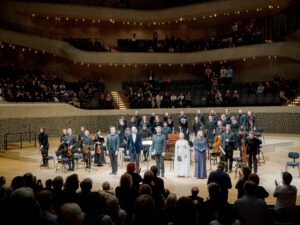
Three hundred and ten years after its inception, George Frideric Handel’s “Brockes-Passion”—his only sacred work set in his native German, based on a libretto from Hamburg—came back home tonight as a living exploration of deep-seated psychological landscapes. This performance, led by Maarten Engeltjes and the ensemble PRJCT Amsterdam, succeeded in achieving a delicate balance between the work’s operatic spirit—once a source of controversy for 18th-century Hamburg’s religious authorities—and its fundamental nature as a personal invitation to introspective meditation.
An Aura of Controlled Expression
To a modern audience, Barthold Heinrich Brockes’ libretto can occasionally feel over-rhetorical, its imagery too dense and its metaphors somewhat excessive by today’s standards. The interpretive path chosen here was one of restraint and depth, laid in its careful excavation of the text’s emotional potential. It was evident that PRJCT Amsterdam remained highly controlled throughout, convincingly conveying Handel’s gift for musical characterization and vivid “word-painting.”
The strings were remarkably acute, their playing characterized by a constant, mutual listening that created an atmosphere of sacred intimacy. At times, this sensitivity even evoked the hallowed quality of consort music in earlier era. This soft & persuasive power was complemented by the oboes which consistently evoked a sense of profound reflection and lamentation. Perhaps most stunning was the basso continuo. The solo cello and chest organ did more than provide a rhythmic foundation; they offered support that can only be described as an illuminating aura, a protective layer of sound that allowed the vocalists to explore the heights of their roles with grace.
Transparency in the Crowd
The Flemish Radio Choir provided a demonstration in transparent & vivid choral singing, embodying the various roles and moods of the Passion with startling clarity. In the intricate fugal sections, their precision highlighted Handel’s unmatched ability for musical characterization—a skill honed during his early apprenticeship at the Oper Gänsemarkt in Hamburg under Reinhard Keiser.
They transformed seamlessly from the wavering uncertainty of Jesus’s followers to the sharp, venomous hatred directed at Judas. Whether portraying the crowd’s skepticism of Christ’s divinity or the accusatory pointing at Peter, the choir inhabited every role with visceral realism. The individual choir members who stepped forward for solo cameos possessed highly distinctive timbres, keeping the audience’s attention firmly gripped throughout the narrative.
The Human and the Divine
The whole narrative was anchored by Benedikt Kristjánsson as the Evangelist, who proved to be a masterful storyteller, using subtle shifts in tone to signal the turning points of the drama and lead the audience through Brockes’ rich text. While the role of the Evangelist contains no arias, he was finally able to fully showcase his bright, solid, and resonant tenor voice, by appearing as a follower of Jesus in the second half.
Opposite him, Edward Grint offered a fascinating portrayal of Jesus. He occasionally betrayed a flicker of human unease—a vulnerability that made the breathless moments of his divine proclamation all the more powerful. The climax of this journey—the final, desperate cry to the Father from the Cross—was a moment of shattering intensity that fully utilized Handel’s sound-painting capabilities.
Similarly compelling was the role of Petrus, sung by Fabio Trümpy. His arc—from mortal doubt and self-suspicion to the crushing weight of remorse and fierce loyalty to his lord—was delivered with a conviction that felt painfully human. It was a vivid reminder of how Brockes’ libretto sought to pierce the “stony hearts” of its listeners by focusing on the psychological reality of the Passion. As his counterpart, conductor Maarten Engeltjes stepped in as a countertenor to portray Judas. This casting choice leaned into the traditional association of the countertenor voice with “unnatural” or conflicted traits, and Engeltjes captured Judas’s internal wreckage—his regret and self-loathing—with chilling accuracy.
The Brilliance of the Bibilical Women
Julia Lezhneva, entrusted with the lion’s share of the work’s most operatic arias, delivered a performance of mature, self-disciplined artistry. Without a hint of ostentation, she utilized her signature long-breath control and supple coloratura to imbue her character with an immense sympathetic quality. Most impressively, in those passages of grief, she employed a subtle, choked inflection—a vocal sob that was profoundly moving yet remained perfectly poised.
Carolyn Sampson, appearing only in the second half, provided the engaging vocal counterpoint. Mainly cast as one of the Believers, her voice radiated consolation and empathetic warmth. However, her standout moment was as Maria; the agonizing grief and pity she brought to the duet with Jesus was arguably the most infectious emotional peak of the entire night, demonstrating the heartbreaking languid lyricism.
Conclusion
For listeners accustomed to the dazzling brilliance of Handel’s Italian operas, this production of the Brockes-Passion might have initially seemed unexpectedly inward-looking, even austere. Yet, it was manifest that this performance was the result of a profound and deliberate artistic preparation, with intellectual taste and refined elegance. One could only imagine that had the performance remained entirely uncut—even beginning an hour earlier to enable a complete, unabridged journey through original text—it would have reached the realm of perfect.