Opéra de Monte Carlo 2025-26 Review: Der Fliegende Holländer
By Robert Adelson & Jacqueline Letzter(Photo: © OMC Marco Borrelli)
On November 2nd the Opéra de Monte Carlo opened its 2025–26 season with a single, semi-staged performance of Wagner’s “Der Fliegende Holländer” starring Bryn Terfel in the title role. One of Cecilia Bartoli’s distinctive innovations as Artistic Director has been to introduce more of these productions mises en espace—performances that are acted onstage without full sets and costumes—instead of purely concert versions. Past examples have included visits from the Wiener Staatsoper in the Mozart–Da Ponte trilogy, which will conclude later this season with “Così fan tutte.” These minimalist stagings engage the audience’s imagination in refreshing ways and often leave one feeling that anything more elaborate would be superfluous.
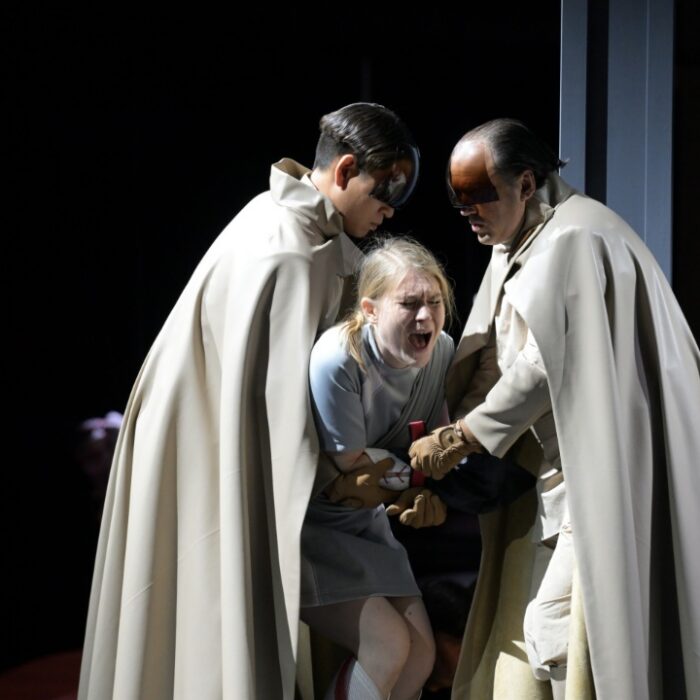
The program gave no directorial or costume credits, suggesting that the singers’ movement and acting were their own invention. The only non-musical credit went to D-Wok, the digital design company co-owned by stage director Davide Livermore, responsible for the video projections. The stage itself was largely bare, dominated by a cube made of screens showing ever-changing imagery—waves in shifting colors, a skull, or a gilded frame representing Senta’s portrait of the Dutchman. This was the sole visual element throughout the opera. Its use was largely effective, although keeping the curtain up during the overture and forcing the audience to stare at the restless water projections proved an unfortunate distraction from the orchestra’s playing.

(Photo: © OMC Marco Borrelli)
A Larger Space, Different Challenges
Rather than the 500-seat Salle Garnier, famed for its intimacy and glowing acoustics, the performance took place in the much larger 1,900-seat Salle des Princes at the Grimaldi Forum. The vastness of this venue has previously tempted the company to use discreet amplification—with unsatisfactory results. Thankfully the current production used only natural voices, but the opening scene between bass-baritone Albert Dohmen as Daland and tenor Trystan Llyr Griffiths as Steersman initially raised concern that the voices might struggle to project. Fortunately, those fears proved unfounded: Dohmen’s sound carried easily, though Griffiths’ lighter voice continued to have some difficulty, especially in the lower register.
Terfel’s Commanding Dutchman Leads a Stellar Cast
Clad entirely in black, Bryn Terfel dominated the stage from his first line, “Die Frist ist um” (“The time is up”). Within seconds, he had the audience under his spell. Each word was colored with such nuance that one hardly noticed that Wagner set all four words to the same repeated E-sharp. Terfel’s exceptional dynamic control—shifting from cavernous resonance to haunting softness—gave his portrayal rare emotional breadth. His thunderous cry, “Wann dröhnt er, der Vernichtungschlag” (“When will resound the crack of doom”) soared effortlessly above the orchestra. Ever the showman, Terfel even inserted his trademark fingers-in-mouth whistle during the Act three call to his ghostly crew, a witty gesture familiar from his legendary interpretation of the aria “Son lo spirito che nega” from Boito’s “Mefistofele.”

(Photo: © OMC Marco Borrelli)
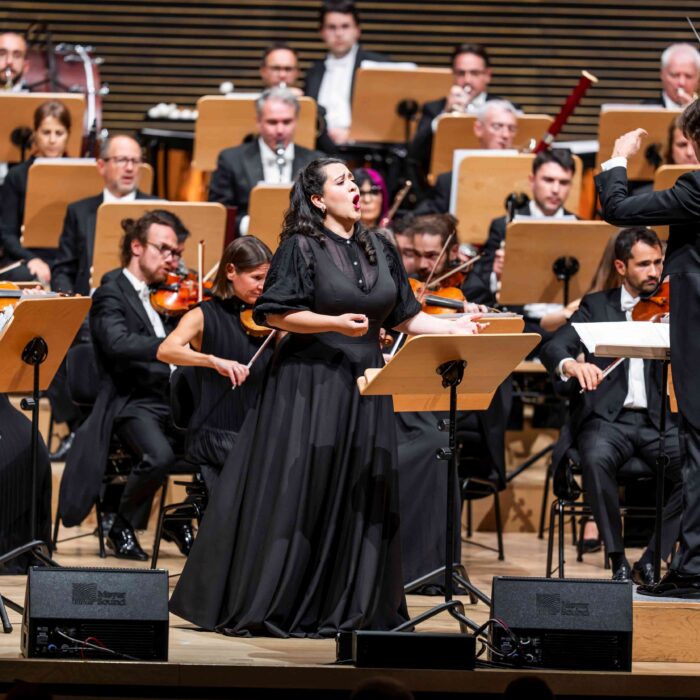
Asmik Grigorian, who made a celebrated role debut as Senta at Bayreuth in 2021, brought a vivid dramatic presence to Monte Carlo. Her Senta was a naïve and childish dreamer—dressed in a whimsical blouse depicting a one-eyed pirate cat over a dark skirt—more adolescent than mystic. After a strong introduction from Angharad Lyddon in the role of Mary, Grigorian launched her Act two Ballad at a deliberately slow tempo, gradually infusing the verses with greater freedom and intensity. Though both she and Terfel occasionally sacrificed clarity of German diction, the expressive conviction and tonal beauty of their singing more than compensated.
Terfel and Grigorian wisely avoided sentimental realism. Their relationship seemed more imagined than lived—Senta enamored of her storybook pirate, the Dutchman seeking deliverance rather than love. They sang much of their duet from opposite sides of the stage, only joining hands at the end. By contrast, Daniel Behle’s earnest yet somewhat stiff Erik—dressed in a tuxedo and spectacles—only emphasized his inability to rival the allure of the Dutchman who haunts Senta’s imagination.
As the opera closed, Senta walked slowly offstage toward the Dutchman’s fate, while the video cube filled with the image of roses sinking into the sea—a simple but poignant final touch.
Strong Choral Performances
Wagner’s “Holländer” owes much to both French grand opera and early German Romanticism, particularly Weber’s “Der Freischütz,” in its large choral scenes. The Opéra de Monte Carlo chorus, prepared by Stefano Visconti, met these demands impressively, with the women’s rapid exchanges and laughter in Act two particularly well executed.
Conductor Gianluca Marcianò led the performance with steady control and a finely judged balance between stage and pit. At times—particularly in the overture—one wished for a broader dramatic sweep, but the ensemble scenes, notably the Act three sailors’ chorus, had a satisfying rhythmic swagger. Performed without intermission, the two-and-a-half-hour opera places considerable demands on the orchestra, yet the musicians of the Orchestre Philharmonique de Monte Carlo rose impressively to the challenge, with distinguished contributions from the low brass, English horn, and harp.
This “Holländer” marked the first of two Wagner operas in Monte-Carlo’s season; “Die Walküre” will follow in January, continuing the company’s exploration of “Der Ring des Nibelungen” on period instruments.