The Frick Collection Concert Season 2025-26 Review: Handelian Heroes
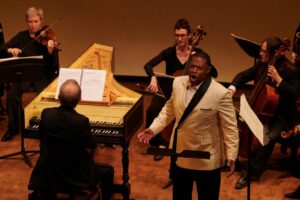
Les Talens Lyriques Ensemble, Led by Christophe Rousset, Featuring Countertenor Key’mon W. Murrah
By Jennifer E. Pyron(Photo: Cris Sunwoo © The Frick Collection)
The Frick Collection’s new Stephen A. Schwarzman Auditorium concert season 2025-26 featured the much anticipated debut of Les Talens Lyriques ensemble led by Christophe Rousset and world-renowned countertenor Key’mon W. Murrah on May 22, 2026. This final concert was well worth the wait and might just be my favorite collaboration of the year.
Les Talens Lyriques
Christophe Rousset’s love for Handel’s works began during his harpsichord studies in Aix-en-Provence when he attended a final rehearsal of Handel’s “Alcina” that left a lasting impression. Since then he has guided his ensemble, as harpsichordist and conductor, to achieve his wildest dreams of making rare recordings including Handel’s “Scipione” at the Beaune Festival, which remains a critically acclaimed benchmark recording of the work. The ensemble has also recorded Handel’s “Rinaldo,” “Riccardo Primo,” “Tamerlano,” “Alcina,” “Agrippina,” “Giulio Cesare in Egitto,” “Serse,” and “Ariodante.” Les Talens Lyriques’ gift for expressing Handel’s emotions comes from Rousset’s passion for the music and above all his mastery in live performances. Rousset’s stage presence is electric and Les Talens Lyriques is an extension of his magnetic presence. “Handelian Heroes” documented this unique level of excellence one aria at a time.
Countertenor Key’mon W. Murrah
Countertenor Key’mon W. Murrah is taking the world by storm with his signature coloratura and exquisite style. Murrah’s joy for singing and deep understanding of Handel’s emotions creates a palette of infinite possibilities for the text and enriches the landscape of one’s imagination when listening to him perform. His voice is unlike any other countertenor and his technique is textbook quality. His ability to naturally produce a high register and then dive into the depths of his chest voice is flawless. His jaw remains open and relaxed with his tongue in natural placement as though he has been singing for lifetimes before this one. Murrah is, in my opinion, the countertenor to experience live right now. May his star continue to catapult!
Handelian Heroes
Handel’s “Julius Caesar in Egypt” (“Giulio Cesare in Egitto”) HWV 17 (1724) overture began the evening’s performance. The ensemble brought to life the open and relaxed setting of the Stephen A. Schwarzman Auditorium. “Awake in the core” (“Sesto;” Act One, Scene Four) resonated beautifully as Murrah’s voice filled the hall with warmth and rich timbre. His high notes were impeccably clear and pure, creating moments of respite and wonder in between the coloratura. “Cara speme questo core” (“Sesto;” Act One, Scene Eight) illuminated Murrah’s gift of agility and adaptability when singing Handel’s longing emotions. His voice’s elasticity stretched into his high register with ease and made his lines feel fluid and forward driving throughout. Every note was connected and the energy continuously built into the next phrase. There was literally never a dull moment, nor would there be in this dazzling program. Sinfonia (Act Three, Scene Two) was high energy and the ensemble’s gusto was radiant. “L’Angue offended mai rest” (“Sesto;” Act Two, Scene Six) followed and Murrah’s voice sustained the dancelike pulse of tumultuous emotions. His coloratura was balanced and never overpowered the style of the ensemble. Together they danced and celebrated Handel’s genius.
“Serse,” HWV 40 (1738) “Ombra mai fu” (“Serse;” Act One, Scene One) highlighted Murrah’s impeccable timing and glittering top notes. Les Talens Lyriques sounded at one with Murrah’s breathing and singing. This was the most tender moment of the program. “Crude furie” (“Serse;” Act Three, Scene 11) showcased Murrah’s ferocious coloratura, spinning his voice intelligently into the hall with a broad range of emotionality and depth. His final run was spectacular.
“Scherza infida” (“Ariodante;” HWV 33, 1735, Act Two, Scene Three) is one of the most beautiful of Handel’s arias, especially with its striking bassoon countermelody (here played by Josep Casadellà). Murrah harnessed the heart-wrenching emotions of this work with his masterful vocal technique, never spilling over too much into the guttural nuances — instead treading on top of the devastation with finesse. This is where Murrah excelled most. His gift for remaining balanced even under the heaviest of lamentations is unmatched. His authenticity is also unmatched, which is even more rare for a countertenor. “Dopo notte” (“Ariodante;” Act Three, Scene Nine) was lively and buoyant in the hall. Les Talens Lyriques sounded glorious in their playing and Murrah joined in the fun with his impressive coloratura runs. The tempo made this piece that much more exciting and I saw audience members sitting on the edge of their seats.
Handel’s Concerto Grosso in B-flat Major, Op. 3, No. 2, HWV 313 (1734) was a delightful performance by Les Talens Lyriques featuring Gilone Gaubert-Jacques, Josépha Jégard, and Hadrien Delmotte (violin I); Benjamin Chénier, Charlotte Grattard, and Yuki Koike (violin II); Chloé Parisot and Maya Enokida (viola); Jérôme Huille and Marjolaine Cambon (cello); Joseph Carver (double bass); Gilles Vanssons and Irène del Rio Busto (oboe); Josep Casadellà (bassoon); and Christophe Rousset (harpsichord and conductor).
“Cara sposa” (“Rinaldo;” HWV 7a 1711, Act One, Scene Seven) was the perfect followup to the Concerto. Murrah’s legato was rich and soothing as the ensemble enveloped him with their sensational waves of emotions. The blend during this particular moment was impeccable and created a dreamy environment for listeners to bathe in. Murrah’s phrasing was superhuman as his notes stretched into an infinite horizon beyond. It is an admirable ability when a singer can access every note with ease and adaptability. It is another level of skill entirely when a singer performs under the illusion of never having to take a breath! Murrah’s performance was seamless in its accuracy and ascension into the ethereal. The audience applauded this aria with sincere awe. Bravi tutti! “Venti turbini” (“Rinaldo;” Act One, Scene Nine) showcased Murrah’s coloratura the most. His voice rose to the challenge with remarkable exuberance and his facial expressions were of pure joy. This is a singer who knows how to sing very well and does so in genuine celebration of the beautiful music. His high notes resonated in the hall with a golden aura full of life. I remember my first impression of his voice in John Adams’ “El Niño” at Met Opera and wanting to hear more. Murrah’s voice is made for unique performances like “Handelian Heroes” and Rousset’s midas touch.
The evening’s encore was a special performance of “Lascia la spina” (“Il Trionfo del Tempo e del Disinganno”) and “La Giustizia” (“Sesto;” “Giulio Cesare in Egitto,” Act Three, Scene Five). The audience gave a long standing ovation at the end, knowing that history had just been made.