Salzburg Whitsun Festival 2026: Il ritorno di Ulisse in patria
By Laura Servidei(Photo: © SF/Marco Borrelli)
A Marionette Theatre for Monteverdi
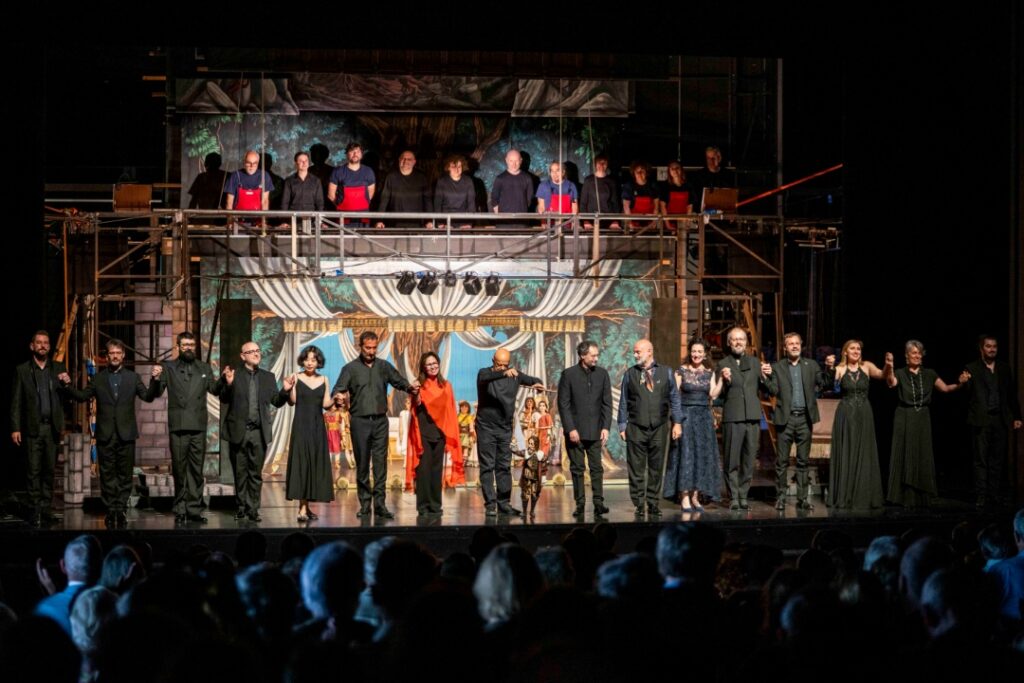
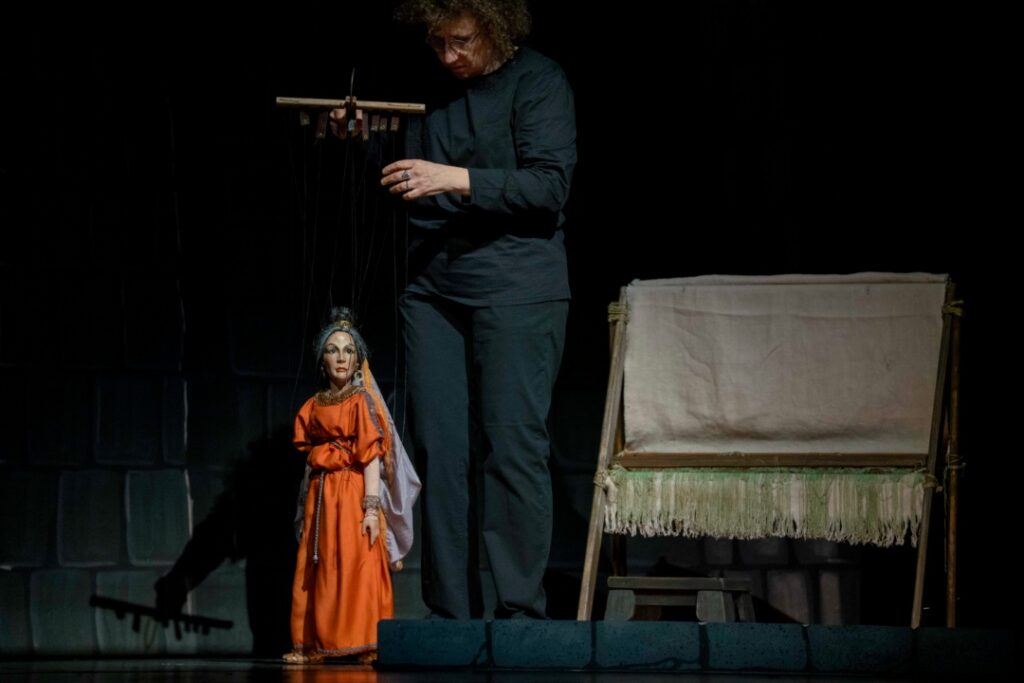
The Salzburg Whitsun Festival presents a production of Claudio Monteverdi’s “Il ritorno d’Ulisse” in patria by Franco Citterio and Giovanni Schiavolin as a marionette performance, in collaboration with Italy’s most renowned puppet company, the Compagnia Marionettistica Carlo Colla & Figli of Milan. A small puppet theatre is constructed on the stage of the Haus für Mozart, with the puppeteers hidden behind a screen and only occasionally appearing onstage for scenes taking place outside the miniature theatre. Since the beginning of the twentieth century, the Compagnia Colla has staged performances inspired by the great Italian operas, adapting famous stories and incorporating music into their productions. A similarly conceived performance of Monteverdi’s “L’Orfeo” was presented at the Whitsun Festival three years ago to great acclaim.
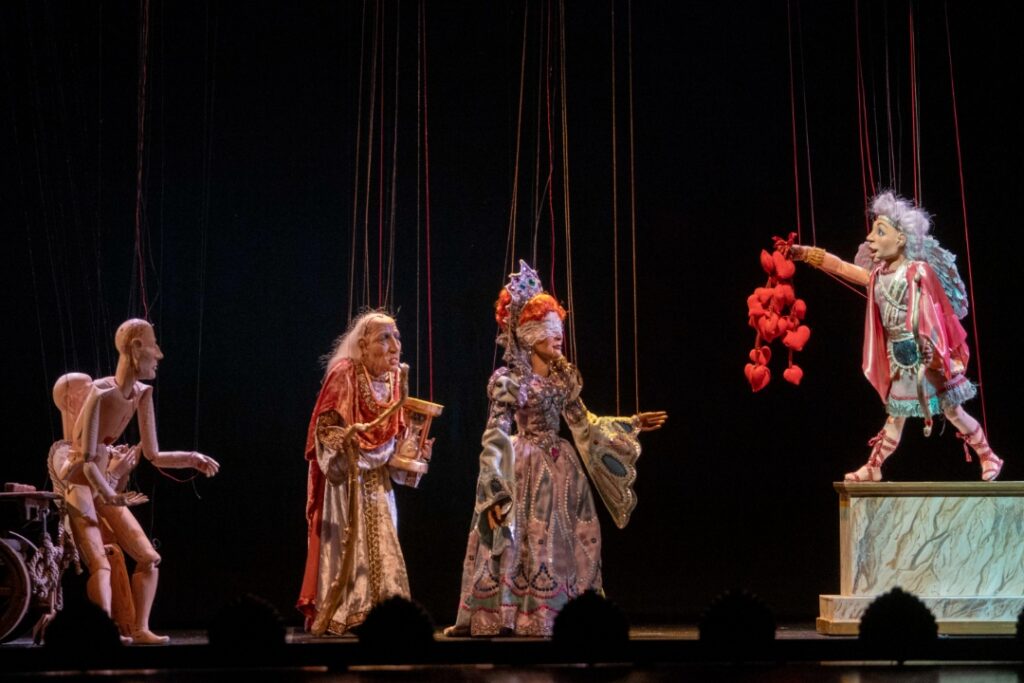
A production of this kind is not merely a tribute to puppet theatre, nor simply an aesthetic curiosity: it is a radical reconception of the opera’s theatrical language. The characters inhabit an unreal dimension, their movements slightly uncanny in a way that only master puppeteers can achieve. The marionettes moved with extraordinary delicacy and sharply defined characterization, each figure possessing a distinct individuality. For example, when Ulysses arrives in Ithaca and is transformed by the goddess Minerva into an old man, the puppet’s gestures and gait become entirely different from those of the hero in his original form, revealing both the refinement of the craftsmanship and the extraordinary skill of the puppeteers.
(Photo: © SF/Marco Borrelli)
Visual Fantasy and Seventeenth-Century Echoes
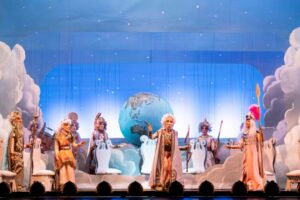
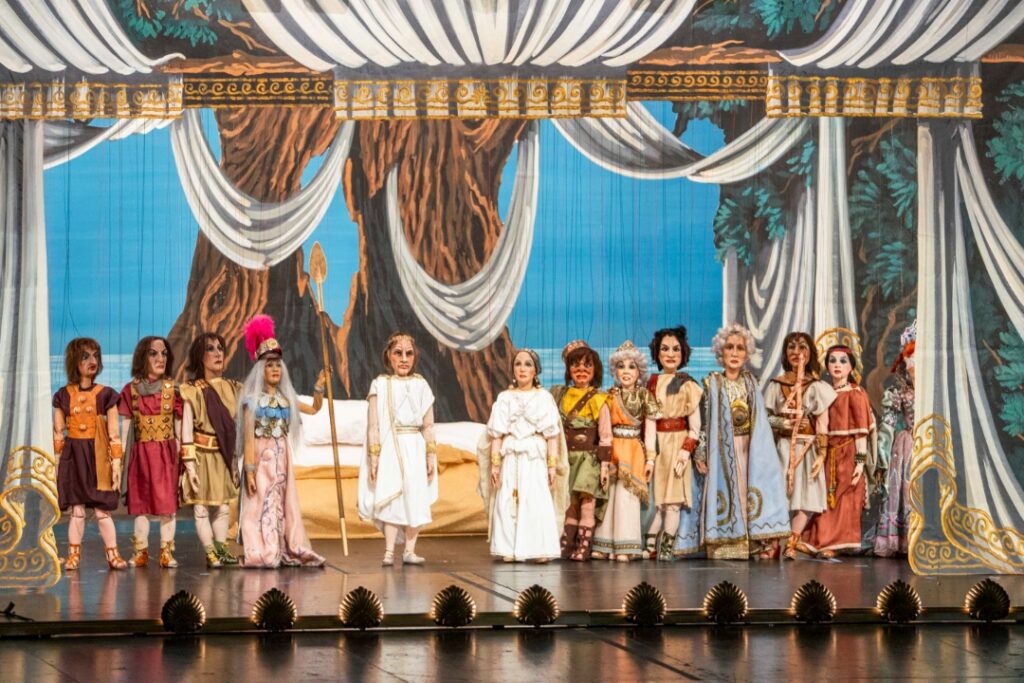
The sets evoked a mythical Mediterranean world of rocky Ithacan coastlines and shimmering seas, while the puppets and costumes conjured gods, sailors, shepherds, and royal figures. The scenery, enhanced by carefully judged lighting, created a dreamlike and faintly antique atmosphere that brought the opera’s many characters and episodes vividly to life. The stage designs—alternating between palace interiors and outdoor landscapes—and the costumes, closely aligned with the personalities described in the libretto, produced a form of fantastical realism. Scene changes were rich, frequent, and seamless, always perfectly synchronized with the action. The “special effects”—such as the transformation of Ulysses into an old man or the arrows shot from the bow to kill Penelope’s suitors—were simple and perhaps slightly naïve, yet they offered a vivid glimpse into what seventeenth-century opera theatre might once have looked like.
Within this framework, the characters drift through painted landscapes while woodland animals hop across the stage, in a world so imaginary and fantastical that the only truly real element anchoring the audience to the drama is the music. The marionettes become visual allusions to the living characters whose voices emerge from the pit.
(Photo: © SF/Marco Borrelli)
Gianluca Capuano’s Monteverdian Vision
As a result, the production places the musical performance firmly at the center—and what a performance it was. Gianluca Capuano returns here to his first love, early Italian music; one could immediately sense how completely at ease he was within these now-unfamiliar musical paradigms. Les Musiciens du Prince appeared as a lean ensemble built around a slightly reinforced continuo group, in keeping with Venetian practice of the period: two violins, three violas, cello, double bass, viola da gamba, two theorbos, harp, harpsichord, and percussion. The continuo breathed with the singers, guided more by emotional instinct than theoretical rigidity. Capuano’s reading of the score was sensitive and richly detailed, combining respect for the work with fearless imagination and genuine creativity. The strings seemed to converse directly with the singers, while the percussion was used intelligently to underline dance rhythms and propel the drama forward. The result was a deeply felt retelling of an ancient tale, viewed with fresh eyes and shaped by a profoundly spiritual sensibility.
The libretto, by Giacomo Badoaro, is based on Books 13–23 of Homer’s “Odyssey” and recounts how Ulysses, King of Ithaca, returns home after his long journey from the Trojan War to find Penelope besieged by three suitors. With the help of the gods, his son Telemaco, and his loyal companion Eumete, Ulysses defeats the suitors and reclaims both his kingdom and his wife.
The opera opened with the marionettes of Homer and Monteverdi greeting one another onstage, before Monteverdi himself gave the downbeat to the orchestra.
(Photo: © SF/Marco Borrelli)
Sara Mingardo’s Majestic Penelope
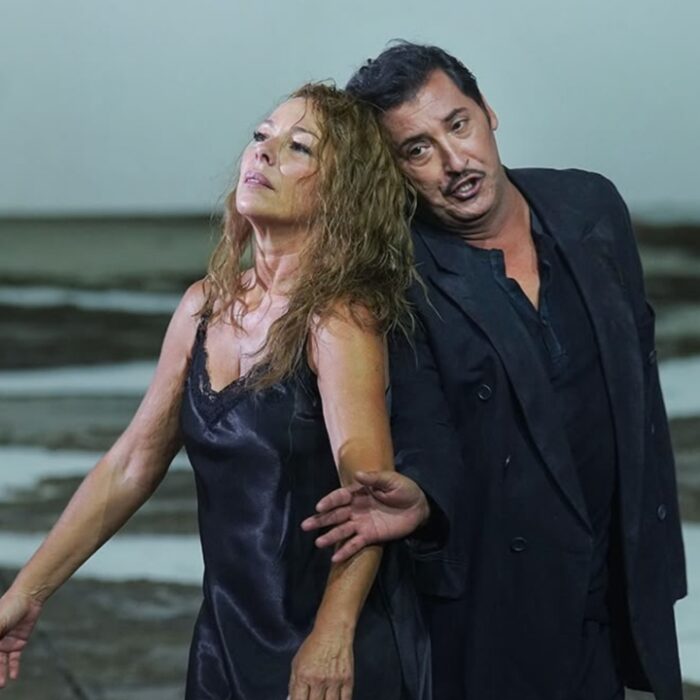
Following a prologue in which the allegorical figures of Time, Fortune, and Love declare their determination to make human life miserable, Sara Mingardo immediately established the emotional tone of the evening with Penelope’s lament. Her singing was natural, almost conversational, and yet deeply expressive of the Queen’s sorrow, while also revealing flashes of frustration at her impossible situation: a husband lost at sea, arrogant suitors invading her home, and her honor constantly under threat. Mingardo’s mezzo-soprano glowed with amber and bronze colors, powerful yet worn by grief in her repeated cries of “Torna, Ulisse!,” each inflected differently from the last. In the final scene, as Ulisse reveals himself, her voice became commanding and monumental, challenging him to prove his identity with unwavering authority and fierce determination to defend her home and position.
(Photo: © SF/Marco Borrelli)
Voices Behind the Marionettes
Vito Priante sang Ulisse with a deep, smooth baritone full of authority. The role requires sudden shifts of emotion: joy at finally reaching Ithaca quickly gives way to caution and disguise, before culminating in vengeance. Priante captured these transformations with remarkable subtlety, perfectly synchronized with the movements of his marionette. The final release of tension, in the concluding love duet with Mingardo, was deeply tender and moving.
The goddess Minerva was portrayed by Arianna Vendittelli, whose mezzo-soprano moved effortlessly into the upper register, her coloratura sparkling and assured. Massimo Altieri sang Telemaco, the son of Ulisse and Penelope, with a natural and spontaneous tenor. Alessandro Ravasio impressed as both Tempo and Nettuno with a booming bass and powerful low register. Eumete, Ulysses’ loyal companion, was sung by Stefano Gambarini, whose strong and elegant tenor made a notable impression.
The gluttonous Iro, the opera’s comic figure perpetually obsessed with food and drink, was performed by director Davide Livermore, himself a former professional opera singer, with a pleasant tenor voice and considerable comic flair. Even the singers in the smallest roles showed complete stylistic assurance and contributed significantly to the success of the performance.
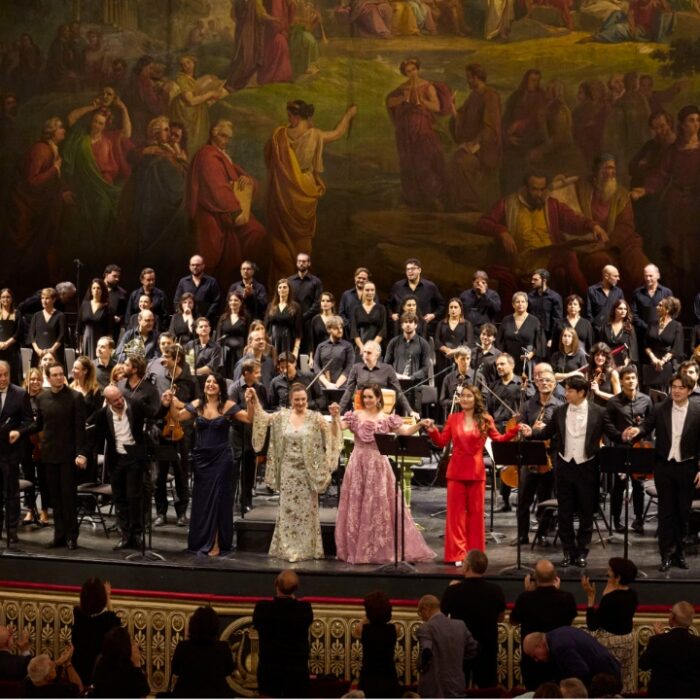
At the curtain call, all the singers came onstage to shake the hand of their marionette counterparts and receive the audience’s applause, while Gianluca Capuano appeared paired with Monteverdi himself.