Opéra de Marseille 2025-26 Review: Das Rheingold
By Robert Adelson & Jacqueline Letzter(Photo: © Camille Rovera/Opéra de Marseille)
The Opéra de Marseille’s new production of Wagner’s “Das Rheingold” marks the first staging of one of the Ring operas in France’s second-largest city since 1996. Its success augurs well for the tenure of the company’s talented young music director, Michele Spotti.
Gold, Power and the Rheinbank
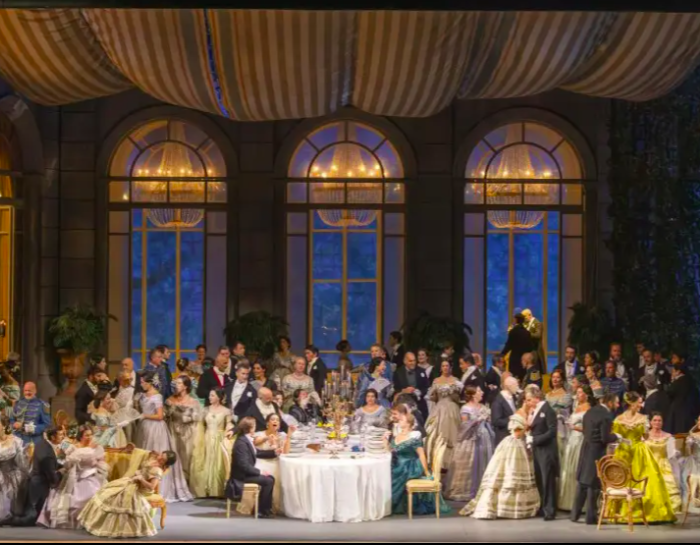
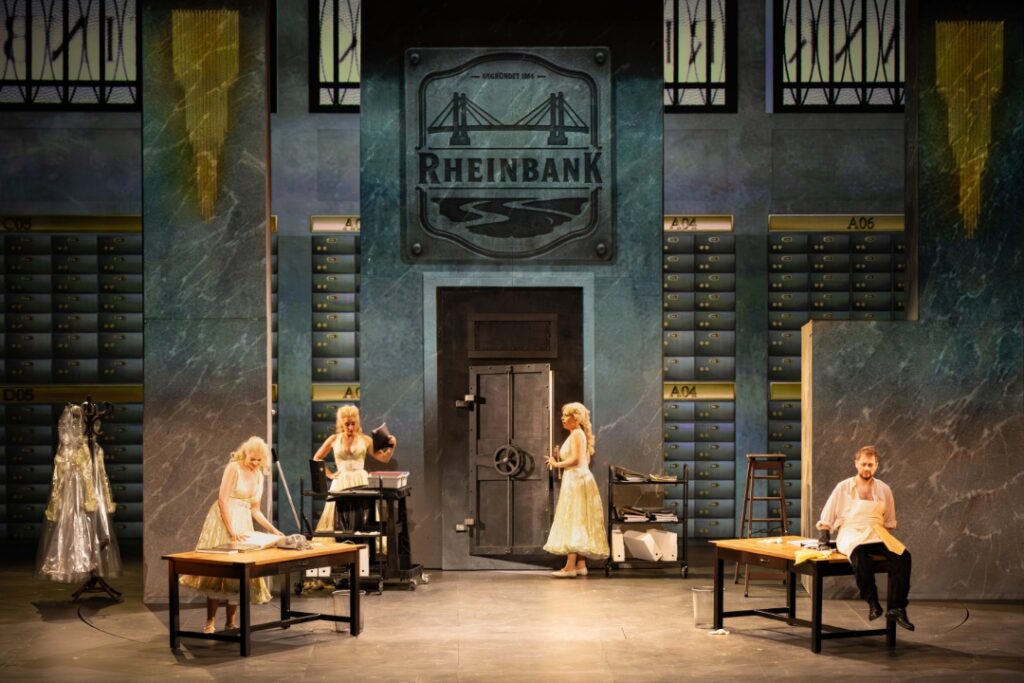
Charles Roubaud’s staging is modern yet eminently accessible. The curtain rises about a minute into the prelude to reveal the vault of the vaguely postwar “Rheinbank,” whose name provides the production’s only overt reference to the aquatic world so fundamental to the opera. It is early morning, and only the bank’s janitor, Alberich (Zoltán Nagy), is present, mopping the floor to the groundswell of E-flat major chords rising from the orchestra pit. When the Rhinemaidens (Amandine Ammirati, Marie Kalinine and Lucie Roche) appear—bank employees surprisingly clad in seductive flouncy dresses—they mock Alberich less for his appearance than for his lowly social status. At the close of the opera, when the gods cross the rainbow bridge into Valhalla, Roubaud presents the band of flawed and diminished deities ascending in a golden elevator inside their newly acquired Trumpian skyscraper.
(Photo: © Camille Rovera/Opéra de Marseille)
Interpreting the Ring cycle as a critique of capitalism is hardly revolutionary, but Roubaud wisely avoids becoming mired in heavy-handed philosophizing. His vision is comparatively light and often comic. In the opening scene, Alberich’s pursuit of the Rhinemaidens feels playful, almost like Papageno courting Papagena. Missing, however, is the gradual accumulation of dramatic tension arising from the Rhinemaidens’ rejection of Alberich, which ultimately drives him to renounce love — an act unprecedented within the moral universe of the opera whose consequences set the entire cycle in motion.
(Photo: © Camille Rovera/Opéra de Marseille)
Simple but Effective Stagecraft
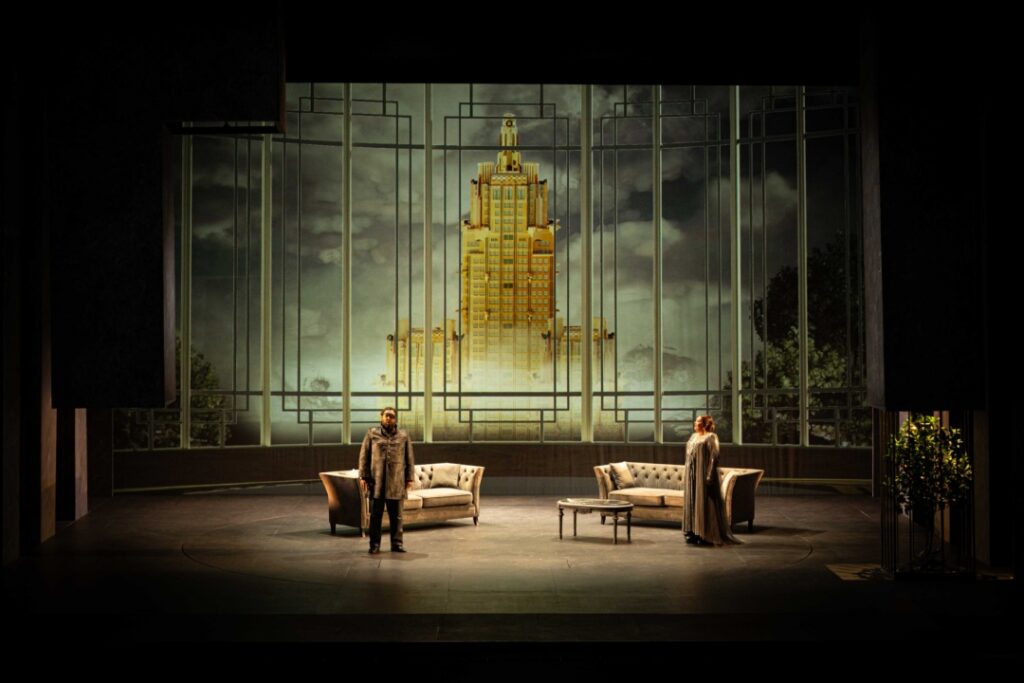
The sets by Emmanuelle Favre are built around a steeply raked stage dominated by a rotating circular platform. The restrained use of video projections proved particularly effective. During the orchestral interludes between scenes, for example, the curtain was lowered rather than filled with unnecessary visual activity. As a result, the few moments employing special effects had genuine impact. Alberich’s transformations through the Tarnhelm—first disappearing, then turning into a dragon and finally a toad—were realized through striking hologram-style projections by Julien Soulier.
Standout Vocal Performances
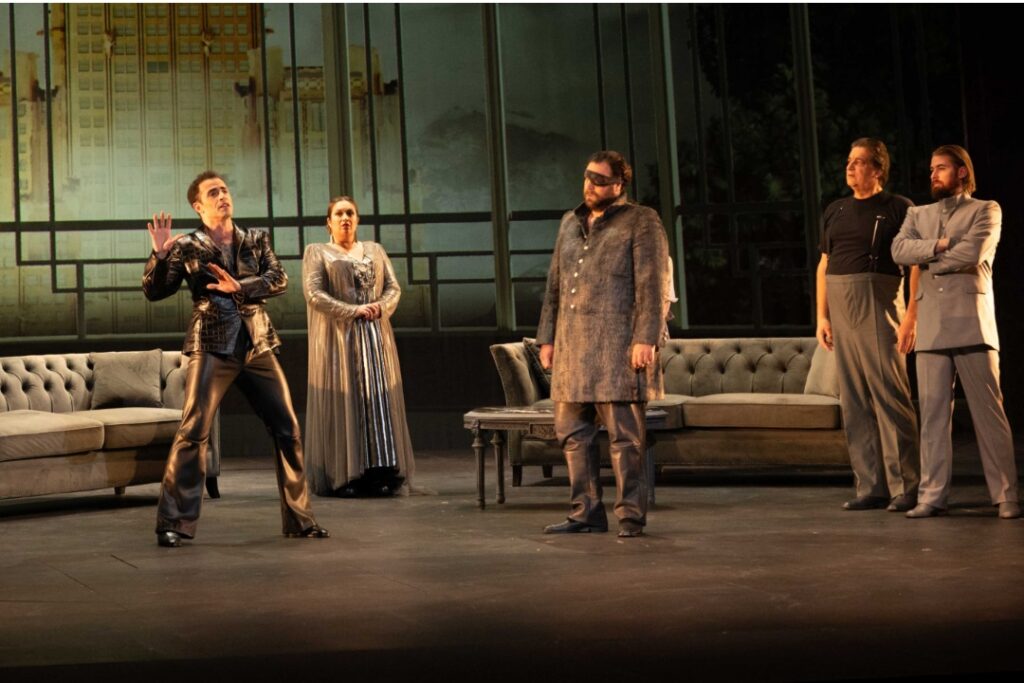
The evening’s finest performances came from the singers in the two most demanding roles: Nagy as Alberich and Samy Camps as Loge. Nagy was especially compelling in Alberich’s curse upon the ring in the final scene, delivering it with searing intensity. Camps proved a superb comic actor, aided by a slick costume more suited to a Las Vegas nightclub singer than to the realm of the gods. Any occasional strain in the upper register was quickly forgiven, thanks to the incisiveness with which he delivered Loge’s sardonic commentary on divine hypocrisy.
(Photo: © Camille Rovera/Opéra de Marseille)
The cast was almost entirely Francophone, with the exceptions of Nagy as Alberich and Marius Brenciu as Mime. Problems with German diction were noticeable only in Cornelia Oncioiu’s brief appearance as Erda. Vocal styles were generally well matched, although not all singers adapted equally easily to the difficult acoustics of the opera house. Unless positioned downstage and facing the audience directly, voices were frequently covered by the orchestra, even in passages with relatively light accompaniment. As a result, Alexandre Duhamel’s Wotan and Éric Huchet’s Froh were at times less clearly audible in the second scene than one might have wished. These acoustical challenges were unfortunate and could not be attributed solely to the singers themselves. Duhamel went on to deliver a convincing performance, culminating in a finely projected “Abendlich strahlt der Sonne” that rose above Wagner’s rich orchestration during the gods’ entry into Valhalla. The vibrant soprano of Elodie Hache in the role of Freia projected consistently well, as did the giants Fasolt and Fafner (Patrick Bolleire and Louis Morvan).
Spotti’s Orchestral Vision
Spotti drew an exciting performance from the Opéra de Marseille orchestra, distinguished by incisive brass playing and strong rhythmic drive. Perhaps partly in response to the perennial challenge of fitting Wagner’s oversized orchestra into a traditional opera pit, Spotti positioned the harps, timpani, cymbals—and in the final scene, the Rheinmaidens—in boxes adjacent to the stage. Not only did this arrangement allow the audience to hear harp passages that are often submerged in the orchestral texture, but it also created a striking stereophonic effect. In the final entry into Valhalla, the rhythmically staggered harp figures seemed to ripple outward through the hall from both sides, lending the final scene unusual sonic grandeur.