Opéra Comique Paris 2025-26 Review: Werther
By Ossama el Naggar(Photo: Jean-Louis Fernandez)
I first heard Samoan tenor Pene Pati a year ago in Munich in “La bohème,” an opera I’ve seen so often that I make every effort to avoid it. But this time was different; I was completely disarmed by this beautiful lyric tenor’s voice, his charm and his authenticity. Endowed with brilliant high notes, a beautiful timbre, perfect diction, and most of all sincerity in his portrayal of Rodolfo. I thoroughly enjoyed the performance. I was almost reconciled with “La bohème,” and have since made a point of hearing this talented singer whenever possible.
Therefore I was thrilled to attend the production on January 29 of “Werther,” an opera that had its world premiere (in German) in 1892 in Vienna (and not Paris), probably as it’s based on the epistolary novel by Goethe, “Die Leiden des jungen Werthers” (1774). Its Paris premiere was given by the Opéra Comique the next year, though in a different venue. The present-day 1200 seat Opéra Comique, also known as Salle Favart, was inaugurated in 1898. It has excellent acoustics and its smaller size provides more intimacy than Paris’s other operatic venues.

(Photo: Jean-Louis Fernandez)
Production Details
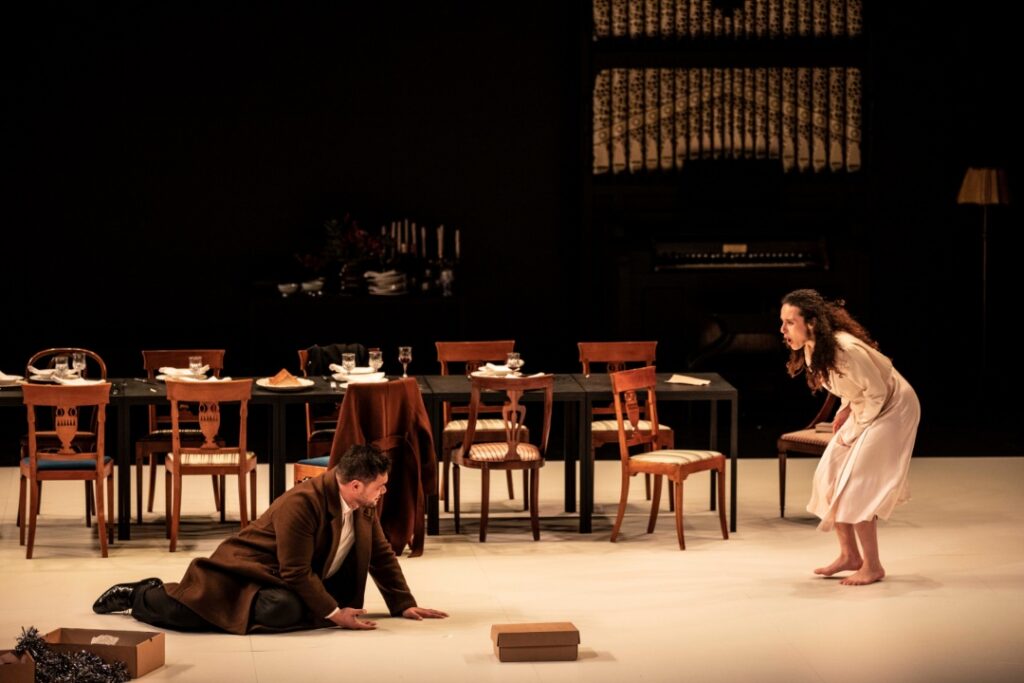
Intimacy and authenticity are the most notable characteristics of London-based American director Ted Huffman’s present production. Minimal, though not austere, his sets accentuated the intensity of the drama and highlighted the wholesomeness of the central characters in Goethe’s novel. The organ in the dining room epitomized the upstanding Lutheran family that is the bailiff and his children. With the exception of Albert, Charlotte’s husband, lust, power and scheming are absent. The only peccadillo is the fondness for drink of the elder generation of men: Charlotte’s father the bailiff and his friends Johann and Schmidt.
Huffman’s treatment also intensified the emotions. There was a palpable turbulence felt in undercurrents that remained under control – made more frightening by their subtlety. This was complemented by Raphaël Pichon’s masterful conducting. Like Huffman, he tackled the score with utter discretion, never indulging in the intense emotion of the Act one aria, “O Nature, pleine de grâce,” or the lovely duet “Il faut nous séparer.” Thanks to Pichon and a brilliant cast, “Werther” was for once unsentimental but romantic in the literary sense. When emotions poured out at the end of the opera, Pichon finally let go, but never in an explosive or vulgar way, thus achieving maximum effect. This was the first time I shed tears in “Werther,” and not only during the hero’s death scene, but during several others as well, thanks to Huffman and Pichon’s ability to create the sensation of a volcano’s pre-eruption without exteriorizing any of the emotions.
Musical Highlights
Pati’s Act one aria, “O Nature, pleine de grâce,” impressed with truly elegant phrasing, almost inconceivable for a non-native speaker. In that aria, Pati channeled Werther’s dreamy disposition and his detachment from reality, essential to understand the character’s eventual suicide. The pivotal line “et toi soleil, viens m’inonder de tes rayons” was carefully phrased and expressive. His Act two aria, “Un autre est son époux!,” as powerful an aria as can be found in the French repertoire, was devastating. The crucial line “C’est moi qu’elle pouvait aimer” was carefully coloured with despair that sent shivers down one’s spine. His Act three aria, “Pourquoi me réveiller?,” the opera’s most famous, and one of the most popular moments for tenors, was elegantly interpreted. Pati avoided excessive pathos, rendering its emotional intensity all the more potent. Unsurprisingly, it brought the house down.

(Photo: Jean-Louis Fernandez)
This was the first time hearing young French mezzo Adèle Charvet. Initially, I was apprehensive as her timbre is on the light side. A darker hue ensues more gravitas for the character. However, Charvet is such a capable interpreter that any apprehension dissipated. Despite its relatively small size, Charvet’s voice is sensual and truly feminine. Her timbre is distinct and her diction is impeccable. This was one luminous Charlotte, younger than most thanks to her bright timbre but more cerebral and intense. Often Charlotte is portrayed as reasonable, compared to the tempestuous Werther. However, Charvet’s portrayal exuded such intensity that it seemed natural she would break down at the end of the opera.
Her Act one duet with Werther, “Il faut nous séparer,” one of the prettiest and most affecting in French opera, was the most memorable moment in the performance thanks to the sheer beauty of the music and voices. It was disarming that the quick attraction between the two felt so natural. Nothing was contrived, an ailment that often plagues French opera today. Alas, in French opera, being mannered is often mistaken for elegance. Blessed with impeccable diction and great acting skills, Charvet conveyed Charlotte’s fragility in two scenes from Act three, “Werther! Qui m’aurait dit! Ces lettres!” and “Va! Laisse couler mes larmes.” Of course, Pichon’s delicate accompaniment was essential to the success of these two moving airs.
French lyric soprano Julie Roset was an ideal ingénue younger sister. Unlike some directors, Huffman didn’t overemphasize Sophie’s attraction for Werther. This Sophie idealized her older sister more than she may superstitiously have had romantic ideas about Werther. Roset’s light lyric soprano contrasted beautifully with Charlotte’s mezzo in their Act three duet, “Ah, le rire est béni.”
(Photo: Jean-Louis Fernandez)
American baritone John Chest was vocally suited for the role; his portrayal of Albert was not overly dour. The smaller roles were also well sung. No needless subplots were inserted, such as accentuating the vicissitudes of Brühlmann and Kätchen’s seven-year engagement. The advantage of this clean approach was that it put the emphasis on Charlotte and Werther.
This is the third performance of “Werther” that I’ve attended in ten months. The first was Christof Loy’s fabulous production with Benjamin Bernheim and Marina Viotti in Paris in March, then, last July in Berlin I heard an in-concert version with Jonathan Tetelman and Aigul Akhmetshina. Loy’s intelligent staging is unlikely to be surpassed for years, but Huffman’s staging here, though less intellectually stimulating, was more affecting emotionally, devoid as it was of artifice. While Bernheim is a paragon of intoxicatingly stylish French singing and Tetelman possesses a beautiful virile voice, I was most moved by Pene Pati, thanks to his unpretentious sincerity. I look forward very much to hearing more from this wonderfully appealing tenor.