Opera Australia 2026 Review: The Drover’s Wife
By Gordon WilliamsGeorge Palmer and Leah Purcell’s “The Drover’s Wife” had its world premiere in Brisbane in May and saw its first Sydney performance on August 7. In the program booklet, Opera Australia CEO Alex Budd says it is Opera Australia’s first First Nations work at the Sydney Opera House. In the words of the work’s co-librettist, director, and instigator Purcell, “Opera has allowed me to expand this world in a way that feels both natural and powerful. The form itself invites scale: emotional, visual, and spiritual.” Several musical-dramatic works with Indigenous themes and Indigenous casts have been essayed across Australia over the years. Having collaborated with composer Andrew Schultz in the early 2000s on a dramatic cantata set in Central Australia, “Journey to Horseshoe Bend,” I am conscious of the importance of melding Aboriginal-Australian and European-Australian content.
In talking about a world that has been expanded, Purcell references the work’s previous incarnations. “The Drover’s Wife” has quite a lineage. There was an award-winning play by Purcell, which became an award-winning novel and film of the same name, all of which was based on an 1892 short story by Henry Lawson that every Australian school student used to know (and many still do). This current incarnation was co-commissioned by Queensland Performing Arts Centre and Opera Australia in association with Oombarra Productions, the producing entity for Purcell’s work. Purcell’s role in this project has been so extensive as to almost warrant a reversal of the normal ascription of operatic authorship to one of librettist/composer.
In Purcell and Palmer’s hands, the opera becomes a tale delving deeper and more familiarly into the nature of Australia than Lawson’s arid, early-European surface view of the Outback. His was a way of seeing Australia that persisted into the 1970s and could be summed up in his phrase, “Nothing to relieve the eye…” Purcell makes the beauty of the landscape the domain of Australia’s Aboriginal people, an essential ingredient in the healing message behind the brutality of the story. She was inspired after working as an actor on the movie “Jindabyne” to relocate her retelling to the Snowy Mountains, the high country between New South Wales and Victoria. This is not the sunburnt plains that are a major part of the consciousness of white-Australians of a certain vintage, including Lawson.
This was a terrific production with a magnificent set by Isabel Hudson that was beautifully lit by Karen Norris. It boasted an attractive, persuasive score by Palmer. A former state Supreme Court judge, Palmer has been composing since his teen years and retired from the Bench in 2011 to devote himself entirely to composition. The opera sported a libretto based on a sturdy and powerful play, and accepted music’s invitation to broaden the scope of the play. It did this to large extent by including more overt Aboriginal traditional content: a re-balancing that raised additional questions for me.
The story’s protagonist is Molly Johnson, sung by soprano Nina Korbe (who played Maria in Opera Australia’s “West Side Story on the Harbour” in 2024). Molly is alone in her isolated home looking after the Johnson children while her husband is away. He is off droving, apparently. A drover might be understood by overseas readers as a kind of cowboy who specifically drives cattle over long distances, sometimes called an “overlander.” The life of a 19th-century drover’s wife was thus one of legendary loneliness and fraught with challenges. Lawson’s original story detailed the wife’s battles with a mad bullock and a snake that gets under the floorboards of the Johnsons’ lonely cottage. These are recounted in Palmer and Purcell’s opera in reminiscences that are an excellent pretext for musical set-numbers, along with other incidents from the past. Augmenting clues in Lawson’s original text, Purcell adds the world that preceded that of the European settlers, and the hostility of local people. “[T]he harsh realities of the land and the ever-present threat of colonial authority close in,” to quote the program booklet.
The opera begins with a woman onstage who looks very much like an ancestress. This is Ginny May, played by dancer Jeanette Fabila, who reappears throughout the opera at key moments. Then follows a traditional-style chanted dance. The program booklet lists Waangenga Blanco, Vanessa Coolwell, Leonard Donahue, Zoy Frangos, and Yolanda Lowatta as other dancers. But there is also a man lying prostrate on the stage, thought to be dead. A swaggy (hobo) played by baritone Barry Ryan offers to turn him in. There have been a number of murders in the district and the prostrate man may be the culprit.
Molly is suspicious of this swaggy, a white man, and when he grabs the rifle with which she has been keeping him at bay, the prostrate man rises up and helps her. He reveals himself to be an Aboriginal man on the run, having been fingered for the murders. He is “Yadaka of the Guugu Yimithirr, adopted Ngambri Walgalu” — a statement that was sung a couple of times with rising pride by the role’s interpreter, the versatile musical theater performer Marcus Corowa. A bond consequently forms between Yadaka and Molly. This connection grows but remains subtle and inchoate, foreshadowing a twist concerning Molly that adds a tantalizing new ingredient to Lawson’s 19th-century storyline, wherein Molly’s difficulties will be resolved by re-absorption into the Aboriginal country and cosmography.
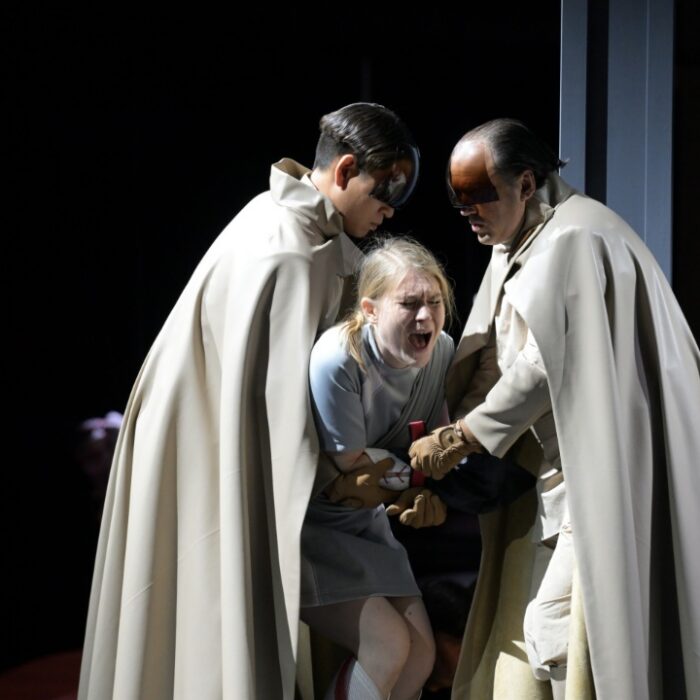
A subplot concerns the journey to adulthood of Molly’s 14 year-old son, Danny, played by musical theater performer Nick Smith. Danny’s growth into maturity is hemmed in by violence. There is the violence inflicted upon his ‘ma’ by locals such as Robert Parsen (bass-baritone Simon Meadows) and John McPharlen (Frangos) — it is for such depictions of assault that the program booklet contains a trigger warning. Then there is Yadaka’s worldview: the Final Act of a Manhood Ceremony is your “first kill,” though he hastens to add that this does not extend to women or children.
Hudson’s set was nothing less than magnificent, featuring a twisted, weather-beaten snow gum, hand-crafted by Opera Australia’s workshop staff, the leaves of which crowned the wife’s little cottage. The background was a slit that at times partially opened to reveal wonderful imagery — videography by Craig Wilkinson and Rose Mulcare and time-lapse photography by Murray Fredericks. When it was opened wide it suggested a rocky overhang and the silhouette of distant ranges. In effect, every Australian will be able to supply for themselves the scent of this location! The playscript of “The Drover’s Wife” suggests specific times of day and one actually felt them through these images and Norris’ lighting.
For a story that contains an underlying acknowledgement of eternity, Palmer’s score contained much that was memorable. The text-setting was often recitative-like, yet with sufficient interest in the orchestra to keep the listener musically engaged. The melody used in the company’s video trailer, about Molly’s parents’ love as “deep as the highest peak to the lowest valley,” stayed with the listener. Originally a phrase of Yadaka’s from the play, it was nicely turned into an exhilarating operatic ensemble including Yadaka, Black Mary (played by soprano Shauntai Abdul-Rahman), and her husband, Jock (played by tenor John Longmuir). While the score sometimes closely, even obviously, followed or prompted the action, there was a great deal of satisfaction in being able to sense the beginnings of set numbers and register musical reminiscences.
There were beautiful moments, such as the duet “Sleep now, my little one” between Black Mary and Molly, suggesting a correspondence between these characters, and the beautiful viola and cello solos played by Virginia Comerford (Principal Viola) and Teije Hylkema (Principal Cello) after Yadaka was killed and mourned. In fact, the orchestral interludes, which often seemed tied to changing times or moments of reflection, could be extracted for concentrated listening. There was musical freedom here and a nice shape to the score, though it could have been pushed even further, in my opinion — maybe even to Puccini-esque largesse. The libretto, co-written by Purcell and Palmer though based on Purcell’s play, retained an Australian colloquial flavor, even down to encouraging Australian accents (e.g. “yaself” for “yourself”).
Korbe carried the show with her portrayal of an isolated but formidable and resourceful woman. This was a star act. Molly’s “I love the snow gum” which, in my experience, sticks out oddly in the play, became a particularly effective scena here through Korbe’s delivery.
The other principals held our attention, too. Each character got their scene, particularly in the reminiscences. Corowa’s account of Yadaka’s time in a circus, and his recollection of losing his family when a waterhole was poisoned, were examples of the sort of settler-violence that the work does not shy away from. Smith as young Danny had the unenviable task of portraying a 14 year-old. Yet he was convincing in his clarity and consciousness. Among the smaller roles, bass-baritone Shane Lowrencev clearly relished his role as the grandiloquent peddler Douglas Merchant.
In the printed program Palmer makes a point of acknowledging conductor Tahu Matheson’s “masterful” interpretation of the score and expresses debt to him for being “involved in every step of the journey, from the first workshop to conducting the opera both in Brisbane and Sydney.” Matheson provided great stewardship of this performance.
Purcell’s playscript version of “The Drover’s Wife” ends with one of the most riveting last lines I can recall. Molly says to Danny, “And when ya’re old enough, son… I’ll introduce you to Robert Parsen and John McPharlen.” It is stark and powerful, evoking the objects of Danny’s vengeful “first kill.” The promise of bloody vengeance is still there in the opera, but seemingly subordinated to a supervening message about the importance of Indigenous identity. You can easily make the case that this emphasis has arisen from historical necessity. From a technical point of view, “identity” as a concept justifies the choice of where in the story the interval is inserted, creating a “to be continued” for an Act two that is not in the 90-minute play.
The problem for me lay in the opera’s enveloping Aboriginal folklore. Do not get me wrong! It makes perfect sense for an operatic adaption to burrow into the mythological hinterland of a story — opera was Wagner’s medium after all. And I am aware that traditional Aboriginal people live with the metaphysical realm of their foundational stories all around them. The Lake Amadeus Land Claim Report, for example, speaks of certain applicants’ forebears being regarded as actual characters in local legends. What seemed to be happening here, though, was a glossing-over. It was the suggestion that there was a pervasively benign all-encompassing spirit world that is a perfect sanctuary containing no terrors, no harms, no aspects that are so psychically dangerous that they ought not to be spoken of. This was partly a consequence of the Aboriginal world being represented chiefly through choreography, which has less impact in an operatic setting. It was also because the natural environment, emblematic of the pre-European world, was presented so beautifully through photography and video. But was the violence really only contained in the “ever-present threat of colonial authority?” What happened to Molly’s husband? Was it clear who actually murdered the family over the other side of the ranges?
I felt that this glossing-over hampered the “return-to-one’s-roots” ideology from achieving a fully effective dénoument. Molly’s final decision may be too easily won. The score’s final moments also reflected, for me, a kind of irresolution, with raw juxtaposition of triumphal orchestral music and traditional chant.
I had some questions. Nevertheless, the audience reaction to this new opera at both the performances I attended (on August 9 and 11) indicated that the majority of operagoers had no such qualms. This new opera was received very warmly — perhaps even with a sense of relief that the stage of Opera Australia was finally open to discussing these themes.