Columbia University School of the Arts Miller Theatre 2026-27 Review: Macabéa
Suzanne Farrin & Sergio Chejfec’s New Opera Stuns at Composer Portrait Premiere
By Daniele Sahr(Photo: Rob Davidson for Miller Theatre at Columbia University)
If opera is one of the best ways the arts can present a tragedy, then where better to unpack the modern era’s dehumanization of individuals born into poverty. In Suzanne Farrin’s new opera “Macabéa,” performed as a concert premiere at Columbia University’s Miller Theatre in their Composer Portrait series, we are introduced to the eponymous hero – a young woman born in Rio’s slums, raised by an abusive aunt, taken advantage of by boyfriends, pushed around by women, misled by an arrogant boss, and killed garishly by a speeding Mercedes.
But that’s just the plot. The actual narrative follows a beautifully fragmented voice of the young Macabéa, played with touching sincerity by soprano Charlotte Mundy. The opera reveals the inner curiosities, small joys, and delicate human love for life that all persons have a right to enjoy – especially those with so little to begin with.
Based on the 1977 novel, “The Hour of the Star,” by Clarice Lispector (who passed away that same year), Farrin realized the project with Argentine writer, Sergio Chejfec, whom she found not only to be an ideal collaborator but whose interpretation of Lispector and care with words was both inspirational and emotionally stirring for her. And as the concert premiere at Miller Theater revealed, equally so to an audience.
Even without having read this particular novel, I experienced Chejfec’s turns of phrase along with the flowing pace of the narrative to capture exactly the mood of Lispector’s works: occupying a unique space between the domestic constraints of capitalist society and the inherent yearning for metaphysical exploration.
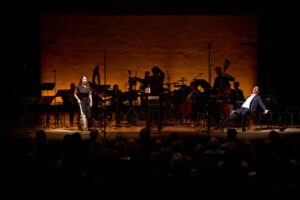
Chejfec passed suddenly in 2022, leaving Farrin devastated, as she explains in the companion essay by Katelyn Simone included in the program. However, if the performance was any indication, she lost no momentum in creating this convincing operatic project with his completed libretto. With a running time of about 75 minutes, the story is broken into three Acts with 13 brief Scenes. The score was written for the Talea Ensemble, whose command of new music produced a tight partnership with singers – not always so readily pulled off in a first performance of a new operatic work. Conductor Eduardo Leandro unpacked the work’s complexity with finesse, both revealing its groundbreaking style and revealing its accessibility.
The exceptional aspects of Farrin’s score lay in how the music seemingly shadowed the characters. Rather than accompany or mimic, music and singing elevated each other, meeting climactically against the text.
Guttural string passages played by cello and bass accentuated the leading male role of Rodrigo, performed by countertenor Christopher Dylan Herbert – a haughty boss character at his most arrogant. Herbert’s brashly privileged exclamatory lines, splendidly macho acting, and jarring leaps between low and high pitched material turned this character into an obnoxiously oblivious yet highly realistic monster of a person.
When Rodrigo’s maid Aparecida (who helps him find Macabéa) played by soprano Samantha Sosa sings an aria, “eu gosto de pão,” about loving bread, her boyfriend, and fanning her boss, Farrin has Sosa vacuum on stage with an actual Hoover while the score encapsulates a strange eeriness to embody the tenuousness of these women’s lives.
In Scene five, titled “Macabéa signs a contract” – an experience nearly any audience member can relate to – Macabéa and Rodrigo sing their duet with a bittersweet yet ominous blend of her optimism set against his insouciant dominance. Talea underscores the moment with a fabric of percussive clicks, knocks and wooden timbres that emanate not only from Sae Hashimoto’s mallets but the strings and horns as well. They sound like signifiers of the text’s grammar, highlighting the production’s unique attention to the role of language. Macabéa’s aria, “eu gosto de estar só,” that follows is about her random but deeply soul-searching thoughts set against a harp line that added a texture of magic to Mundy’s skillful characterization that framed a secretary-turned-maid into a nymphlike sprite.
Tenor Gregório Taniguchi, played Macabéa’s boyfriend Olímpica. A cold, selfish man, Taniguchi leaned heavily into this character’s despicability with wonderful effect (he will leave Macabéa for her untrustworthy old coworker). We love to hate him. Taniguchi’s elegant, silky voice offered the evening’s most exquisite, hypnotic outpouring of lyrical Portuguese while at the same time evoking this man’s vapid confidence.
The production also includes three sopranos who are named Macabéa’s roommates but act as a kind of shadowy chorus, sometimes present other times remarkably absent – much like anyone to support Macabéa.
Glória is that traitorous coworker, performed by mezzo-soprano Mary Beth Nelson Zaros. With a voice of unwavering power and artful acting sensibility, Zaros joined Mundy to sing a duet in a stand-out scene held in the office bathroom – a space where women of all economic classes regularly gather to separate themselves from men, or a crowd. Both a private and public place at once, Macabéa reveals herself to be all trusting as a quirky gentle soul that takes the time to notice things like letters (she loves “R” – the first letter of Rodrigo’s name) or take random pleasures in things like chewing aspirin. Zaros raised one eyebrow at these odd thoughts, drawing chuckles from the audience. But the music never lets go of Macabéa’s truth, moving from fragmented sounds to an airy hopeful sonic space only to suddenly stop to the crackling recording of Caruso’s romantic singing – meant to be from a radio of Macabéa’s.
Farrin added other samplings of sound throughout the work, like a typewriter (Macabéa’s one marketable but simple skill). A moment of silence slowly reveals the tinkering sounds of a music box churning out Beethoven’s “Für Elise” that Macabéa holds lovingly in her hand near her end. A familiar cellphone ring tone and text message dings emanate from the speaker (Rodrigo fatefully contacting Macabéa leading to her demise on the street). A menagerie of references abound, including from “Pelléas et Mélisande.” It would take more than one listening to capture them all.
The whole production is pulled together by an Argentinian narrator, referred to as The Stranger, who speaks in Spanish played by João Luiz Rezende Lopes. Lopes sat behind the musicians, always drawing us back to Macabéa with a stoic but slightly melancholy tone – drawn from the inevitabilities of dealing with real life. This was an unusual element for an opera but worked well in keeping the structure and maintaining this as an experience from literature. The effect of pulling us back in, just like any good narrator, spoke to the craft behind Chejfec’s libretto and gave the opera a compelling contemporary flare.
At last, Macabea’s death comes as a shock. After she blithely believes the good fortune promised her by the fortune teller, Carlota, performed by contralto Kristen Sollek with a wonderful tinge of careless selfishness, she receives a phone call from Rodrigo and is hit by a yellow Mercedes.
Suddenly this life, which had no future but still relished in possibility, was gone. In a powerful decision to remove operatic dramatics, Scene 12, “Macabéa’s Blood” is an instrumental interlude, in which violinist Karen Kim plays solo with string quartet accompaniment that links back to Macabéa’s voice – one of the few long melodic instrumental passages. Macabéa’s soul seems to depart with a mixture of percussive shaker sounds, recordings of distant seagulls, and a rumbling of distant bells.
As Scene 13 closes with all the living characters singing in a contrapuntal chant style, one remarks, “Was the end as grandiose as you liked?” The opera “Carmen” comes to mind – a story that leaves an audience tragically sad and incensed in that sensational, voyeuristic way. “Macabéa” is the opposite. It does not pull tears that would quickly be forgotten with an after-show glass of champagne. Farrin does something more powerful: she is able to insert us into Macabéa’s life. We are shocked by her death because somehow we have been complicit in it by not stopping something so horrible and real from occurring, as if we had driven that garish yellow Mercedes ourselves.
Following the very well-received premiere, Executive Director Melissa Smey brought Farrin on stage to answer a few questions in a brief postlude interview. Farrin remarked on her desire to bring to life the idea that no individual is disposable – to show that anyone can have an inner rich life. She succeeded at this, and her music got everything right.
A staged premiere is set for June 2027 at the PS21 Center for Contemporary Performance in Chatham, NY with its Brazilian premiere to follow in 2028.