O2 Trainer: How Bas Rutten Links Opera & the Art of Professional Fighting
By Mike Hardy(Photo: Bas Rutten)
It’s hard to imagine what could possibly link the divine art of classical singing with the somewhat brutal (if noble) art of professional fighting.
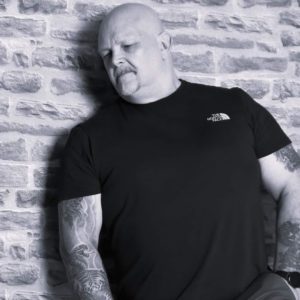
Bas Rutten, the legendary former MMA master and pioneer, UFC world heavyweight champion and ‘Hall of Famer,’ three-time ‘King of Pancrase’ world champion, kickboxer extraordinaire, self-defense expert, stuntman and Hollywood movie star will gladly explain all.
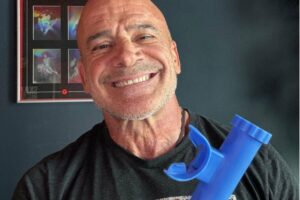
Dutch American Bas Rutten has developed a portable breathing resistance device, designed to strengthen the diaphragm and intercostal muscles, that increases inspiratory muscle endurance, which can enhance stamina, improve oxygen intake, and speed up recovery times for athletes and fitness enthusiasts. In addition to which, potentially greatly enhance voice projection and breath control. At least one music academy, in Australia, is reporting benefits from having tested the device.
Speaking with OperaWire from his home in Texas, where he also runs his “Elite MMA Gym,” Rutten explains all.
“When I was a young man I had really bad asthma. So bad that if I were to spend 10 minutes with a dog, I would be a week in bed afterwards because I would be so allergic to the dog. My lungs would close; I couldn’t even eat on certain days. At the same time, I was also training in Track and Field, running 400, 800, 1500 meters, which I needed for my decathlon because that’s what I was focusing on. It was very hard, of course. But I realized that every time after an asthma attack, I would beat my running times every single time. And I’m thinking, what is going on? Is that the medication I’m taking? I didn’t know what it was.
Then, one day I was in the doctor’s office, and I saw an image of a pair of lungs on the wall and it showed a healthy bronchial tube and it showed an infected bronchial tube next to it. And that was it! I was 14 years old and I realized I’d been working out and developing my lungs because I’d been breathing in through a really tiny hole, unknowingly I made my lungs stronger. Therefore, when the infection is gone, the hole is larger and now it’s easier for them to get the air in.
So, then I thought, why not try and come up with something that controls that air intake? So, I created this thing from washers and bolts and nuts with this tiny little hole that went in front of my teeth for me to focus breathing through. Of course, I quickly realized this was a very dangerous thing because if you end up inhaling the thing and it bypasses one of the bronchial tubes, you’re dead. The Heimlich maneuver isn’t going to save you.”
Rutten’s first attempts at creating a device may have been crude as well as potentially dangerous, but the science behind it wasn’t. Years later, after he had retired from fighting, with encouragement from friends, he returned to the design.
“At the time, I was still using my inhaler. If I would sneeze violently, I needed to open up my lungs. If I walked up a hill, I would have to pause to recover because my lungs would close. I had exercise-induced asthma, so I always carried my inhaler to open up the airways when needed. When I developed the new prototype, three and a half weeks with the ‘O2 Trainer,’ my asthma disappeared. That was when I knew I was on to something. I sent it to a friend of mine in Holland who has asthma. I didn’t say anything other than ‘I want you to start using this thing.’ I didn’t say anything else. Eight days later, he called me. He tells me his asthma is gone and he’s actually selling the device in Europe right now.
At first, it was hard to market the device, but I visited Dr. Belisa Vranich who’s a world -renowned breathing expert. The first thing she did was to measure my chest expansion in between inhaling and exhaling. She looked at me and started laughing. She told me, ‘That’s not possible,’ and went and got another doctor to witness. She told me that my chest expanded two inches further than anyone else’s and she asked me what I was doing, how was it possible?
I showed her my first production model ‘O2 Trainer’ and she wrote about it in her book, and that’s when people started paying attention. Of course, there’s over a thousand published medical journals about inspiratory muscle training. I didn’t invent it. It’s just that my invention was so simplistic that I was able to get the patent for it, and that kind of set up the ‘O2 Trainer.’ It has been proven to help people with COPD, asthma, back problems because it also helps to align your spine.”
So how on earth did Rutten ever get the idea that this could be of value to opera singers?
“When my wife started complaining!,” he explains. “She started saying to me, hey, keep your voice down! You’re so loud!’ Especially if we were in a restaurant. And I couldn’t understand it because I wasn’t speaking any louder. And then I realized it must be the ‘O2 Trainer’ affecting my voice and I knew instantly this must be a great thing for singers. That’s how it started. Then we got contacted by an Australian singing school and they wanted to try it out and they loved it. And then I understood that all stage actors and singers are breathing diaphragmatically.”
Rutten produces a vegetable steamer from across his room.
“Let me grab this thing because it explains things better. So, this is a vegetable steamer…normally it goes into the water…but this is kind of what your diaphragm looks like, a thin (4mm) dome shaped muscle/tendon. First let me explain this. Your lungs have no muscles; they don’t do anything by themselves. Breathing is done by your diaphragm and external intercostals; the diaphragm separates the chest cavity from the abdominal cavity. And the outside part of your diaphragm is attached to the bottom of your ribcage, 360 degrees circumferential. I said the diaphragm was dome shaped? Well, it moves downward in the body and flattens out, that means it expands in the center of your body and pushes your chest outwards (together with the external intercostals), that expansion creates a negative pressure between the body and lungs and that negative pressure sucks the lungs open. This line is wild: Your chest doesn’t expand because you put air in it; your chest expands and that expansion fills up your lungs with air.”
“Wanna test this theory out? Exhale completely, keep your nose and mouth closed and try to expand your chest. Good luck! So, when we focus on diaphragmatic breathing rather than breathing by raising the shoulders, the diaphragm drops low and the air you inhale goes to the bottom of your lungs, and that’s the densest oxygen rich part of your lungs.
At the end of the day, your diaphragm is this big, thin, but very strong muscle, together with the intercostals you have about eleven pounds of breathing muscles. So like any muscle in the body, if you make them work and develop them, the diaphragm and the intercostal muscles, they will become far more efficient at their job.”
Rutten’s early prototypes of the breathing device may have been experimental, but it’s clear he certainly knows about the science of breathing, partly thanks to his extensive research and his association with Dr. Vranich. Of course, athletes aside (especially fighters) for which there is overwhelming evidence that they employ such lung training techniques, including current boxing heavyweight champion Oleksandr Usyk who uses a similar device to the ‘O2 Trainer’ I was interested in hearing about its value as a breathing development aid for singers.
I spoke to Tina Alcorace, founder of RISE Academy of music in New South Wales, Australia. I asked her whether she was of the opinion that such a device held any value to singers undergoing classical training.
“From my experience while working with singers in training, I do believe the ‘O2 Trainer’ can offer genuine value when used appropriately for singers of all genres. We are genuinely in support of it as a supplementary tool, particularly for developing stronger inspiratory muscles and improving overall breath efficiency,” said Tina Alcorace.
“In practice, I’ve seen it assist singers, especially those still developing their technique, in building better breath support and stamina. It can also promote more consistent airflow, which is essential for pitch stability, tone, and control of phrasing. For some students, it has helped reduce unnecessary tension, as improved breathing mechanics lessen the tendency to compensate through the throat or upper body.
That said, I would always frame it as a complementary aid rather than a replacement for proper vocal training. Technique and guidance remain essential, as singers must learn to coordinate breath with phonation and musical intention. When integrated thoughtfully, however, tools like this can reinforce good habits and accelerate awareness of efficient breathing. I do believe there is strong potential for devices like this to become more widely recognised and accessible within the singing community for all genres of singing, particularly as conversations around functional breathing continue to evolve,” said Alcorace.
I ask Rutten whether he ever thinks about what more he might have achieved as a fighter, had he been able to benefit from his own device.
“You know, I’ve been thinking about it a lot, but I think that God puts us on a path, and that path needs to go the way it goes. I have run out of gas in fights. It made me lose. But then again, that made me determined that I was never going to be running out of gas anymore. And I’m very fortunate that, well, I ended up with a 22-fight unbeaten streak. So, it worked out, thankfully.”
Categories
Interviews